

Sequential Cr(VI) Reduction by Sodium Thiosulfate Pentahydrate Followed by CaO-Assisted Alkaline Precipitation in Settling Pond Wastewater
Article Sidebar
Section
Issue
Published
Main Article Content


Abstract
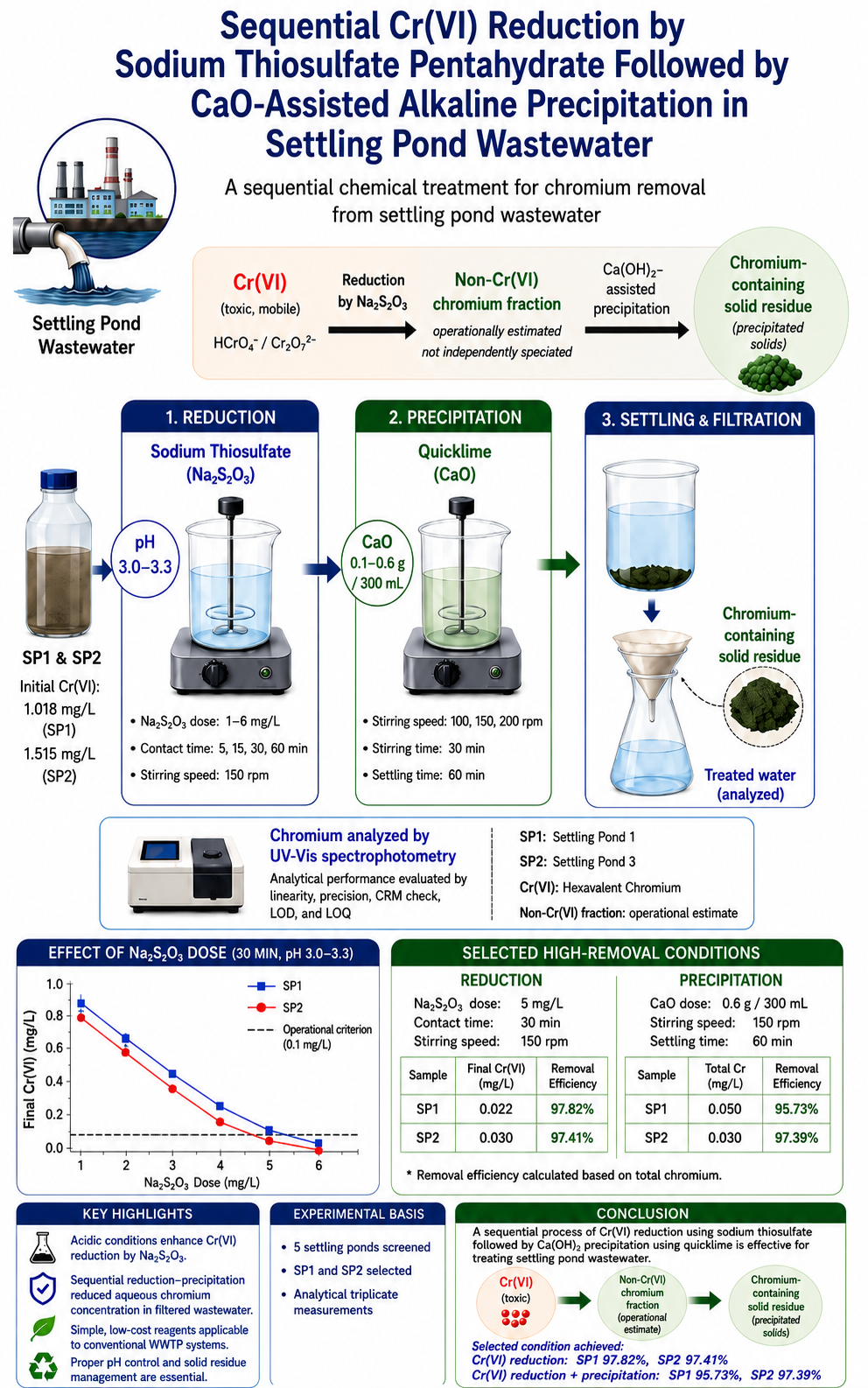
Settling pond wastewater containing hexavalent chromium, Cr(VI), requires sequential treatment that addresses oxidation state and aqueous-phase removal. Five settling ponds were screened, and SP1 and SP2 were selected as high-Cr(VI) matrices. Treatment used 0.45 µm-filtered aliquots. Cr(VI) reduction was evaluated at pH 3.0-3.3 using nominal sodium thiosulfate pentahydrate (Na₂S₂O₃·5H₂O) doses of 1-6 mg/L and contact times of 5, 15, 30, and 60 min, followed by CaO-assisted alkaline precipitation using 0.1-0.6 g CaO per 300 mL at 100, 150, and 200 rpm. Each treatment condition consisted of one process run, while Cr(VI) and total chromium were measured in analytical triplicate; responses were therefore interpreted descriptively. A 1.00 mg/L working solution prepared from a CRM certified for total chromium gave an apparent Cr(VI)-to-certified-total-Cr response ratio of 90.861% (RSD 0.373%, n = 12), which was not interpreted as Cr(VI) recovery because chromium speciation was not certified. At 5 mg/L Na₂S₂O₃·5H₂O and 30 min, Cr(VI) decreased to 0.022 mg/L in SP1 and 0.030 mg/L in SP2. Subsequent treatment with 0.6 g CaO per 300 mL produced Cr(VI) <0.004 mg/L and total chromium of 0.050 and 0.030 mg/L. Minimum combined-process Cr(VI) removals were >99.63% and >99.68%, while estimated aqueous total-chromium removals were 95.73% and 97.39%. The process is suitable for laboratory screening, but independent treatment replication, a reagent-free acidic control, unfiltered-matrix validation, species-specific Cr(VI) validation, controlled precipitation-pH experiments, and direct solid-phase characterization remain necessary before confirmatory optimization and scale-up.
How to Cite




Downloads
|
|


|
|


Copyright © 2026 Muh. Agil Kurniawan, Ismail Marzuki

This work is licensed under a Creative Commons Attribution-ShareAlike 4.0 International License.
You are free to:
Share — copy and redistribute the material in any medium or format
Adapt — remix, transform, and build upon the material for any purpose, even commercially
Under the following terms:
Attribution — You must give appropriate credit, provide a link to the license, and indicate if changes were made. You may do so in any reasonable manner, but not in any way that suggests the licensor endorses you or your use.
ShareAlike — If you remix, transform, or build upon the material, you must distribute your contributions under the same license as the original
No additional restrictions — You may not apply legal terms or technological measures that legally restrict others from doing anything the license permits
References
[1] M.-N. Georgaki, M. Charalambous, N. Kazakis, M. A. Talias, C. Georgakis, T. Papamitsou, and C. Mytiglaki, “Chromium in water and carcinogenic human health risk,” Environments, vol. 10, no. 2, art. 33, Feb. 2023. https://doi.org/10.3390/environments10020033
[2] S. Mohanty, A. Benya, S. Hota, M. S. Kumar, and S. Singh, “Eco-toxicity of hexavalent chromium and its adverse impact on environment and human health in Sukinda Valley of India: A review on pollution and prevention strategies,” Environ. Chem. Ecotoxicol., vol. 5, pp. 46–54, 2023. https://doi.org/10.1016/j.enceco.2023.01.002
[3] A. Monga, A. B. Fulke, and D. Dasgupta, “Recent developments in essentiality of trivalent chromium and toxicity of hexavalent chromium: Implications on human health and remediation strategies,” J. Hazard. Mater. Adv., vol. 7, art. 100113, 2022. https://doi.org/10.1016/j.hazadv.2022.100113
[4] V. Singh et al., “Hexavalent-chromium-induced oxidative stress and the protective role of antioxidants against cellular toxicity,” Antioxidants, vol. 11, no. 12, art. 2375, Dec. 2022. https://doi.org/10.3390/antiox11122375
[5] M. Szabó, J. Kalmár, T. Ditrói, G. Bellér, G. Lente, N. Simic, and I. Fábián, “Equilibria and kinetics of chromium(VI) speciation in aqueous solution—A comprehensive study from pH 2 to 11,” Inorg. Chim. Acta, vol. 472, pp. 295–301, 2018. https://doi.org/10.1016/j.ica.2017.05.038
[6] C. M. Stern, D. W. Hayes, L. O. Kgoadi, and N. Elgrishi, “Emerging investigator series: Carbon electrodes are effective for the detection and reduction of hexavalent chromium in water,” Environ. Sci.: Water Res. Technol., vol. 6, no. 5, pp. 1256–1261, 2020. https://doi.org/10.1039/D0EW00146E
[7] S. S. Kerur, S. Bandekar, M. S. Hanagadakar, S. S. Nandi, G. M. Ratnamala, and P. G. Hegde, “Removal of hexavalent chromium—Industry treated water and wastewater: A review,” Mater. Today Proc., vol. 42, pp. 1112–1121, 2021. https://doi.org/10.1016/j.matpr.2020.12.492
[8] M. Nur-E-Alam, M. A. S. Mia, F. Ahmad, and M. M. Rahman, “An overview of chromium removal techniques from tannery effluent,” Appl. Water Sci., vol. 10, no. 9, art. 205, 2020. https://doi.org/10.1007/s13201-020-01286-0
[9] K. Staszak, I. Kruszelnicka, D. Ginter-Kramarczyk, W. Góra, M. Baraniak, G. Lota, and M. Regel-Rosocka, “Advances in the removal of Cr(III) from spent industrial effluents—A review,” Materials, vol. 16, no. 1, art. 378, Jan. 2023. https://doi.org/10.3390/ma16010378
[10] R. Djellabi et al., “Advances in photocatalytic reduction of hexavalent chromium: From fundamental concepts to materials design and technology challenges,” J. Water Process Eng., vol. 50, art. 103301, 2022. https://doi.org/10.1016/j.jwpe.2022.103301
Show All References (16 more)
[11] T. Jayasinghe, G. Amarasooriya, T. Kawakami, V. Sivalingam, and G. Samarakoon, “Hexavalent chromium removal from wastewater through electrolysis: Influence of Al³⁺, Fe³⁺, and Mg²⁺ ion additives on treatment efficiency,” Front. Chem. Eng., vol. 7, art. 1580201, 2025. https://doi.org/10.3389/fceng.2025.1580201
[12] J. Xiong, X. Yang, L. Xiao, S. Song, L. Cao, M. Xia, P. Wu, Y. Shi, K. Pi, and G. Qiu, “Enhanced electrochemical reduction and precipitation removal of Cr(VI) by a confined crystallization inducing cathode structure,” Desalination, art. 119408, 2025. https://doi.org/10.1016/j.desal.2025.119408
[13] X. Lin, L. Xu, Z. Zhao, S. Liu, J. Zhang, and D. Wu, “Highly efficient removal of hexavalent chromium from electroplating wastewater by ferrous/ferric hydroxide complex: From lab-scale to pilot-scale study,” Chem. Eng. J., vol. 454, art. 140429, 2023. https://doi.org/10.1016/j.cej.2022.140429
[14] A. R. Choudhury, N. Singh, J. Lalwani, S. Khodia, M. Padhi, S. Chitransh, S. G. Palani, P. Mondal, and H. Srinivasan, “Enhanced irreversible stabilisation of hexavalent chromium in field-scale industrial waste disposal,” RSC Adv., vol. 15, no. 9, pp. 6914–6930, 2025. https://doi.org/10.1039/d4ra08092k
[15] Z. Chen, Y. Xia, H. Liu, H. Liu, and L. Xun, “The mechanisms of thiosulfate toxicity against Saccharomyces cerevisiae,” Antioxidants, vol. 10, no. 5, art. 646, May 2021. https://doi.org/10.3390/antiox10050646
[16] A. M. Deal, A. M. Prophet, F. Bernal, R. J. Saykally, and K. R. Wilson, “A detailed reaction mechanism for thiosulfate oxidation by ozone in aqueous environments,” Environ. Sci. Technol., vol. 58, no. 42, pp. 18959–18968, 2024. https://doi.org/10.1021/acs.est.4c06188
[17] T. V. Nyangadzayi and F. Ntuli, “Optimization of chromium precipitation from ferrochrome leach solutions,” J. S. Afr. Inst. Min. Metall., vol. 124, no. 12, pp. 725–730, 2024. https://doi.org/10.17159/2411-9717/702/2024
[18] M. A. Fadhili and T. T. Anasstasia, “Penurunan Logam Krom Air Limbah Industri Pertambangan Nikel dengan Variasi Waktu Tinggal Fitoremediasi (Studi kasus: di Pertambangan Nikel Sulawesi Selatan),” J. Teknol. Lingkung. Lahan Basah, vol. 12, no. 2, pp. 526–535, 2024. https://doi.org/10.26418/jtllb.v12i2.77369
[19] M. Maryudi, A. Rahayu, R. Syauqi, and M. K. Islami, “Teknologi Pengolahan Kandungan Kromium dalam Limbah Penyamakan Kulit Menggunakan Proses Adsorpsi: Review,” J. Tek. Kim. Lingkung., vol. 5, no. 1, pp. 90–99, 202. https://doi.org/10.33795/jtkl.v5i1.207
[20] A. Sanchez-Hachair and A. Hofmann, “Hexavalent chromium quantification in solution: Comparing direct UV–visible spectrometry with 1,5-diphenylcarbazide colorimetry,” C. R. Chim., vol. 21, no. 9, pp. 890–896, 2018. https://doi.org/10.1016/j.crci.2018.05.002
[21] W. Warmiati and W. Wijayanti, “Reaction stability test of hexavalent chromium complex with 1,5-diphenylcarbazide in analysis using UV-visible spectrophotometer,” Indonesia. J. Chem. Res., vol. 11, no. 3, pp. 218–222, 2024. https://doi.org/10.30598/ijcr.2024.11-war
[22] Muhaimin, R. I. I. Hawa, E. R. Hidayati, and N. Suryani, “Test method verification of chrome hexavalent (Cr-VI) test in wastewater using UV-visible spectrophotometer,” in AIP Conf. Proc., vol. 2370, no. 1, art. 030001, 2021. https://doi.org/10.1063/5.0062198
[23] S. D. Chavan and D. M. Desai, “Analytical method validation: A brief review,” World J. Adv. Res. Rev., vol. 16, no. 2, pp. 389–402, 2022. https://doi.org/10.30574/wjarr.2022.16.2.1165
[24] World Health Organization, Guidelines for Drinking-Water Quality, 4th ed., incorporating the first addendum. Geneva, Switzerland: WHO, 2017. [Online]. Available: https://www.who.int/publications/i/item/9789241549950
[25] Ministry of Environment of the Republic of Indonesia, Regulation No. 5 of 2014 on Wastewater Quality Standards. Jakarta, Indonesia, 2014. [Online]. Available: https://peraturan.bpk.go.id/Details/322442/permen-lh-no-5-tahun-2014
[26] C. Mystrioti, S. Koursari, A. Xenidis, and N. Papassiopi, “Hexavalent chromium reduction by gallic acid,” Chemosphere, vol. 273, art. 129737, 2021. https://doi.org/10.1016/j.chemosphere.2021.129737