
Sequential Cr(VI) Reduction by Sodium Thiosulfate Pentahydrate Followed by CaO-Assisted Alkaline Precipitation in Settling Pond Wastewater

Article Sidebar
Main Article Content


Abstract
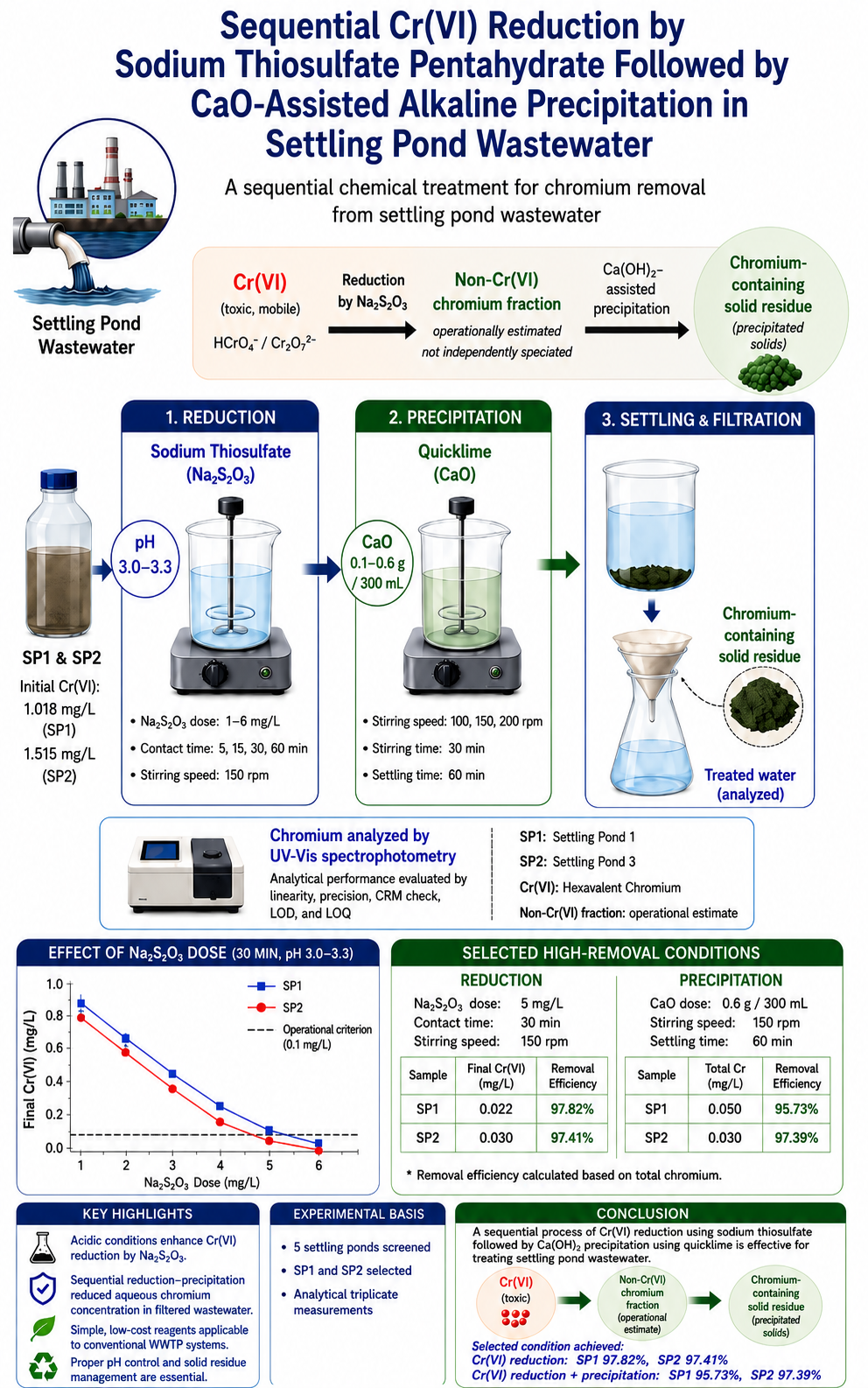
Settling pond wastewater containing hexavalent chromium, Cr(VI), requires sequential treatment that addresses oxidation state and aqueous-phase removal. Five settling ponds were screened, and SP1 and SP2 were selected as high-Cr(VI) matrices. Treatment used 0.45 µm-filtered aliquots. Cr(VI) reduction was evaluated at pH 3.0-3.3 using nominal sodium thiosulfate pentahydrate (Na₂S₂O₃·5H₂O) doses of 1-6 mg/L and contact times of 5, 15, 30, and 60 min, followed by CaO-assisted alkaline precipitation using 0.1-0.6 g CaO per 300 mL at 100, 150, and 200 rpm. Each treatment condition consisted of one process run, while Cr(VI) and total chromium were measured in analytical triplicate; responses were therefore interpreted descriptively. A 1.00 mg/L working solution prepared from a CRM certified for total chromium gave an apparent Cr(VI)-to-certified-total-Cr response ratio of 90.861% (RSD 0.373%, n = 12), which was not interpreted as Cr(VI) recovery because chromium speciation was not certified. At 5 mg/L Na₂S₂O₃·5H₂O and 30 min, Cr(VI) decreased to 0.022 mg/L in SP1 and 0.030 mg/L in SP2. Subsequent treatment with 0.6 g CaO per 300 mL produced Cr(VI) <0.004 mg/L and total chromium of 0.050 and 0.030 mg/L. Minimum combined-process Cr(VI) removals were >99.63% and >99.68%, while estimated aqueous total-chromium removals were 95.73% and 97.39%. The process is suitable for laboratory screening, but independent treatment replication, a reagent-free acidic control, unfiltered-matrix validation, species-specific Cr(VI) validation, controlled precipitation-pH experiments, and direct solid-phase characterization remain necessary before confirmatory optimization and scale-up.
Downloads
Article Details
Section
Copyright © 2026 Muh. Agil Kurniawan, Ismail Marzuki

This work is licensed under a Creative Commons Attribution-ShareAlike 4.0 International License.
How to Cite




References
[1] M.-N. Georgaki, M. Charalambous, N. Kazakis, M. A. Talias, C. Georgakis, T. Papamitsou, and C. Mytiglaki, “Chromium in water and carcinogenic human health risk,” Environments, vol. 10, no. 2, art. 33, Feb. 2023. https://doi.org/10.3390/environments10020033
[2] S. Mohanty, A. Benya, S. Hota, M. S. Kumar, and S. Singh, “Eco-toxicity of hexavalent chromium and its adverse impact on environment and human health in Sukinda Valley of India: A review on pollution and prevention strategies,” Environ. Chem. Ecotoxicol., vol. 5, pp. 46–54, 2023. https://doi.org/10.1016/j.enceco.2023.01.002
[3] A. Monga, A. B. Fulke, and D. Dasgupta, “Recent developments in essentiality of trivalent chromium and toxicity of hexavalent chromium: Implications on human health and remediation strategies,” J. Hazard. Mater. Adv., vol. 7, art. 100113, 2022. https://doi.org/10.1016/j.hazadv.2022.100113
[4] V. Singh et al., “Hexavalent-chromium-induced oxidative stress and the protective role of antioxidants against cellular toxicity,” Antioxidants, vol. 11, no. 12, art. 2375, Dec. 2022. https://doi.org/10.3390/antiox11122375
[5] M. Szabó, J. Kalmár, T. Ditrói, G. Bellér, G. Lente, N. Simic, and I. Fábián, “Equilibria and kinetics of chromium(VI) speciation in aqueous solution—A comprehensive study from pH 2 to 11,” Inorg. Chim. Acta, vol. 472, pp. 295–301, 2018. https://doi.org/10.1016/j.ica.2017.05.038
[6] C. M. Stern, D. W. Hayes, L. O. Kgoadi, and N. Elgrishi, “Emerging investigator series: Carbon electrodes are effective for the detection and reduction of hexavalent chromium in water,” Environ. Sci.: Water Res. Technol., vol. 6, no. 5, pp. 1256–1261, 2020. https://doi.org/10.1039/D0EW00146E
[7] S. S. Kerur, S. Bandekar, M. S. Hanagadakar, S. S. Nandi, G. M. Ratnamala, and P. G. Hegde, “Removal of hexavalent chromium—Industry treated water and wastewater: A review,” Mater. Today Proc., vol. 42, pp. 1112–1121, 2021. https://doi.org/10.1016/j.matpr.2020.12.492
[8] M. Nur-E-Alam, M. A. S. Mia, F. Ahmad, and M. M. Rahman, “An overview of chromium removal techniques from tannery effluent,” Appl. Water Sci., vol. 10, no. 9, art. 205, 2020. https://doi.org/10.1007/s13201-020-01286-0
[9] K. Staszak, I. Kruszelnicka, D. Ginter-Kramarczyk, W. Góra, M. Baraniak, G. Lota, and M. Regel-Rosocka, “Advances in the removal of Cr(III) from spent industrial effluents—A review,” Materials, vol. 16, no. 1, art. 378, Jan. 2023. https://doi.org/10.3390/ma16010378
[10] R. Djellabi et al., “Advances in photocatalytic reduction of hexavalent chromium: From fundamental concepts to materials design and technology challenges,” J. Water Process Eng., vol. 50, art. 103301, 2022. https://doi.org/10.1016/j.jwpe.2022.103301
[11] T. Jayasinghe, G. Amarasooriya, T. Kawakami, V. Sivalingam, and G. Samarakoon, “Hexavalent chromium removal from wastewater through electrolysis: Influence of Al³⁺, Fe³⁺, and Mg²⁺ ion additives on treatment efficiency,” Front. Chem. Eng., vol. 7, art. 1580201, 2025. https://doi.org/10.3389/fceng.2025.1580201
[12] J. Xiong, X. Yang, L. Xiao, S. Song, L. Cao, M. Xia, P. Wu, Y. Shi, K. Pi, and G. Qiu, “Enhanced electrochemical reduction and precipitation removal of Cr(VI) by a confined crystallization inducing cathode structure,” Desalination, art. 119408, 2025. https://doi.org/10.1016/j.desal.2025.119408
[13] X. Lin, L. Xu, Z. Zhao, S. Liu, J. Zhang, and D. Wu, “Highly efficient removal of hexavalent chromium from electroplating wastewater by ferrous/ferric hydroxide complex: From lab-scale to pilot-scale study,” Chem. Eng. J., vol. 454, art. 140429, 2023. https://doi.org/10.1016/j.cej.2022.140429
[14] A. R. Choudhury, N. Singh, J. Lalwani, S. Khodia, M. Padhi, S. Chitransh, S. G. Palani, P. Mondal, and H. Srinivasan, “Enhanced irreversible stabilisation of hexavalent chromium in field-scale industrial waste disposal,” RSC Adv., vol. 15, no. 9, pp. 6914–6930, 2025. https://doi.org/10.1039/d4ra08092k
[15] Z. Chen, Y. Xia, H. Liu, H. Liu, and L. Xun, “The mechanisms of thiosulfate toxicity against Saccharomyces cerevisiae,” Antioxidants, vol. 10, no. 5, art. 646, May 2021. https://doi.org/10.3390/antiox10050646
[16] A. M. Deal, A. M. Prophet, F. Bernal, R. J. Saykally, and K. R. Wilson, “A detailed reaction mechanism for thiosulfate oxidation by ozone in aqueous environments,” Environ. Sci. Technol., vol. 58, no. 42, pp. 18959–18968, 2024. https://doi.org/10.1021/acs.est.4c06188
[17] T. V. Nyangadzayi and F. Ntuli, “Optimization of chromium precipitation from ferrochrome leach solutions,” J. S. Afr. Inst. Min. Metall., vol. 124, no. 12, pp. 725–730, 2024. https://doi.org/10.17159/2411-9717/702/2024
[18] M. A. Fadhili and T. T. Anasstasia, “Penurunan Logam Krom Air Limbah Industri Pertambangan Nikel dengan Variasi Waktu Tinggal Fitoremediasi (Studi kasus: di Pertambangan Nikel Sulawesi Selatan),” J. Teknol. Lingkung. Lahan Basah, vol. 12, no. 2, pp. 526–535, 2024. https://doi.org/10.26418/jtllb.v12i2.77369
[19] M. Maryudi, A. Rahayu, R. Syauqi, and M. K. Islami, “Teknologi Pengolahan Kandungan Kromium dalam Limbah Penyamakan Kulit Menggunakan Proses Adsorpsi: Review,” J. Tek. Kim. Lingkung., vol. 5, no. 1, pp. 90–99, 202. https://doi.org/10.33795/jtkl.v5i1.207
[20] A. Sanchez-Hachair and A. Hofmann, “Hexavalent chromium quantification in solution: Comparing direct UV–visible spectrometry with 1,5-diphenylcarbazide colorimetry,” C. R. Chim., vol. 21, no. 9, pp. 890–896, 2018. https://doi.org/10.1016/j.crci.2018.05.002
[21] W. Warmiati and W. Wijayanti, “Reaction stability test of hexavalent chromium complex with 1,5-diphenylcarbazide in analysis using UV-visible spectrophotometer,” Indonesia. J. Chem. Res., vol. 11, no. 3, pp. 218–222, 2024. https://doi.org/10.30598/ijcr.2024.11-war
[22] Muhaimin, R. I. I. Hawa, E. R. Hidayati, and N. Suryani, “Test method verification of chrome hexavalent (Cr-VI) test in wastewater using UV-visible spectrophotometer,” in AIP Conf. Proc., vol. 2370, no. 1, art. 030001, 2021. https://doi.org/10.1063/5.0062198
[23] S. D. Chavan and D. M. Desai, “Analytical method validation: A brief review,” World J. Adv. Res. Rev., vol. 16, no. 2, pp. 389–402, 2022. https://doi.org/10.30574/wjarr.2022.16.2.1165
[24] World Health Organization, Guidelines for Drinking-Water Quality, 4th ed., incorporating the first addendum. Geneva, Switzerland: WHO, 2017. [Online]. Available: https://www.who.int/publications/i/item/9789241549950
[25] Ministry of Environment of the Republic of Indonesia, Regulation No. 5 of 2014 on Wastewater Quality Standards. Jakarta, Indonesia, 2014. [Online]. Available: https://peraturan.bpk.go.id/Details/322442/permen-lh-no-5-tahun-2014
[26] C. Mystrioti, S. Koursari, A. Xenidis, and N. Papassiopi, “Hexavalent chromium reduction by gallic acid,” Chemosphere, vol. 273, art. 129737, 2021. https://doi.org/10.1016/j.chemosphere.2021.129737