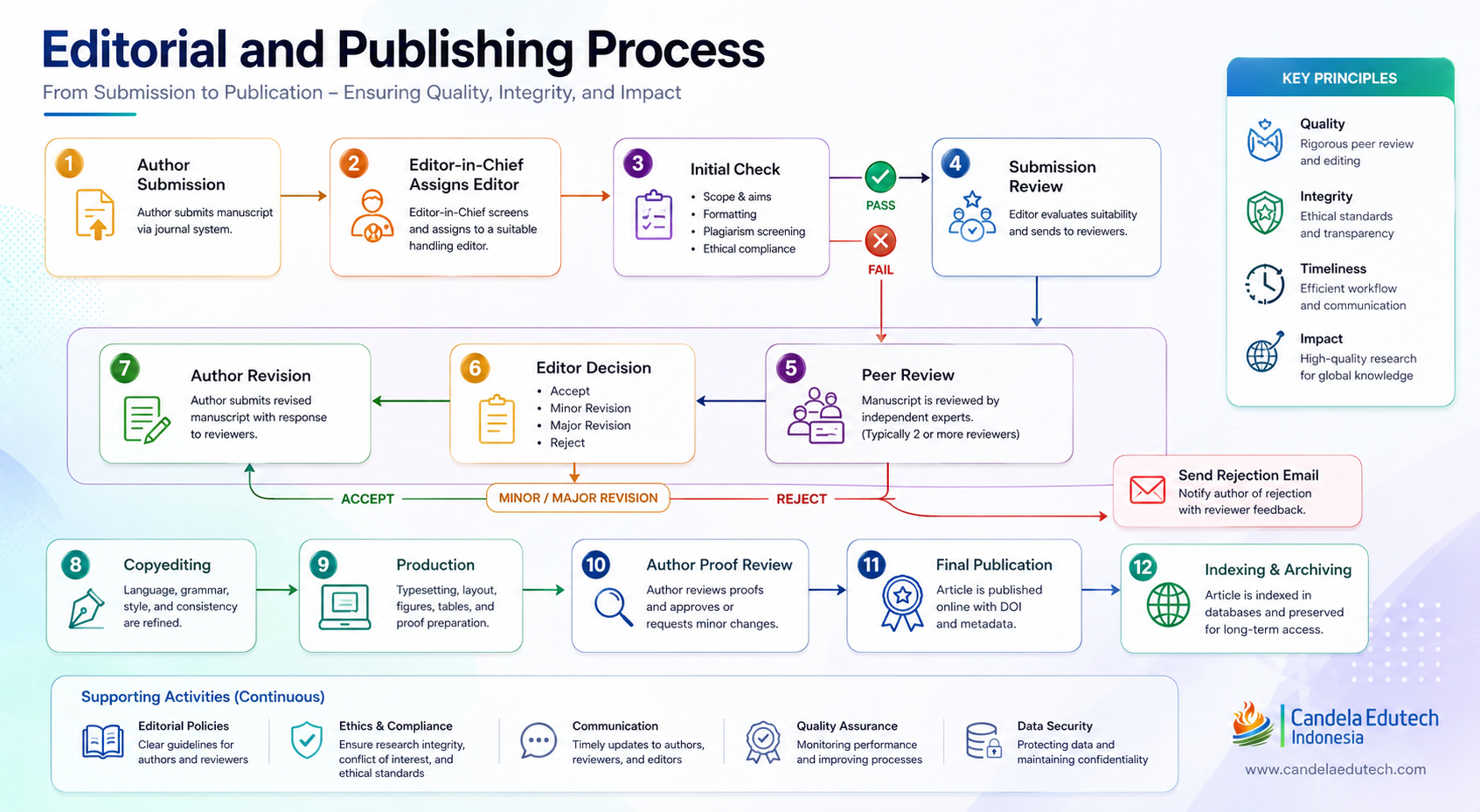
Peer Reviewed Process
Description
All manuscripts submitted to Journal of Green Chemical and Environmental Engineering (JGCEE) undergo a rigorous double-blind peer review process to ensure the quality, originality, relevance, and integrity of published research.
Authors are required to prepare their manuscripts in accordance with the journal’s Author Guidelines. Submissions must represent the original and independent work of the authors and should not have been published or submitted for publication elsewhere. Each new submission is initially assessed by the Principal Editor using the Manuscript Readiness Level (MRL) to determine whether the manuscript falls within the journal’s general scope and meets the minimum requirements for further consideration. The initial editorial assessment considers the manuscript’s scope, scientific content, presentation, originality, methodological readiness, formatting, and compliance with the journal’s publication requirements. Manuscripts that do not meet the required scope, structure, formatting, originality, or submission requirements may be returned to the authors for improvement or may not proceed to scientific assessment or peer review.
Manuscripts that pass the initial assessment are assigned to qualified reviewers. At least two independent experts are normally involved in the peer review process. The identities of both authors and reviewers are kept confidential throughout the double-blind review process.
Review Stages
Double-Blind Peer Review
JGCEE applies a double-blind peer review process. The identities of authors and reviewers are concealed from each other throughout the review process to support objective and independent scholarly evaluation.
Types of Decision
Review Outcomes
Accept • Minor Revision • Major Revision • Reject
Review Timeline
The average peer review process takes approximately 4–8 weeks. The actual duration may vary depending on reviewer availability, manuscript complexity, revision requirements, and the time required by authors to submit revisions.
Ethics & Transparency
- Confidential Review Process: Manuscripts and reviewer comments are treated confidentially.
- Objective Evaluation: Reviewers are expected to provide objective, constructive, and evidence-based assessments.
- Conflict of Interest: Reviewers should declare any potential conflict of interest before accepting an assignment.
Galley Proof
After acceptance and completion of the production process, the galley proof may be sent to the corresponding author for final checking before publication. Authors are expected to carefully check the proof for typographical, formatting, author information, affiliation, and other production-related errors. The final proof should be returned to the journal within the period specified by the editorial office to avoid delays in publication.