
The Impact of Occupational Safety and Health (OSH) Programs Hazard Report and Tahan Report on Reducing Workplace Accidents at PT Merdeka Tsingshan Indonesia

Article Sidebar
Main Article Content


Abstract
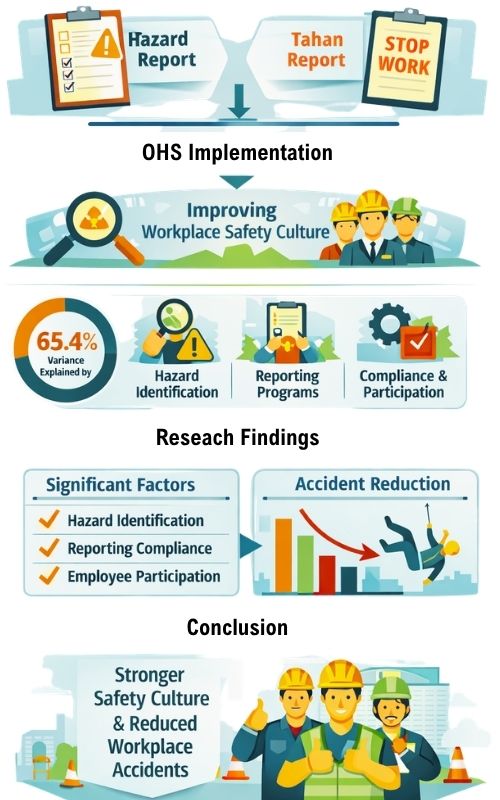
This study examines the influence of occupational safety and health (OSH) implementation through Hazard Report and Tahan Report programs on improving workplace safety culture and reducing occupational accidents at PT. Merdeka Tsingshan Indonesia. A quantitative approach was employed using a structured questionnaire distributed to company employees, with responses measured on a Likert scale. The collected data were analyzed using descriptive statistics, validity and reliability testing, and multiple linear regression analysis, including partial (t-test) and simultaneous (F-test) hypothesis testing. The findings indicate that the research instrument is both valid and highly reliable, with a Cronbach’s Alpha value exceeding the acceptable threshold. The coefficient of determination shows that approximately 65.4% of the variation in workplace safety culture can be explained by the independent variables, including employees’ understanding of hazard identification, implementation of reporting programs, compliance and participation levels, and program effectiveness. Furthermore, the results reveal that these variables have a statistically significant effect on safety culture, both individually and collectively. This study concludes that the implementation of Hazard Report and Tahan Report programs plays a crucial role in strengthening safety culture and contributes significantly to the reduction of workplace accidents, highlighting the importance of active employee involvement and consistent safety reporting systems in achieving effective occupational safety management.
Downloads
Article Details
Section
Copyright © 2025 Ade Putra Niswan Makkasau, Ahmad Padhil, A. Dwi Wahyuni P

This work is licensed under a Creative Commons Attribution-ShareAlike 4.0 International License.
How to Cite




References
[1] M. Ardeline and R. Lasmita, ‘Occupational Health and Safety Risk Analysis Using The HAZOP Method at UD Kerupuk Mamak Kito’, vol. 5, no. 2.
[2] P. Saik et al., ‘Improving the Process of Managing Psychosocial Risks in Organizations’, RMHP, vol. Volume 17, pp. 2997–3016, Dec. 2024, doi: https://doi.org/10.2147/RMHP.S488263.
[3] M. A. Shaikh, S. Weiguo, U. Shahid, and R. Karim, ‘Effect of Occupational Health and Safety Management and Employee Turnover Intention: A Comparative Study in Pakistan’s Mining Industry’, Sage Open, vol. 15, no. 2, p. 21582440251347716, Apr. 2025, doi: https://doi.org/10.1177/21582440251347716.
[4] International Organization for Standardization, ‘ISO 45001:2018 Occupational health and safety management systems - Requirements with guidance for use’. ISO, 2018.
[5] I. P. Nguembi, L. Yang, and V. S. Appiah, ‘Safety and risk management of Chinese enterprises in Gabon’s mining industry’, Heliyon, vol. 9, no. 10, p. e20721, Oct. 2023, doi: https://doi.org/10.1016/j.heliyon.2023.e20721.
[6] B. M. Eiter et al., ‘Occupational Safety and Health of Women in Mining’, Journal of Women’s Health, vol. 32, no. 4, pp. 388–395, Apr. 2023, doi: https://doi.org/10.1089/jwh.2023.0034.
[7] A. Giuffrida, R. F. Iunes, and W. D. Savedoff, ‘Economic and Health Effects of Occupational Hazards in Latin America and the Caribbean’, Inter-American Development Bank, May 2001. doi: https://doi.org/10.18235/0008920.
[8] S. H. Fatima, P. Rothmore, L. C. Giles, and P. Bi, ‘Impacts of hot climatic conditions on work, health, and safety in Australia: A case study of policies in practice in the construction industry’, Safety Science, vol. 165, p. 106197, Sep. 2023, doi: https://doi.org/10.1016/j.ssci.2023.106197.
[9] N. Etruly and R. Nafi’ah, ‘The effect of occupational safety and health on employee productivity in furniture industry’, 2023.
[10] P. Bęś, P. Strzałkowski, J. Górniak-Zimroz, M. Szóstak, and M. Janiszewski, ‘Innovative Technologies to Improve Occupational Safety in Mining and Construction Industries—Part II’, Sensors, vol. 25, no. 18, p. 5717, Sep. 2025, doi: https://doi.org/10.3390/s25185717.
[11] M. Pishgar, S. F. Issa, M. Sietsema, P. Pratap, and H. Darabi, ‘REDECA: A Novel Framework to Review Artificial Intelligence and Its Applications in Occupational Safety and Health’, IJERPH, vol. 18, no. 13, p. 6705, Jun. 2021, doi: https://doi.org/10.3390/ijerph18136705.
[12] C. Maharani, A. Amri, and M. Sayuti, ‘Analysis of Occupational Health and Safety Hazard Risk Using Hazard and Operability and Fault Tree Analysis Methods’, Int. J. Eng. Scie. and Inform. Technology., vol. 5, no. 1, pp. 117–127, Dec. 2024, doi: https://doi.org/10.52088/ijesty.v5i1.676.
[13] R. Rusli, I. Zulkarnain, and Y. Ekandari, ‘Risk Analysis of Occupational Safety and Health (OSH) Using the Hazard And Operability Study (HAZOP) Method for the Semani Drainage Project (Sentosa-Remaja-A. Yani): Rekayasa’, J.Sci.Eng, vol. 1, no. 2, pp. 66–72, Jan. 2024, doi: https://doi.org/10.30650/jse.v1i2.3883.
[14] Made Yenny Puspitarini, Abdul Rohim Tualeka, Sahrir Sillehu, Ketut Ima Ismara, Nur Aini, and Yustinus Denny Ardyanto Wahyudiono, ‘Analysis Of Occupational Accident And Health Risk Control Opportunities In East Kalimantan Heavy Equipment Companies’, J Vocat Heal Stud, vol. 9, no. 3, pp. 176–182, Mar. 2026, doi: https://doi.org/10.20473/jvhs.V9.I3.2026.176-182.
[15] Eko Prasetyo, T. Ulya, David Laksamana Caesar, Ervi Rachma Dewi, and Livana Ph, ‘Implementation of Occupational Safety and Health (OSH) Office Program in Community Health Center’, J. Nurs. Pract, vol. 8, no. 3, pp. 675–687, Apr. 2025, doi: https://doi.org/10.30994/jnp.v8i3.812.
[16] S. M. Zalukhu, E. Baene, and P. Lahagu, ‘Implementation Of Occupational Safety And Health (OSH) In Enhancing Employee Performance Contribution at CV. Serikat Maju Terus Gunungsitoli City’.
[17] P. Yunus, Y. Thamrin, and M. K. Alwi, ‘Analysis of Occupational Safety and Health Management System Implementation (SMK3) at PT. PLN (Persero) UP3 South Makassar’, JCHP, vol. 5, no. 2, pp. 105–118, Sep. 2025, doi: https://doi.org/10.55885/jchp.v5i2.724.
[18] N. Nelfita, D. A. Lubis, R. H. Wijaya, Y. R. Rumapea, and M. A. Sampurno, ‘Analysis of the Impact of Implementation of Occupational Safety and Health Programs on Productivity: Literature Analysis’, vol. 4, no. 3.
[19] A. Costin, A. Wehle, and A. Adibfar, ‘Leading Indicators—A Conceptual IoT-Based Framework to Produce Active Leading Indicators for Construction Safety’, Safety, vol. 5, no. 4, p. 86, Dec. 2019, doi: https://doi.org/10.3390/safety5040086.
[20] S. Hartati, I. Nurdin, and B. Galeria, ‘Implementation Of Occupational Safety And Health (Osh) In Preventing Employee Work Accidents At The Regional Disaster Management Agency (Bpbd) Purworejo Regency’, CosmoGov, vol. 10, no. 1, pp. 99–114, Jul. 2024, doi: https://doi.org/10.24198/cosmogov.v10i1.54260.
[21] M. Yusup, R. Syauqi Naufal, and M. Hardini, ‘Management of Utilizing Data Analysis and Hypothesis Testing in Improving the Quality of Research Reports’, ATM, vol. 2, no. 2, pp. 159–167, Jan. 2019, doi: https://doi.org/10.33050/atm.v2i2.789.
[22] A. Sigit and A. N. Azizah, ‘Analysis Implementation of Occupational Health and Safety Management System in Building Construction Project at “7 in 1” Project, Yogyakarta State University’, MATEC Web Conf., vol. 280, p. 01013, 2019, doi: https://doi.org/10.1051/matecconf/201928001013.
[23] M. Anis, Asiyatun, and R. D. A. P. Satriyono, ‘Analysis Of Occupational Safety And Health (OSH) Application Of Assessment And Hazard Risk Control In The Mie Soon Industry Center Of Manjung Village, Klaten’, SHS Web Conf., vol. 189, p. 01033, 2024, doi: https://doi.org/10.1051/shsconf/202418901033.
[24] T. Yulianofa, K. W. Ningsih, and M. Cahyani, ‘The Effect Of Occupational Safety And Health (Osh) On Employee Performance’, vol. 3, no. 1, 2025.
[25] N. S. Pane, ‘Effect Of Occupational Safety And Health, Work Environment And Compensation On Employee Performance’, vol. 2, no. 5, 2022.
[26] M. A. Permana, B. Witjaksana, and J. Purnama, ‘Analysis of Occupational Safety and Health (OSH) Cost Requirements in The Construction of Rubaru 1 Elementary School’, Elementary School.