

Activated Carbon from Sawdust Biomass Via ZnCl₂ and NaOH Activation for Water Biofiltration Applications
Article Sidebar
Section
Issue
Published
Main Article Content


Abstract
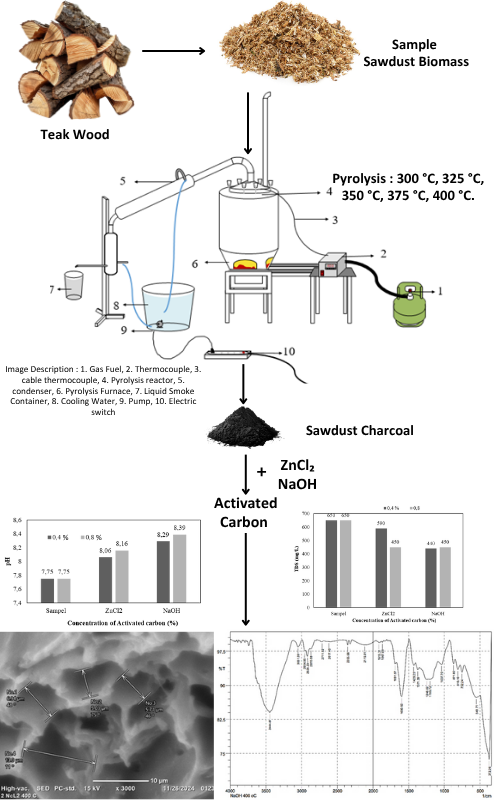
The declining availability of fossil energy sources in Indonesia has driven the development of renewable and environmentally friendly alternatives, including the utilization of biomass waste such as teak sawdust (Tectona grandis L.F.). This study aims to produce activated carbon via pyrolysis and chemical activation using ZnCl₂ and NaOH for water filtration applications. Pyrolysis was conducted at 300-400°C with biomass-to-activator ratios of 1:3, 1:5, and 1:7. SEM analysis revealed that chemical activation increased pore number and size; ZnCl₂ produced larger and more complex pore structures, while NaOH resulted in more uniform pores. FTIR spectra showed a reduction in hydroxyl (O–H), carbonyl (C=O), and ether (C–O) groups with increasing temperature, along with the emergence of aromatic (C=C) bands, indicating enhanced carbonization and structural stability. NaOH activation at 380°C yielded the highest iodine adsorption (1124 mg/g), while ZnCl₂ was optimal at 320 °C (980 mg/g). These results demonstrate that teak sawdust-derived activated carbon possesses a microporous structure and functional surface groups suitable for water purification and efficient removal of organic contaminants
How to Cite




Downloads
|
|


|
|


Copyright © 2025 Syarwan Hamid, Gusnawati, Thahirah Arief, Muh. Ilham Anggamulia, Hijrah Amaliah Azis, Muh Arman

This work is licensed under a Creative Commons Attribution-ShareAlike 4.0 International License.
You are free to:
Share — copy and redistribute the material in any medium or format
Adapt — remix, transform, and build upon the material for any purpose, even commercially
Under the following terms:
Attribution — You must give appropriate credit, provide a link to the license, and indicate if changes were made. You may do so in any reasonable manner, but not in any way that suggests the licensor endorses you or your use.
ShareAlike — If you remix, transform, or build upon the material, you must distribute your contributions under the same license as the original
No additional restrictions — You may not apply legal terms or technological measures that legally restrict others from doing anything the license permits
References
[1] T. Tay, S. Ucar, S. Karagöz. J. Hazard. Mater. 165 (2009) 481 doi: https://doi.org/10.1016/j.jhazmat.2008.10.011
[2] S. Yudo, N. I. Said. Environmental Engineering Journal. 10 (2018) 58 doi: https://doi.org/10.29122/jrl.v10i2.2847
[3] N. M. N. B Surya Dewi, Ganec Swara 15 (2021) 1159 doi: https://doi.org/10.35327/gara.v15i2.231
[4] H. Kristianto. Journal of Process Integration. 6 (2017) 104. doi: https://doi.org/10.36055/jip.v6i3.1031
[5] L. Marisa, A. Mukarramah, A. I . Fatya. Al Kawnu: Science and Local Wisdom Journal. 3 (2024) 26 doi: https://doi.org/10.18592/ak.v3i2.12671
[6] E. Elmaslar Özbaş, B. Balçık, H. K. Ozcan, Desalination Water Treat. 172 (2019) 78 doi: https://doi.org/10.5004/dwt.2019.24493
[7] M. Arman, Z. Sabara, T. Arief, Engineering J. 28 (2024) 1 doi: https://doi.org/10.4186/ej.2024.28.8.1
[8] A. Saputra, O. Rina, R. Hidayat. IJCA (Indonesian Journal of Chemical Analysis). 6 (2023) 143. doi: https://doi.org/10.20885/ijca.vol6.iss2.art6
[9] F. Ateş, Ö. Özcan, Eur. J. Eng. Tech. Res. 3 (2018) 6 doi: https://doi.org/10.24018/ejeng.2018.3.11.939
[10] S. Saputro, L. Mahardiani, D. A. Wulandar, In: IOP Conference Series: Materials Science and Engineering. Institute of Physics Publishing, 333 (2018) 012055 doi: https://doi.org/10.1088/1757-899X/333/1/012055
Show All References (20 more)
[11] B. Li, J. Hu, H. Xiong, Y. Xiao, ACS Omega 5 (2020) 9398 doi: https://doi.org/10.1021/acsomega.0c00461
[12] A. Mianowski, M. Owczarek, A. Marecka, Energy Sour. A: Recov. Util. Env. Effects 29 (2007) 839. doi: https://doi.org/10.1080/00908310500430901
[13] R.Y. Arundina, I. Permana, E.R.S. Togatorop. Journal of Renewable Natural Materials. 10 (2021) 81. doi: https://doi.org/10.15294/jbat.v10i2.33488
[14] A. A. Awe, B. O. Opeolu, O. S. Fatoki, O. S. Ayanda, V. A. Jackson, R. Snyman, Appl. Biol. Chem. 63 (2020) 12 doi: https://doi.org/10.1186/s13765-020-00494-1
[15] H. A. Rahi, N. A. Ali, Iraqi J. Phys. 23 (2025) 94 doi: https://doi.org/10.30723/ijp.v23i1.1356
[16] K. A. Adegoke, O. O. Adesina, O.A. Okon-Akan, O. R. Adegoke, A. B. Olabintan, O. A. Ajala, H. Olagoke, N. W. Maxakato, O. S. Bello, Curr. Res. Green Sust. Chem. 5 (2022) 100274 doi: https://doi.org/10.1016/j.crgsc.2022.100274
[17] J. W. Zhang, N. D. Hai, M. AI. Kholif, H. P. Chao, Carbon Res. Conv. published online (2025) 100332 doi: https://doi.org/10.1016/j.crcon.2025.100332
[18] P. K. Jha, V. K. Jha. Mongolian J. Chem. 21 (2020) 1 (https://doi.org/10.5564/mjc.v21i47.1249)
[19] Y. Villegas-Peralta, P. A. Gonzalez Tineo, C. A. Duarte Ruiz, Desalination Water Treat. 321 (2025) 100947 doi: https://doi.org/10.1016/j.dwt.2024.100947
[20] S. Saputro, M. Masykuri, L. Mahardiani, In: IOP Conference Series: Materials Science and Engineering. Institute of Physics Publishing, 176 (2017) 012019 doi: https://doi.org/10.1088/1757-899X/176/1/012019
[21] V. Rofikoh, B. Zaman, B.P. Samadikun BP. Journal of Environmental Science. 22 (2023) 132 doi: https://doi.org/10.14710/jil.22.1.132-141
[22] R. Hischier, F. Reale, V. Castellani, S. Sala, J. Clean. Prod. 267 (2020) 121952 doi: https://doi.org/10.1016/j.jclepro.2020.121952
[23] M. F. Mohamad Yusop, M. N. N. Khan, R. Zakaria, A. Z. Abdullah, M. A. Ahmad, Arabian Journal of Chemistry. 16 (2023) 104780 doi: https://doi.org/10.1016/j.arabjc.2023.104780
[24] M. S. Hafizuddin, C. L. Lee, K. L. Chin, P. S. H’ng, P. S. Khoo, U. Rashid, Polymers (Basel). 13 (2021) 3954 doi: https://doi.org/10.3390/polym13223954
[25] M. Akhtar, M. Sarfraz, M. Ahmad, N. Raza, L. Zhang, Desalination Water Treat. 321 (2025) 100914 doi: https://doi.org/10.1016/j.dwt.2024.100914
[26] S. Wardani, S. Savitri, F. Mawardah, M. Adham, L. Lindawati, Elkawnie: J. Islamic Sci. Technol. 7 (2022) 328 doi:https://doi.org/10.22373/ekw.v7i2.9586
[27] Y. E. Lee, J. H. Jo, I. T. Kim, Y. S. Yoo, Energies (Basel). 10 (2017) 1555 doi: https://doi.org/10.3390/en10101555
[28] D. Desprianto, I. Supu, I. Suliawati, J. Juwita, E. Erfiana, Jambura Phys. J. 3 (2021) 87 doi: https://doi.org/10.34312/jpj.v3i2.11665
[29] O. J. Al-sareji, M. Meiczinger, R.A. Al-Juboori, R. Ali Grmasha, M. Andredaki, V. Somogyi, I. A. Idowu, C. Stenger-Kovács, M. Jakab, E. Lengyel, K. S. Hashim, Sci Rep. 13 (2023) 1933. Doi: https://doi.org/10.1038/s41598-023-38821-3
[30] E. A. Oyedoh, O. P. Igbokwe, S. Afr. J. Chem. Eng. 51 (2025) 302 doi: https://doi.org/doi:10.1016/j.sajce.2024.12.006