

Bio-inspired Self-Healing Concrete for Sustainable Structures: A Critical Review
Article Sidebar
Section
Issue
Published
Main Article Content


Abstract
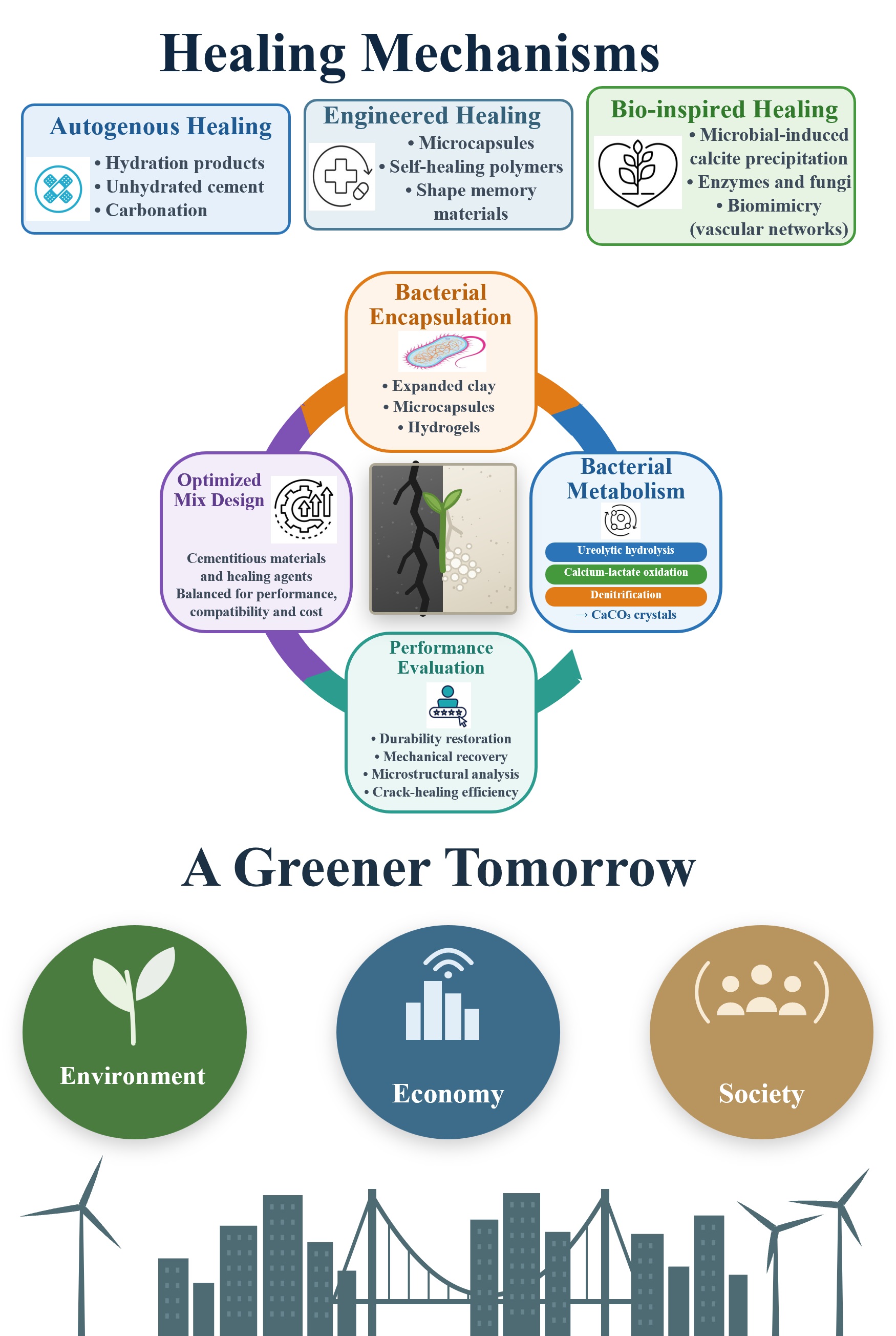
Cracks provide pathways for water, chlorides, sulfates, and carbon dioxide to penetrate reinforced concrete, while conventional crack repairs are often costly, disruptive, and environmentally burdensome. Bio-inspired self-healing concrete incorporates bacteria, enzymes, fungi, or vascular networks to promote autonomous crack sealing and extend service life. This critical review addresses four research questions: (i) how bio-inspired healing compares with autogenous and non-biological engineered healing; (ii) how biological-agent selection, encapsulation and mix design influence trade-offs among healing performance, mechanical properties and cost; (iii) how reliable and comparable laboratory and field evidence is; and (iv) under which conditions self-healing concrete provides environmental and economic benefits. Literature retrieved from Scopus and Web of Science was screened using predefined criteria and critically synthesised, with emphasis on experimental and field evidence. Microbially induced calcium carbonate precipitation (MICP) generally seals cracks 0.3-0.5 mm wide, although laboratory studies report closure of cracks up to 0.8-0.97 mm and reductions in water permeability exceeding 90%. However, healing-agent production can increase embodied carbon by 36% per m³ in one recent assessment. Environmental benefits therefore depend on achieved service-life extension, avoided repairs and targeted application. Reported life-cycle benefits range from approximately 12% to 75%, depending on assessment boundaries and assumptions. Major limitations include non-standardised testing, uncertain long-term bacterial viability and repeated-healing capacity, limited field evidence and regulatory uncertainty. Research priorities include standardised testing, long-term field monitoring, hybrid healing systems, predictive modelling and engineered living materials.
How to Cite




Downloads
|
|


|
|


Copyright © 2026 Michael Ojobo, Ikechukwu Solomon Utobuiro, Jibrin Muhammad Yelwa, Alhagie Drammeh

This work is licensed under a Creative Commons Attribution-ShareAlike 4.0 International License.
You are free to:
Share — copy and redistribute the material in any medium or format
Adapt — remix, transform, and build upon the material for any purpose, even commercially
Under the following terms:
Attribution — You must give appropriate credit, provide a link to the license, and indicate if changes were made. You may do so in any reasonable manner, but not in any way that suggests the licensor endorses you or your use.
ShareAlike — If you remix, transform, or build upon the material, you must distribute your contributions under the same license as the original
No additional restrictions — You may not apply legal terms or technological measures that legally restrict others from doing anything the license permits
References
[1] M. Amran et al., ‘Self-Healing Concrete as a Prospective Construction Material: A Review’, Materials, vol. 15, no. 9, p. 3214, Apr. 2022, https://doi.org/10.3390/ma15093214.
[2] V. Kaushal and E. Saeed, ‘Sustainable and Innovative Self-Healing Concrete Technologies to Mitigate Environmental Impacts in Construction’, CivilEng, vol. 5, no. 3, pp. 549–558, Jun. 2024, https://doi.org/10.3390/civileng5030029.
[3] S. A. Miller, G. Habert, R. J. Myers, and J. T. Harvey, ‘Achieving net zero greenhouse gas emissions in the cement industry via value chain mitigation strategies’, One Earth, vol. 4, no. 10, pp. 1398–1411, Oct. 2021, https://doi.org/10.1016/j.oneear.2021.09.011.
[4] X. Wen, A. M. Pagcaliwagan, H. Hou, and X. Yin, ‘Advancements in self-healing concrete: Material mechanisms, durability assessment, and implications for infrastructure lifecycle management’, Alexandria Engineering Journal, vol. 131, pp. 104–124, Nov. 2025, https://doi.org/10.1016/j.aej.2025.10.011.
[5] M. Seifan, A. K. Samani, and A. Berenjian, ‘Bioconcrete: next generation of self-healing concrete’, Appl Microbiol Biotechnol, vol. 100, no. 6, pp. 2591–2602, Mar. 2016, https://doi.org/10.1007/s00253-016-7316-z.
[6] N. De Belie et al., ‘A Review of Self‐Healing Concrete for Damage Management of Structures’, Adv Materials Inter, vol. 5, no. 17, p. 1800074, Sep. 2018, https://doi.org/10.1002/admi.201800074.
[7] K. Van Tittelboom and N. De Belie, ‘Self-Healing in Cementitious Materials—A Review’, Materials, vol. 6, no. 6, pp. 2182–2217, May 2013, https://doi.org/10.3390/ma6062182.
[8] H. M. Jonkers, A. Thijssen, G. Muyzer, O. Copuroglu, and E. Schlangen, ‘Application of bacteria as self-healing agent for the development of sustainable concrete’, Ecological Engineering, vol. 36, no. 2, pp. 230– 235, Feb. 2010, https://doi.org/10.1016/j.ecoleng.2008.12.036.
[9] W. De Muynck, N. De Belie, and W. Verstraete, ‘Microbial carbonate precipitation in construction materials: A review’, Ecological Engineering, vol. 36, no. 2, pp. 118–136, Feb. 2010, https://doi.org/10.1016/j.ecoleng.2009.02.006.
[10] Km. Pooja and N. Tarannum, ‘Self-healing concrete: a path towards advancement of sustainable infrastructure’, Discov Appl Sci, vol. 7, no. 7, p. 703, Jul. 2025, https://doi.org/10.1007/s42452-025-06529-w.
Show All References (101 more)
[11] M. Nodehi, T. Ozbakkaloglu, and A. Gholampour, ‘A systematic review of bacteria-based self-healing concrete: Biomineralization, mechanical, and durability properties’, Journal of Building Engineering, vol. 49, p. 104038, May 2022, https://doi.org/10.1016/j.jobe.2022.104038.
[12] B. Aytekin, A. Mardani, and Ş. Yazıcı, ‘State-of-art review of bacteria-based self-healing concrete: Biomineralization process, crack healing, and mechanical properties’, Construction and Building Materials, vol. 378, p. 131198, May 2023, https://doi.org/10.1016/j.conbuildmat.2023.131198.
[13] T. Sharma, A. Banerjee, and P. Nanthagopalan, ‘Probing the Abyss: Bacteria-based self-healing in cementitious construction materials – A Review’, Construction and Building Materials, vol. 455, p. 139054, Dec. 2024, https://doi.org/10.1016/j.conbuildmat.2024.139054.
[14] I. Justo-Reinoso, A. Heath, S. Gebhard, and K. Paine, ‘Aerobic non-ureolytic bacteria-based self-healing cementitious composites: A comprehensive review’, Journal of Building Engineering, vol. 42, p. 102834, Oct. 2021, https://doi.org/10.1016/j.jobe.2021.102834.
[15] A. Van Wylick et al., ‘A review on the potential of filamentous fungi for microbial self-healing of concrete’, Fungal Biology and Biotechnology, vol. 8, no. 1, p. 16, Nov. 2021, https://doi.org/10.1186/s40694-021-00122-7.
[16] G. Souradeep and H. W. Kua, ‘Encapsulation Technology and Techniques in Self-Healing Concrete’, J. Mater. Civ. Eng., vol. 28, no. 12, p. 04016165, Dec. 2016, https://doi.org/10.1061/(ASCE)MT.1943-5533.0001687.
[17] C. Xue, W. Li, J. Li, V. W. Y. Tam, and G. Ye, ‘A review study on encapsulation‐based self‐healing for cementitious materials’, Structural Concrete, vol. 20, no. 1, pp. 198–212, Feb. 2019, https://doi.org/10.1002/suco.201800177.
[18] M. H. Alzard, H. El-Hassan, T. El-Maaddawy, M. Alsalami, F. Abdulrahman, and A. A. Hassan, ‘A Bibliometric Analysis of the Studies on Self-Healing Concrete Published between 1974 and 2021’, Sustainability, vol. 14, no. 18, p. 11646, Sep. 2022, https://doi.org/10.3390/su141811646.
[19] S. Zhou, Z. Li, K. Li, Y. Jia, C. Wang, and X. Zhuang, ‘Microcapsule-enabled self-healing concrete: A bibliometric analysis’, Frontiers of Structural and Civil Engineering, vol. 17, no. 11, pp. 1611–1629, Nov. 2023, https://doi.org/10.1007/s11709-023-0023-9.
[20] G. Yu, Q. Fu, J. Huang, J. Hu, L. Lu, and J. Zhou, ‘Research status and trends in sustainable microbial self-healing concrete: a bibliometric analysis based on CiteSpace and VOSviewer’, Environment, Development and Sustainability, vol. 28, no. 1, pp. 2377–2410, 2026, https://doi.org/10.1007/s10668-024-05645-8.
[21] V. Cappellesso et al., ‘A review of the efficiency of self-healing concrete technologies for durable and sustainable concrete under realistic conditions’, International Materials Reviews, vol. 68, no. 5, pp. 556–603, Jan. 2023, https://doi.org/10.1080/09506608.2022.2145747.
[22] N. Hearn, ‘Self-sealing, autogenous healing and continued hydration: What is the difference?’, Mat. Struct., vol. 31, no. 8, pp. 563–567, Oct. 1998, https://doi.org/10.1007/BF02481539.
[23] D. Lahmann, C. Edvardsen, and S. Kessler, ‘Autogenous self‐healing of concrete: Experimental design and test methodsA review’, Engineering Reports, vol. 5, no. 1, p. e12565, Aug. 2022, https://doi.org/10.1002/eng2.12565.
[24] H. Huang, G. Ye, C. Qian, and E. Schlangen, ‘Self-healing in cementitious materials: Materials, methods and service conditions’, Materials & Design, vol. 92, pp. 499–511, Feb. 2016, https://doi.org/10.1016/j.matdes.2015.12.091.
[25] H.-W. Reinhardt and M. Jooss, ‘Permeability and self-healing of cracked concrete as a function of temperature and crack width’, Cement and Concrete Research, vol. 33, no. 7, pp. 981–985, Jul. 2003, https://doi.org/10.1016/S0008-8846(02)01099-2.
[26] Y. Yang, M. D. Lepech, E.-H. Yang, and V. C. Li, ‘Autogenous healing of engineered cementitious composites under wet–dry cycles’, Cement and Concrete Research, vol. 39, no. 5, pp. 382–390, May 2009, https://doi.org/10.1016/j.cemconres.2009.01.013.
[27] S. Qian, J. Zhou, M. R. De Rooij, E. Schlangen, G. Ye, and K. Van Breugel, ‘Self-healing behavior of strain hardening cementitious composites incorporating local waste materials’, Cement and Concrete Composites, vol. 31, no. 9, pp. 613–621, Oct. 2009, https://doi.org/10.1016/j.cemconcomp.2009.03.003.
[28] S. Granger, A. Loukili, G. Pijaudier-Cabot, and G. Chanvillard, ‘Experimental characterization of the self-healing of cracks in an ultra high performance cementitious material: Mechanical tests and acoustic emission analysis’, Cement and Concrete Research, vol. 37, no. 4, pp. 519–527, Apr. 2007, https://doi.org/10.1016/j.cemconres.2006.12.005.
[29] K. Van Tittelboom, N. De Belie, D. Van Loo, and P. Jacobs, ‘Self-healing efficiency of cementitious materials containing tubular capsules filled with healing agent’, Cement and Concrete Composites, vol. 33, no. 4, pp. 497–505, Apr. 2011, https://doi.org/10.1016/j.cemconcomp.2011.01.004.
[30] L. Ferrara, V. Krelani, and F. Moretti, ‘On the use of crystalline admixtures in cement based construction materials: from porosity reducers to promoters of self healing’, Smart Mater. Struct., vol. 25, no. 8, p. 084002, Aug. 2016, https://doi.org/10.1088/0964-1726/25/8/084002.
[31] M. Roig-Flores, S. Moscato, P. Serna, and L. Ferrara, ‘Self-healing capability of concrete with crystalline admixtures in different environments’, Construction and Building Materials, vol. 86, pp. 1–11, Jul. 2015, https://doi.org/10.1016/j.conbuildmat.2015.03.091.
[32] T. Qureshi, A. Kanellopoulos, and A. Al-Tabbaa, ‘Autogenous self-healing of cement with expansive minerals-I: Impact in early age crack healing’, Construction and Building Materials, vol. 192, pp. 768–784, Dec. 2018, https://doi.org/10.1016/j.conbuildmat.2018.10.143.
[33] G. Nossoni and D. Hussey, ‘Role of Supplementary Cementitious Materials in Bacteria-Based Self-Healing Concrete’, ACI Materials Journal, vol. 123, no. 3, May 2026, https://doi.org/10.14359/51749499.
[34] D. Snoeck, J. Dewanckele, V. Cnudde, and N. De Belie, ‘X-ray computed microtomography to study autogenous healing of cementitious materials promoted by superabsorbent polymers’, Cement and Concrete Composites, vol. 65, pp. 83–93, Jan. 2016, https://doi.org/10.1016/j.cemconcomp.2015.10.016.
[35] A. R. Suleiman, L. V. Zhang, and M. L. Nehdi, ‘Quantifying Crack Self-Healing in Concrete with Superabsorbent Polymers under Varying Temperature and Relative Humidity’, Sustainability, vol. 13, no. 24, p. 13999, Dec. 2021, https://doi.org/10.3390/su132413999.
[36] C. Dry, ‘Matrix cracking repair and filling using active and passive modes for smart timed release of chemicals from fibers into cement matrices’, Smart Mater. Struct., vol. 3, no. 2, pp. 118–123, Jun. 1994, https://doi.org/10.1088/0964-1726/3/2/006.
[37] P. Minnebo et al., ‘A Novel Design of Autonomously Healed Concrete: Towards a Vascular Healing Network’, Materials, vol. 10, no. 1, p. 49, Jan. 2017, https://doi.org/10.3390/ma10010049.
[38] C. De Nardi, D. Gardner, and A. D. Jefferson, ‘Development of 3D Printed Networks in Self-Healing Concrete’, Materials, vol. 13, no. 6, p. 1328, Mar. 2020, https://doi.org/10.3390/ma13061328.
[39] A. Kanellopoulos, P. Giannaros, D. Palmer, A. Kerr, and A. Al-Tabbaa, ‘Polymeric microcapsules with switchable mechanical properties for self-healing concrete: synthesis, characterisation and proof of concept’, Smart Mater. Struct., vol. 26, no. 4, p. 045025, Apr. 2017, https://doi.org/10.1088/1361-665X/aa516c.
[40] A. Jefferson, C. Joseph, R. Lark, B. Isaacs, S. Dunn, and B. Weager, ‘A new system for crack closure of cementitious materials using shrinkable polymers’, Cement and Concrete Research, vol. 40, no. 5, pp. 795– 801, May 2010, https://doi.org/10.1016/j.cemconres.2010.01.004.
[41] B. Balzano, J. Sweeney, G. Thompson, C.-L. Tuinea-Bobe, and A. Jefferson, ‘Enhanced concrete crack closure with hybrid shape memory polymer tendons’, Engineering Structures, vol. 226, p. 111330, Jan. 2021, https://doi.org/10.1016/j.engstruct.2020.111330.
[42] T. Van Mullem, N. De Belie, and R. Maddalena, ‘From crack closure to durability improvement of cementitious mortar with knotted shape memory polymer (k-SMP) fibres’, Developments in the Built Environment, vol. 24, p. 100812, Dec. 2025, https://doi.org/10.1016/j.dibe.2025.100812.
[43] R. Davies, T. Jefferson, and D. Gardner, ‘Development and Testing of Vascular Networks for Self-Healing Cementitious Materials’, Journal of Materials in Civil Engineering, vol. 33, no. 7, p. 04021164, Jul. 2021, https://doi.org/10.1061/(asce)mt.1943-5533.0003802.
[44] T. Van Mullem et al., ‘Addressing the need for standardization of test methods for self-healing concrete: an inter-laboratory study on concrete with macrocapsules’, Science and Technology of Advanced Materials, vol. 21, no. 1, pp. 661–682, Jan. 2020, https://doi.org/10.1080/14686996.2020.1814117.
[45] E. Tziviloglou, V. Wiktor, H. M. Jonkers, and E. Schlangen, ‘Bacteria-based self-healing concrete to increase liquid tightness of cracks’, Construction and Building Materials, vol. 122, pp. 118–125, Sep. 2016, https://doi.org/10.1016/j.conbuildmat.2016.06.080.
[46] I. Justo-Reinoso, B. J. Reeksting, A. Heath, S. Gebhard, and K. Paine, ‘Evaluation of Cyclic Healing Potential of Bacteria-Based Self-Healing Cementitious Composites’, Sustainability, vol. 14, no. 11, p. 6845, Jun. 2022, https://doi.org/10.3390/su14116845.
[47] J. Wang, Y. C. Ersan, N. Boon, and N. De Belie, ‘Application of microorganisms in concrete: a promising sustainable strategy to improve concrete durability’, Appl Microbiol Biotechnol, vol. 100, no. 7, pp. 2993– 3007, Apr. 2016, https://doi.org/10.1007/s00253-016-7370-6.
[48] V. Wiktor and H. M. Jonkers, ‘Quantification of crack-healing in novel bacteria-based self-healing concrete’, Cement and Concrete Composites, vol. 33, no. 7, pp. 763–770, Aug. 2011, https://doi.org/10.1016/j.cemconcomp.2011.03.012.
[49] Y. Ç. Erşan, N. D. Belie, and N. Boon, ‘Microbially induced CaCO3 precipitation through denitrification: An optimization study in minimal nutrient environment’, Biochemical Engineering Journal, vol. 101, pp. 108–118, Sep. 2015, https://doi.org/10.1016/j.bej.2015.05.006.
[50] Y. Ç. Erşan, E. Gruyaert, G. Louis, C. Lors, N. De Belie, and N. Boon, ‘Self-protected nitrate reducing culture for intrinsic repair of concrete cracks’, Front. Microbiol., vol. 6, Nov. 2015, https://doi.org/10.3389/fmicb.2015.01228.
[51] T. K. Sharma, M. Alazhari, A. Heath, K. Paine, and R. M. Cooper, ‘Alkaliphilic Bacillus species show potential application in concrete crack repair by virtue of rapid spore production and germination then extracellular calcite formation’, J Appl Microbiol, vol. 122, no. 5, pp. 1233–1244, May 2017, https://doi.org/10.1111/jam.13421.
[52] J. Wang, K. Van Tittelboom, N. De Belie, and W. Verstraete, ‘Use of silica gel or polyurethane immobilized bacteria for self-healing concrete’, Construction and Building Materials, vol. 26, no. 1, pp. 532–540, Jan. 2012, https://doi.org/10.1016/j.conbuildmat.2011.06.054.
[53] J. Y. Wang, H. Soens, W. Verstraete, and N. De Belie, ‘Self-healing concrete by use of microencapsulated bacterial spores’, Cement and Concrete Research, vol. 56, pp. 139–152, Feb. 2014, https://doi.org/10.1016/j.cemconres.2013.11.009.
[54] S. S. Bang, J. K. Galinat, and V. Ramakrishnan, ‘Calcite precipitation induced by polyurethane-immobilized Bacillus pasteurii’, Enzyme and Microbial Technology, vol. 28, no. 4–5, pp. 404–409, Mar. 2001, https://doi.org/10.1016/S0141-0229(00)00348-3.
[55] J. Feng, B. Chen, W. Sun, and Y. Wang, ‘Microbial induced calcium carbonate precipitation study using Bacillus subtilis with application to self-healing concrete preparation and characterization’, Construction and Building Materials, vol. 280, p. 122460, Apr. 2021, https://doi.org/10.1016/j.conbuildmat.2021.122460.
[56] V. Achal, A. Mukherjee, and M. S. Reddy, ‘Effect of calcifying bacteria on permeation properties of concrete structures’, J Ind Microbiol Biotechnol, vol. 38, no. 9, pp. 1229–1234, Sep. 2011, https://doi.org/10.1007/s10295-010-0901-8.
[57] M. Seifan and A. Berenjian, ‘Microbially induced calcium carbonate precipitation: a widespread phenomenon in the biological world’, Appl Microbiol Biotechnol, vol. 103, no. 12, pp. 4693–4708, Jun. 2019, https://doi.org/10.1007/s00253-019-09861-5.
[58] M. S. K. Doost, M. Baradaran, A. Sayadi, and M. H. Fattahi, ‘Bacteria-driven self-healing in concrete: Influence of bacterial species, concentration, and calcium lactate’, Construction and Building Materials, vol. 541, p. 147894, Sep. 2026, https://doi.org/10.1016/j.conbuildmat.2026.147894.
[59] J. Intarasoontron, W. Pungrasmi, P. Nuaklong, P. Jongvivatsakul, and S. Likitlersuang, ‘Comparing performances of MICP bacterial vegetative cell and microencapsulated bacterial spore methods on concrete crack healing’, Construction and Building Materials, vol. 302, p. 124227, Oct. 2021, https://doi.org/10.1016/j.conbuildmat.2021.124227.
[60] V. Wiktor and H. M. Jonkers, ‘Field performance of bacteria-based repair system: Pilot study in a parking garage’, Case Studies in Construction Materials, vol. 2, pp. 11–17, Jun. 2015, https://doi.org/10.1016/j.cscm.2014.12.004.
[61] J. Wang, A. Mignon, G. Trenson, S. Van Vlierberghe, N. Boon, and N. De Belie, ‘A chitosan based pH-responsive hydrogel for encapsulation of bacteria for self-sealing concrete’, Cement and Concrete Composites, vol. 93, pp. 309–322, Oct. 2018, https://doi.org/10.1016/j.cemconcomp.2018.08.007.
[62] X. Xiao, C. Unluer, S. Chu, and E.-H. Yang, ‘Single bacteria spore encapsulation through layer-by-layer self-assembly of poly(dimethyldiallyl ammonium chloride) and silica nanoparticles for self-healing concrete’, Cement and Concrete Composites, vol. 140, p. 105105, Jul. 2023, https://doi.org/10.1016/j.cemconcomp.2023.105105.
[63] J. Y. Wang, N. De Belie, and W. Verstraete, ‘Diatomaceous earth as a protective vehicle for bacteria applied for self-healing concrete’, Journal of Industrial Microbiology and Biotechnology, vol. 39, no. 4, pp. 567–577, Apr. 2012, https://doi.org/10.1007/s10295-011-1037-1.
[64] M. Alazhari, T. Sharma, A. Heath, R. Cooper, and K. Paine, ‘Application of expanded perlite encapsulated bacteria and growth media for self-healing concrete’, Construction and Building Materials, vol. 160, pp. 610–619, Jan. 2018, https://doi.org/10.1016/j.conbuildmat.2017.11.086.
[65] J. Zhang et al., ‘Immobilizing bacteria in expanded perlite for the crack self-healing in concrete’, Construction and Building Materials, vol. 148, pp. 610–617, Sep. 2017, https://doi.org/10.1016/j.conbuildmat.2017.05.021.
[66] J. Xu and X. Wang, ‘Self-healing of concrete cracks by use of bacteria-containing low alkali cementitious material’, Construction and Building Materials, vol. 167, pp. 1–14, Apr. 2018, https://doi.org/10.1016/j.conbuildmat.2018.02.020.
[67] A. Ivaškė, R. Jakubovskis, R. Boris, and J. Urbonavičius, ‘Effects of Low Temperature, Freeze–Thaw Cycles, and Healing Conditions on Viability of Non-Ureolytic Bacteria in Biological Self-Healing Concrete’, Materials, vol. 17, no. 23, p. 5797, Nov. 2024, https://doi.org/10.3390/ma17235797.
[68] I. Ahenkorah, M. M. Rahman, M. R. Karim, S. Beecham, and C. Saint, ‘A Review of Enzyme Induced Carbonate Precipitation (EICP): The Role of Enzyme Kinetics’, Sustainable Chemistry, vol. 2, no. 1, pp. 92–114, Feb. 2021, https://doi.org/10.3390/suschem2010007.
[69] N. K. Dhami, M. S. Reddy, and A. Mukherjee, ‘Biomineralization of calcium carbonates and their engineered applications: a review’, Front. Microbiol., vol. 4, 2013, https://doi.org/10.3389/fmicb.2013.00314.
[70] K. A. Gilmour et al., ‘Microbially induced calcium carbonate precipitation through CO2 sequestration via an engineered Bacillus subtilis’, Microbial Cell Factories, vol. 23, no. 1, p. 168, Jun. 2024, https://doi.org/10.1186/s12934-024-02437-7.
[71] J. Luo et al., ‘Interactions of fungi with concrete: Significant importance for bio-based self-healing concrete’, Construction and Building Materials, vol. 164, pp. 275–285, Mar. 2018, https://doi.org/10.1016/j.conbuildmat.2017.12.233.
[72] R. R. Menon et al., ‘Screening of Fungi for Potential Application of Self-Healing Concrete’, Sci Rep, vol. 9, no. 1, p. 2075, Feb. 2019, https://doi.org/10.1038/s41598-019-39156-8.
[73] D. Gardner, D. Herbert, M. Jayaprakash, A. Jefferson, and A. Paul, ‘Capillary Flow Characteristics of an Autogenic and Autonomic Healing Agent for Self-Healing Concrete’, J. Mater. Civ. Eng., vol. 29, no. 11, p. 04017228, Nov. 2017, https://doi.org/10.1061/(ASCE)MT.1943-5533.0002092.
[74] Y. Shields, T. Van Mullem, N. De Belie, and K. Van Tittelboom, ‘An Investigation of Suitable Healing Agents for Vascular-Based Self-Healing in Cementitious Materials’, Sustainability, vol. 13, no. 23, p. 12948, Nov. 2021, https://doi.org/10.3390/su132312948.
[75] Y. Wang, R. Pullin, M. Pearson, R. Davies, and K. Holford, ‘Detection and Evaluation of Vascular Network Based Self-healing Concrete Using Acoustic Emission’, in Advances in Acoustic Emission Technology, Springer, pp. 299–311, 2021, https://doi.org/10.1007/978-981-15-9837-1_25.
[76] R. Mors and H. M. Jonkers, ‘Bacteria-based self-healing concrete: evaluation of full scale demonstrator projects’, RILEM Tech Lett, vol. 4, pp. 138–144, Apr. 2020, https://doi.org/10.21809/rilemtechlett.2019.93.
[77] W. Khaliq and M. B. Ehsan, ‘Crack healing in concrete using various bio influenced self-healing techniques’, Construction and Building Materials, vol. 102, pp. 349–357, Jan. 2016, https://doi.org/10.1016/j.conbuildmat.2015.11.006.
[78] M. Basit Ehsan Khan, D. Dias-da-Costa, and L. Shen, ‘Factors affecting the self-healing performance of bacteria-based cementitious composites: A review’, Construction and Building Materials, vol. 384, p. 131271, Jun. 2023, https://doi.org/10.1016/j.conbuildmat.2023.131271.
[79] K. Vijay, M. Murmu, and S. V. Deo, ‘Bacteria based self healing concrete – A review’, Construction and Building Materials, vol. 152, pp. 1008–1014, Oct. 2017, https://doi.org/10.1016/j.conbuildmat.2017.07.040.
[80] R. Siddique and N. K. Chahal, ‘Effect of ureolytic bacteria on concrete properties’, Construction and Building Materials, vol. 25, no. 10, pp. 3791–3801, Oct. 2011, https://doi.org/10.1016/j.conbuildmat.2011.04.010.
[81] R. Siddique, K. Singh, Kunal, M. Singh, V. Corinaldesi, and A. Rajor, ‘Properties of bacterial rice husk ash concrete’, Construction and Building Materials, vol. 121, pp. 112–119, Sep. 2016, https://doi.org/10.1016/j.conbuildmat.2016.05.146.
[82] T. Shanmuga Priya, N. Ramesh, A. Agarwal, S. Bhusnur, and K. Chaudhary, ‘Strength and durability characteristics of concrete made by micronized biomass silica and Bacteria-Bacillus sphaericus’, Construction and Building Materials, vol. 226, pp. 827–838, Nov. 2019, https://doi.org/10.1016/j.conbuildmat.2019.07.172.
[83] M. Luo, C. Qian, and R. Li, ‘Factors affecting crack repairing capacity of bacteria-based self-healing concrete’, Construction and Building Materials, vol. 87, pp. 1–7, Jul. 2015, https://doi.org/10.1016/j.conbuildmat.2015.03.117.
[84] I. Justo-Reinoso, N. Arena, B. J. Reeksting, S. Gebhard, and K. Paine, ‘Bacteria-based self-healing concrete− A life cycle assessment perspective’, Developments in the Built Environment, vol. 16, p. 100244, Dec. 2023, https://doi.org/10.1016/j.dibe.2023.100244.
[85] J. Ducasse-Lapeyrusse, R. Gagné, C. Lors, and D. Damidot, ‘Effect of calcium gluconate, calcium lactate, and urea on the kinetics of self-healing in mortars’, Construction and Building Materials, vol. 157, pp. 489– 497, Dec. 2017, https://doi.org/10.1016/j.conbuildmat.2017.09.115.
[86] K. Van Tittelboom et al., ‘Comparison of different approaches for self-healing concrete in a large-scale lab test’, Construction and Building Materials, vol. 107, pp. 125–137, Mar. 2016, https://doi.org/10.1016/j.conbuildmat.2015.12.186.
[87] T. Van Mullem, E. Gruyaert, R. Caspeele, and N. De Belie, ‘First Large Scale Application with Self-Healing Concrete in Belgium: Analysis of the Laboratory Control Tests’, Materials, vol. 13, no. 4, p. 997, Feb. 2020, https://doi.org/10.3390/ma13040997.
[88] X. Du et al., ‘Effects of crack width and healing age on the self-healing efficiency of microbial self-healing concrete and establishment of a healing kinetic model’, Cement and Concrete Composites, vol. 169, p. 106541, May 2026, https://doi.org/10.1016/j.cemconcomp.2026.106541.
[89] R. Jakubovskis, A. Jankutė, J. Urbonavičius, and V. Gribniak, ‘Analysis of mechanical performance and durability of self-healing biological concrete’, Construction and Building Materials, vol. 260, p. 119822, Nov. 2020, https://doi.org/10.1016/j.conbuildmat.2020.119822.
[90] W. Zhang, Q. Zheng, A. Ashour, and B. Han, ‘Self-healing cement concrete composites for resilient infrastructures: A review’, Composites Part B: Engineering, vol. 189, p. 107892, May 2020, https://doi.org/10.1016/j.compositesb.2020.107892.
[91] M. B. Ehsan Khan, L. Shen, and D. Dias-da-Costa, ‘Crack healing performance of bacteria-based mortar under sustained tensile loading in marine environment’, Cement and Concrete Composites, vol. 120, p. 104055, Jul. 2021, https://doi.org/10.1016/j.cemconcomp.2021.104055.
[92] B. Van Belleghem, P. Van Den Heede, K. Van Tittelboom, and N. De Belie, ‘Quantification of the Service Life Extension and Environmental Benefit of Chloride Exposed Self-Healing Concrete’, Materials, vol. 10, no. 1, p. 5, Dec. 2016, https://doi.org/10.3390/ma10010005.
[93] V. G. Cappellesso, T. Van Mullem, E. Gruyaert, K. Van Tittelboom, and N. De Belie, ‘Self-healing concrete with a bacteria-based or crystalline admixture as healing agent to prevent chloride ingress and corrosion in a marine environment’, Developments in the Built Environment, vol. 19, p. 100486, Oct. 2024, https://doi.org/10.1016/j.dibe.2024.100486.
[94] P. Van Den Heede, B. Van Belleghem, M. A. Araújo, J. Feiteira, and N. De Belie, ‘Screening of Different Encapsulated Polymer-Based Healing Agents for Chloride Exposed Self-Healing Concrete Using Chloride Migration Tests’, Key Engineering Materials, vol. 761, pp. 152–158, Jan. 2018, https://doi.org/10.4028/www.scientific.net/KEM.761.152.
[95] J. Xu, Y. Tang, X. Wang, Z. Wang, and W. Yao, ‘Application of ureolysis-based microbial CaCO3 precipitation in self-healing of concrete and inhibition of reinforcement corrosion’, Construction and Building Materials, vol. 265, p. 120364, Dec. 2020, https://doi.org/10.1016/j.conbuildmat.2020.120364.
[96] V. G. Cappellesso, T. Van Mullem, E. Gruyaert, K. Van Tittelboom, and N. De Belie, ‘Bacteria-based self-healing concrete exposed to frost salt scaling’, Cement and Concrete Composites, vol. 139, p. 105016, May 2023, https://doi.org/10.1016/j.cemconcomp.2023.105016.
[97] D. Palin, V. Wiktor, and H. Jonkers, ‘A Bacteria-Based Self-Healing Cementitious Composite for Application in Low-Temperature Marine Environments’, Biomimetics, vol. 2, no. 3, p. 13, Jul. 2017, https://doi.org/10.3390/biomimetics2030013.
[98] V. G. Cappellesso, J. M. Etcheverry, Y. A. Villagran-Zaccardi, E. Gruyaert, K. Van Tittelboom, and N. De Belie, ‘Mitigating sulfate attack in self-healing concrete using bacteria-based or crystalline admixture healing agents’, Cement and Concrete Composites, vol. 169, p. 106514, May 2026, https://doi.org/10.1016/j.cemconcomp.2026.106514.
[99] C. Lors, J. Ducasse-Lapeyrusse, R. Gagné, and D. Damidot, ‘Microbiologically induced calcium carbonate precipitation to repair microcracks remaining after autogenous healing of mortars’, Construction and Building Materials, vol. 141, pp. 461–469, Jun. 2017, https://doi.org/10.1016/j.conbuildmat.2017.03.026.
[100] J. I. T. Garces, I. J. Dollente, A. B. Beltran, R. R. Tan, and M. A. B. Promentilla, ‘Life cycle assessment of self-healing geopolymer concrete’, Cleaner Engineering and Technology, vol. 4, p. 100147, Oct. 2021, https://doi.org/10.1016/j.clet.2021.100147.
[101] P. Van Den Heede, A. Mignon, G. Habert, and N. De Belie, ‘Cradle-to-gate life cycle assessment of self-healing engineered cementitious composite with in-house developed (semi-)synthetic superabsorbent polymers’, Cement and Concrete Composites, vol. 94, pp. 166–180, Nov. 2018, https://doi.org/10.1016/j.cemconcomp.2018.08.017.
[102] M. Bagga et al., ‘Advancements in bacteria based self-healing concrete and the promise of modelling’, Construction and Building Materials, vol. 358, p. 129412, Dec. 2022, https://doi.org/10.1016/j.conbuildmat.2022.129412.
[103] A. Al-Tabbaa, C. Litina, P. Giannaros, A. Kanellopoulos, and L. Souza, ‘First UK field application and performance of microcapsule-based self-healing concrete’, Construction and Building Materials, vol. 208, pp. 669–685, May 2019, https://doi.org/10.1016/j.conbuildmat.2019.02.178.
[104] R. Davies et al., ‘Large Scale Application of Self-Healing Concrete: Design, Construction, and Testing’, Front. Mater., vol. 5, p. 51, Sep. 2018, https://doi.org/10.3389/fmats.2018.00051.
[105] H. Li, Y. Wu, A. Zhou, C. Zhao, L. Deng, and F. Lu, ‘Experimental study on self-healing performance of tunnel lining concrete based on response surface methodology’, Construction and Building Materials, vol. 425, p. 136105, Apr. 2024, https://doi.org/10.1016/j.conbuildmat.2024.136105.
[106] H. Khosravi, P. Kiani, M. Bahram, and M. Lezgy-Nazargah, ‘Prediction of crack repair percentage in self-healing concrete using machine learning’, Scientific Reports, vol. 16, no. 1, p. 533, 2026, https://doi.org/10.1038/s41598-025-30158-3.
[107] D. Liu and A. Li, ‘Predicting the self-healing performance of microbial self-healing concrete: Static, dynamic intelligent prediction, and formula-based approaches’, Construction and Building Materials, vol. 538, p. 147253, Sep. 2026, https://doi.org/10.1016/j.conbuildmat.2026.147253.
[108] H. W. Lee et al., ‘Prediction of microbial-induced calcium carbonate precipitation for self-healing cementitious material’, Cement and Concrete Composites, vol. 158, p. 105945, Apr. 2025, https://doi.org/10.1016/j.cemconcomp.2025.105945.
[109] D. Lahmann and S. Keßler, ‘Reactive transport modelling of autogenous self-healing in cracked concrete’, Cement and Concrete Research, vol. 187, p. 107733, Jan. 2025, https://doi.org/10.1016/j.cemconres.2024.107733.
[110] F. Hou, D. Shen, Y. Diao, H. Guo, and J. Wang, ‘Preliminary study on in-situ spore germination at different crack depths in bacteria-based self-healing concrete’, Cement and Concrete Composites, vol. 162, p. 106140, Sep. 2025, https://doi.org/10.1016/j.cemconcomp.2025.106140.
[111] K. Purnhagen and J. Wesseler, ‘Engineered living materials need engineered EU regulation’, Nature Materials, Jul. 2026, https://doi.org/10.1038/s41563-026-02651-1.