

Optimization of Halal Bioadsorbent Particle Size from Pyrolysis Products of Coconut Trunk Sawdust for the Purification of Virgin Coconut Oil (VCO)
Article Sidebar
Section
Issue
Published
Main Article Content
Abstract
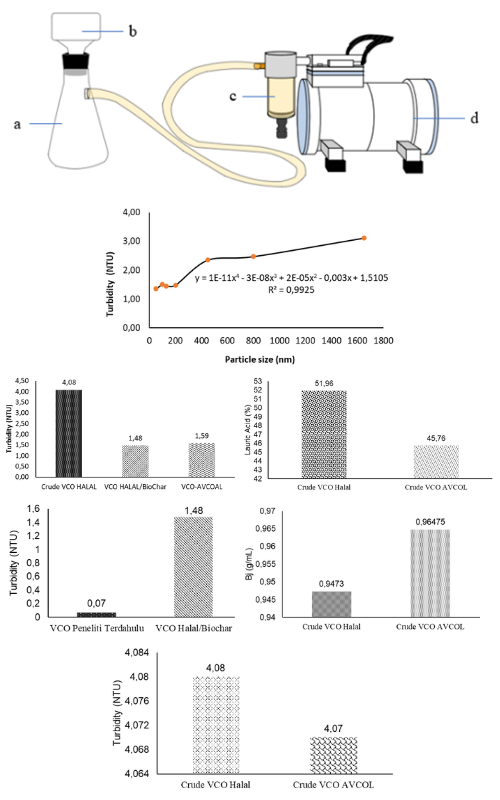
One of the critical challenges in the virgin coconut oil (VCO) industry is the selection of crude VCO filtration media that must be strictly guaranteed halal, since VCO is widely used as a food ingredient and for medicinal purposes. In this study, coconut trunk sawdust waste was utilized as a raw material and converted into charcoal through a pyrolysis process. The resulting charcoal was then applied as a bioadsorbent for crude VCO filtration. This article reports the effect of bioadsorbent particle size variations, specifically -/20, 20/50, 50/100, 100/140, 140/200, and 200/- mesh, to determine the optimum particle size that provides the highest VCO clarity. The experiments were conducted under constant conditions with a bioadsorbent-to-VCO ratio of 2% (g/mL) and a filtration time of 10 minutes. The optimum particle size was obtained at 50/100 mesh (200 µm), which resulted in maximum VCO clarity with a turbidity value of 1.48 NTU. Based on this optimum particle size, the filtered VCO showed desirable quality parameters, including lauric acid content of 51.96%, total suspended solids of 5.77%, density of 0.95 g/mL, total plate count (TPC) <10 CFU/mL, and moisture content of 0.0235%. These characteristics meet both the Indonesian National Standard (SNI) and international standards of the Asian and Pacific Coconut Community (APCC). Moreover, the resulting VCO exhibited better clarity than commercial VCO filtered using paper or cloth media (1.59 NTU), while also ensuring halal integrity through the use of bioadsorbent derived from pyrolyzed coconut trunk sawdust
How to Cite




Downloads
Copyright © 2025 Andi Aladin, Rismawati Rasyid, Takdir Syarif, Siti Nur Annisa, Nurul Faradillah

This work is licensed under a Creative Commons Attribution-ShareAlike 4.0 International License.
You are free to:
Share — copy and redistribute the material in any medium or format
Adapt — remix, transform, and build upon the material for any purpose, even commercially
Under the following terms:
Attribution — You must give appropriate credit, provide a link to the license, and indicate if changes were made. You may do so in any reasonable manner, but not in any way that suggests the licensor endorses you or your use.
ShareAlike — If you remix, transform, or build upon the material, you must distribute your contributions under the same license as the original
No additional restrictions — You may not apply legal terms or technological measures that legally restrict others from doing anything the license permits
References
[1] Aktawan, A., Maryudi., Marzun, H, M. dan Noor, S, A. (2020) “Gasifikasi Serbuk Gergaji Batang Kelapa untuk Menghasilkan Bahan Bakar Gas,” Konversi, 9(1), hal. 1–6.
[2] Sahrum, R.P., Syaiful, A, Z. Dan Gazali, A. (2021) “Uji Kualitas Asap Cair Tempurung Kelapa dan Serbuk Gergaji Kayu Metode Pirolisis,” Saintis, 2(2), hal. 73–78.
[3] Hamid, S., Aladin, A., Modding, B., Syarif, T., Wiyani, L. dan Arman, M. (2023) “Pengaruh Aliran Nitrogen Kontinyu ke dalam Reaktor Pirolisis Limbah Biomassa Serbuk Gergaji Batang Kelapa (Cocos Nucifera) terhadap Nilai Kalor,” Journal of Chemical Process Engineering, 8(1).
[4] Hasan, S., Aladin, A., Syarif, T. dan Arman, M. (2020) “Pengaruh Penambahan Gas Nitrogen terhadap Kualitas Charcoal yang Diproduksi Secara Pirolisis dari Limbah Biomassa Serbuk Gergaji Kayu Ulin (Euxideroxylon Zwageri),” Journal of Chemical Process Engineering, 5(1), hal. 61–68
[5] Darajat, Z., Munira., Septiani, M. dan Aladin, A. (2021) “Pengaruh Ukuran Partikel Bahan dan Waktu Penahanan Pada Pirolisis Lambat Limbah Tongkol Jagung Menjadi Bioarang,” Journal of Chemical Process Engineering, 6(2), hal. 96–102
[6] Ridhuan, K. dan Irawan, D. (2019) “Pengaruh Jenis Biomassa Terhadap Karaktristik Pembakaran dan Hasil Bioarang Asap Cair dari Proses Pirolisis,” Mechanical, 10(1), hal. 7.
[7] Murti, B. dan Sutapa, J.P.G. (2003) “Pemanfaatan Limbah Gergajian Batang Kelapa (Cocos Nucifera L.) sebagai Bahan Baku Pembuatan Arang,” hal. 407–414.
[8] Aladin, A. et al. (2022) ‘Organoleptic Observations of the Preservation of Mackerel Fish using Liquid Smoke from Coconut Shells Pyrolysis’, World Chemical Engineering Journal, 6(1), p. 29.
[9] Ridhuan, K., Irawan, D. dan Inthifawzi, R. (2019) “Proses Pembakaran Pirolisis dengan Jenis Biomassa dan Karakteristik Asap Cair yang Dihasilkan,” Turbo : Jurnal Program Studi Teknik Mesin, 8(1), hal. 69–78.
[10] Aladin, A. et al. (2016) ‘Grated coconut waste as heating jacket and temperature stabiliser in the production of virgin coconut oil by natural fermentation’, ARPN Journal of Engineering and Applied Sciences, 11(8), pp. 5171–5176.
Show All References (16 more)
[11] Wiyani, L. et al. (2020) ‘Antioxidant Activity Of Virgin Coconut Oil And Virgin Coconut Oil Emulsion’, Systematic Reviews In Pharmacy, 11(12), pp. 973–976.
[12] Rosalin, Darma Paramita, V. dan Saleh, M. (2021) “Pemanfaatan Arang Aktif Tempurung Kelapa Sebagai Adsorben untuk Mempertahankan Mutu Virgin Coconut Oil (VCO),” Prosiding Seminar Nasional Fisika [Preprint].
[13] Muharni, Y. dan Hartono, N. (2021) “An application of multiple regression for predicting Turbidity of standard water quality for industrial and household consumption,” Journal Industrial Servicess, 7(1), hal. 8.
[14] Monica, D. (2021) “Pengukuran Nilai Kekeruhan Air PDAM Tirta Keumuening Kota Langsa,” Jurnal Hadron, 3(1), Hal. 19–22.
[15] Fatimah, F. dan Sangi, M.E.C. (2010) “Kualitas Pemurnian Virgin Coconut Oil (VCO) Menggunakan Beberapa Adsorben,” Chemistry Progress, 3(2), hal. 65–69.
[16] Ifa, L., Nurdjannah., Syarif, T. dan Darnengsih. (2021) Bioadsorben dan Aplikasinya. Diedit oleh N.M. Pratama. baru: Yayasan Pendidikan Cendikia Muslim.
[17] Somantri, F.R.R. (2016) “Pembuatan dan Analisis Virgin Coconut Oil yang Dihasilkan dengan Menggunakan Metode Pancingan.”
[18] Aladin, A. et al. (2023) ‘Karakterisasi Charcoal Hasil Pirolisis Serbuk Gergaji Batang Kelapa sebagai Bioadsorben Halal untuk Proses Penyaringan Minyak Kelapa Murni (VCO)’, 6051, pp. 104–109.
[19] Reforma, B., Ma’arif, A. and Sunardi, S. (2022) ‘Alat Pengukur Kualitas Air Bersih Berdasarkan Tingkat Kekeruhan dan Jumlah Padatan Terlarut’, Jurnal Teknologi Elektro, 13(2)
[20] Widiada, I. G. N., Suhaema and Gunarti2 (2010) ‘Perbandingan Komposisi Asam Lemak Virgin Coconut Oil (VCO) Hasil Fermentasi Starter Ragi Roti Dengan VCO Hasil Pabrikan Serta Aktivitas Antibakterinya Pada Bakteri Penyebab Diare’, Jurusan Gizi Poltekkes Kemenkes Mataram, pp. 1–9
[21] Kardiman., Ifa, L. dan Rasyid, R. (2019) ‘Pembuatan Adsorben Dari Sabut Kelapa sebagai
Penyerap Logam Berat Pb(II)’, ILTEK, 14 (2).
[22] Pranata, D., Ardiningsih, P., Rahmalia, W., Nurlina. dan Syahbanu, Intan. (2020) ‘Ekstraksi Minyak Kelapa Murni dengan Metode Pengadukan dan Cold Pressed’, Indonesian Journal of Pure and Applied Chemistry, 3 (2).
[23] Renni, C.P., Mahatmanti, F.W. dan Widiarti, N. (2018) “Pemanfaatan Zeolit Alam Teraktivasi sebagai Adsorben Ion Logam Fe ( III ) dan Cr ( VI ),” Indonesian Journal of Chemical Science, 7(1), hal. 65–70.
[24] Muamar, A., Nisah, K. dan Nasution, R. (2020) “Kajian Arang Aktif Dari Limbah Pertanian Sebagai Bioadsorben Zat Warna,” Program Studi Kimia, Fakultas Sains dan Teknologi Universitas Islam Negeri Ar-Raniry, 2(2), hal. 59–63.
[25] Rahman, A. et al. (2021) “Prediksi Tingkat Kekeruhan (Turbiditas) Menggunakan Citra Satelit Sentinel-2a Di Waduk Jatiluhur, Jawa Barat,” Jurnal Sumber Daya Air, 17(2), hal. 59–68.