

Trend Analysis of Surface Water Quality of the Sangatta River Based on Iron and Manganese Concentrations to Identify Community Impacts
Article Sidebar
Section
Issue
Published
Main Article Content


Abstract
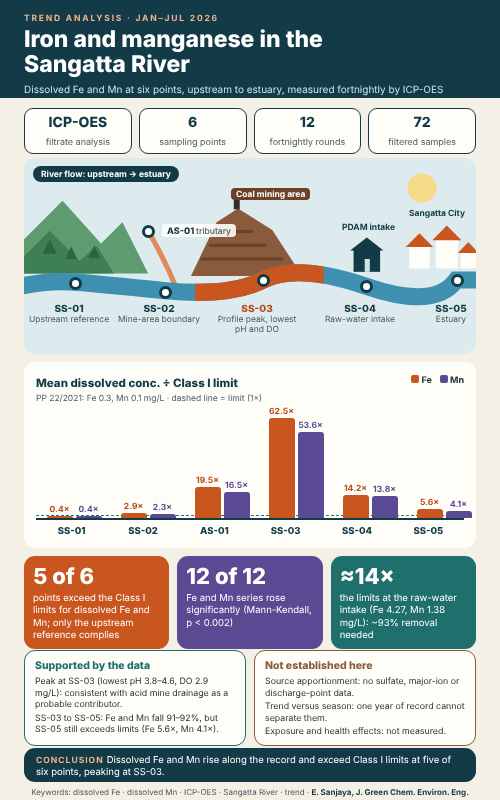
The Sangatta River is the main raw water source for more than 100,000 residents of Sangatta City, East Kutai Regency, and it receives runoff from coal mining areas that can generate acid mine drainage. Total iron (Fe) and manganese (Mn) were measured at six sampling points over twelve biweekly rounds from January to July 2026 (72 samples) using inductively coupled plasma optical emission spectrometry, and the results were compared with national and international water quality standards. Mean Fe reached 18.76 mg/L in the acid mine drainage zone, 62.5 times the Class I limit of Indonesian Government Regulation No. 22 of 2021, and mean Mn reached 5.36 mg/L, 67.0 times the World Health Organization guideline value. Five of six points exceeded the standards, and Fe and Mn concentrations were higher in the dry period than in the rainy period at all affected points. Iron and manganese pollution from acid mine drainage exceeds the natural recovery capacity of the river, so pollution source control and continuous monitoring are required.
How to Cite




Downloads
|
|


|
|


Copyright © 2026 Eddy Sanjaya, Irham Pratama

This work is licensed under a Creative Commons Attribution-ShareAlike 4.0 International License.
You are free to:
Share — copy and redistribute the material in any medium or format
Adapt — remix, transform, and build upon the material for any purpose, even commercially
Under the following terms:
Attribution — You must give appropriate credit, provide a link to the license, and indicate if changes were made. You may do so in any reasonable manner, but not in any way that suggests the licensor endorses you or your use.
ShareAlike — If you remix, transform, or build upon the material, you must distribute your contributions under the same license as the original
No additional restrictions — You may not apply legal terms or technological measures that legally restrict others from doing anything the license permits
References
[1] W. Stumm and J. J. Morgan, Aquatic Chemistry: Chemical Equilibria and Rates in Natural Waters, 3rd ed. New York, NY, USA: Wiley, 1996.
[2] Badan Pusat Statistik Kabupaten Kutai Timur, Kutai Timur Dalam Angka 2022 [East Kutai in Figures 2022]. Sangatta, Indonesia: BPS Kabupaten Kutai Timur, 2022.
[3] Kementerian Energi dan Sumber Daya Mineral, Laporan Kinerja Sektor Pertambangan Mineral dan Batu Bara 2021 [Performance Report of the Mineral and Coal Mining Sector 2021]. Jakarta, Indonesia: KESDM, 2021.
[4] L. Xu, J. Wang, and K. Zhang, “Response of heavy metals to microseism in coal mining subsidence water of Huainan, China,” Water, vol. 15, no. 14, Art. no. 2624, Jul. 2023, https://doi.org/10.3390/w15142624
[5] P. L. Younger, S. A. Banwart, and R. S. Hedin, Mine Water: Hydrology, Pollution, Remediation. Dordrecht, The Netherlands: Kluwer Academic Publishers, 2002.
[6] Y. Jiao, C. Zhang, P. Su, Y. Tang, Z. Huang, and T. Ma, “A review of acid mine drainage: Formation mechanism, treatment technology, typical engineering cases and resource utilization,” Process Saf. Environ. Prot., vol. 170, pp. 1240–1260, Feb. 2023, https://doi.org/10.1016/j.psep.2022.12.083
[7] J. G. Skousen, P. F. Ziemkiewicz, and L. M. McDonald, “Acid mine drainage formation, control and treatment: Approaches and strategies,” Extr. Ind. Soc., vol. 6, no. 1, pp. 241–249, Jan. 2019, https://doi.org/10.1016/j.exis.2018.09.008
[8] P. C. Singer and W. Stumm, “Acidic mine drainage: The rate-determining step,” Science, vol. 167, pp. 1121–1123, 1970.
[9] D. W. Blowes et al., “The geochemistry of acid mine drainage,” in Treatise on Geochemistry, 2nd ed., vol. 11, H. D. Holland and K. K. Turekian, Eds. Oxford, U.K.: Elsevier, 2014, pp. 131–190.
[10] M. F. Bouchard et al., “Intellectual impairment in school-age children exposed to manganese from drinking water,” Environ. Health Perspect., vol. 119, no. 1, pp. 138–143, 2011.
Show All References (20 more)
[11] Agency for Toxic Substances and Disease Registry, Toxicological Profile for Manganese. Atlanta, GA, USA: U.S. Dept. of Health and Human Services, 2012.
[12] P. U. Iyare, “The effects of manganese exposure from drinking water on school-age children: A systematic review,” NeuroToxicology, vol. 73, pp. 1–7, Jul. 2019, https://doi.org/10.1016/j.neuro.2019.02.013
[13] M. F. Bouchard, C. Surette, P. Cormier, and D. Foucher, “Low level exposure to manganese from drinking water and cognition in school-age children,” NeuroToxicology, vol. 64, pp. 110–117, Jan. 2018, https://doi.org/10.1016/j.neuro.2017.07.024
[14] L.-A. Dion, D. Saint-Amour, S. Sauvé, B. Barbeau, D. Mergler, and M. F. Bouchard, “Changes in water manganese levels and longitudinal assessment of intellectual function in children exposed through drinking water,” NeuroToxicology, vol. 64, pp. 118–125, Jan. 2018, https://doi.org/10.1016/j.neuro.2017.08.015
[15] Government of the Republic of Indonesia, “Government Regulation No. 22 of 2021 on the Implementation of Environmental Protection and Management,” State Gazette of the Republic of Indonesia 2021 No. 32, Jakarta, Indonesia, 2021.
[16] Ministry of Health of the Republic of Indonesia, “Minister of Health Regulation No. 2 of 2023 on the implementing regulation of Government Regulation No. 66 of 2014 on environmental health,” Jakarta, Indonesia, 2023.
[17] World Health Organization, Guidelines for Drinking-water Quality: Fourth Edition Incorporating the First and Second Addenda. Geneva, Switzerland: WHO, 2022.
[18] Dinas Lingkungan Hidup Kabupaten Kutai Timur, Laporan Hasil Pemantauan Kualitas Air Sungai Sangatta Tahun 2020–2022 [Report on Sangatta River Water Quality Monitoring Results 2020–2022]. Sangatta, Indonesia: DLH Kutai Timur, 2022.
[19] B. Badariah, S. F. Heraningsih, R. Rainiyati, S. Yulistian, and Z. Jauza, “Pollution analysis and quality assessment of heavy metals in the Batanghari River Water, Jambi, Indonesia,” J. Degrade. Min. Land Manage., vol. 13, no. 3, pp. 10595–10607, Jul. 2026, https://doi.org/10.15243/jdmlm.2026.133.10595
[20] American Public Health Association, Standard Methods for the Examination of Water and Wastewater, 23rd ed. Washington, DC, USA: American Water Works Association, 2017.
[21] U.S. Environmental Protection Agency, “Method 200.7: Determination of metals and trace elements in water and wastes by inductively coupled plasma-atomic emission spectrometry, Rev. 4.4,” U.S. EPA, Cincinnati, OH, USA, 1994.
[22] A. M. Yuce and H. Altundag, “Determination of water quality parameters in Izmit Bay (Marmara Sea) and concentrations of heavy metals by ICP-OES,” Environ. Eng. Manag. J., vol. 19, no. 12, pp. 2157–2163, 2020, https://doi.org/10.30638/eemj.2020.203
[23] L. Xu, P. Wang, D. Tang, J. Xu, C. Luo, and H. Wen, “Monte Carlo bottom-up evaluation of the uncertainty of quantification of heavy metals analysis in acid mine drainage by ICP-OES,” Talanta, vol. 285, Art. no. 127315, Apr. 2025, https://doi.org/10.1016/j.talanta.2024.127315
[24] Badan Standardisasi Nasional, “SNI ISO 11885:2019: Water quality—Determination of selected elements by inductively coupled plasma atomic emission spectrometry (ICP-OES),” BSN, Jakarta, Indonesia, 2019.
[25] X. Chu, H. Wang, F. Zheng, C. Huang, C. Xu, and D. Wu, “Spatial distribution characteristics and sources of nutrients and heavy metals in the Xiujiang River of Poyang Lake Basin in the dry season,” Water, vol. 13, no. 12, Art. no. 1654, Jun. 2021, https://doi.org/10.3390/w13121654
[26] J. Zhang, T. Yang, N. Wang, X. Luo, H. Li, and Y. Liao, “Health risk assessment of heavy metals in wild fish and seasonal variation and source identification of heavy metals in sediments: A case study of typical urban river in Xi’an, China,” Environ. Sci. Pollut. Res., vol. 31, no. 6, pp. 8898–8916, Jan. 2024, https://doi.org/10.1007/s11356-023-31693-0
[27] J. Ilavský, D. Barloková, and M. Prosňanský, “The use of membrane processes in manganese removal from drinking water,” Water, vol. 17, no. 8, Art. no. 1226, Apr. 2025, https://doi.org/10.3390/w17081226
[28] M. A. Rahman, S. Kumar, D. Lamb, and M. M. Rahman, “Health risk assessment of arsenic, manganese, and iron from drinking water for high school children,” Water Air Soil Pollut., vol. 232, no. 7, Jun. 2021, https://doi.org/10.1007/s11270-021-05212-1
[29] A. I. Batool, J. Ikram, M. F. U. Rehman, and N. H. Naveed, “Heavy metals, microbial contamination, and health risks in groundwater of coal mining regions: Carcinogenic and noncarcinogenic insights,” Water Environ. Res., vol. 97, no. 11, Nov. 2025, https://doi.org/10.1002/wer.70211
[30] A. K. Mosai, G. Ndlovu, and H. Tutu, “Improving acid mine drainage treatment by combining treatment technologies: A review,” Sci. Total Environ., vol. 919, Art. no. 170806, Apr. 2024, https://doi.org/10.1016/j.scitotenv.2024.170806