

Comparative Evaluation of Aqua Regia and Tri-Acid Digestion Methods for the Determination of As, Cu, and Pb in an Ore-Grade Certified Reference Material by Flame Atomic Absorption Spectrometry
Article Sidebar
Section
Issue
Published
Main Article Content
Abstract
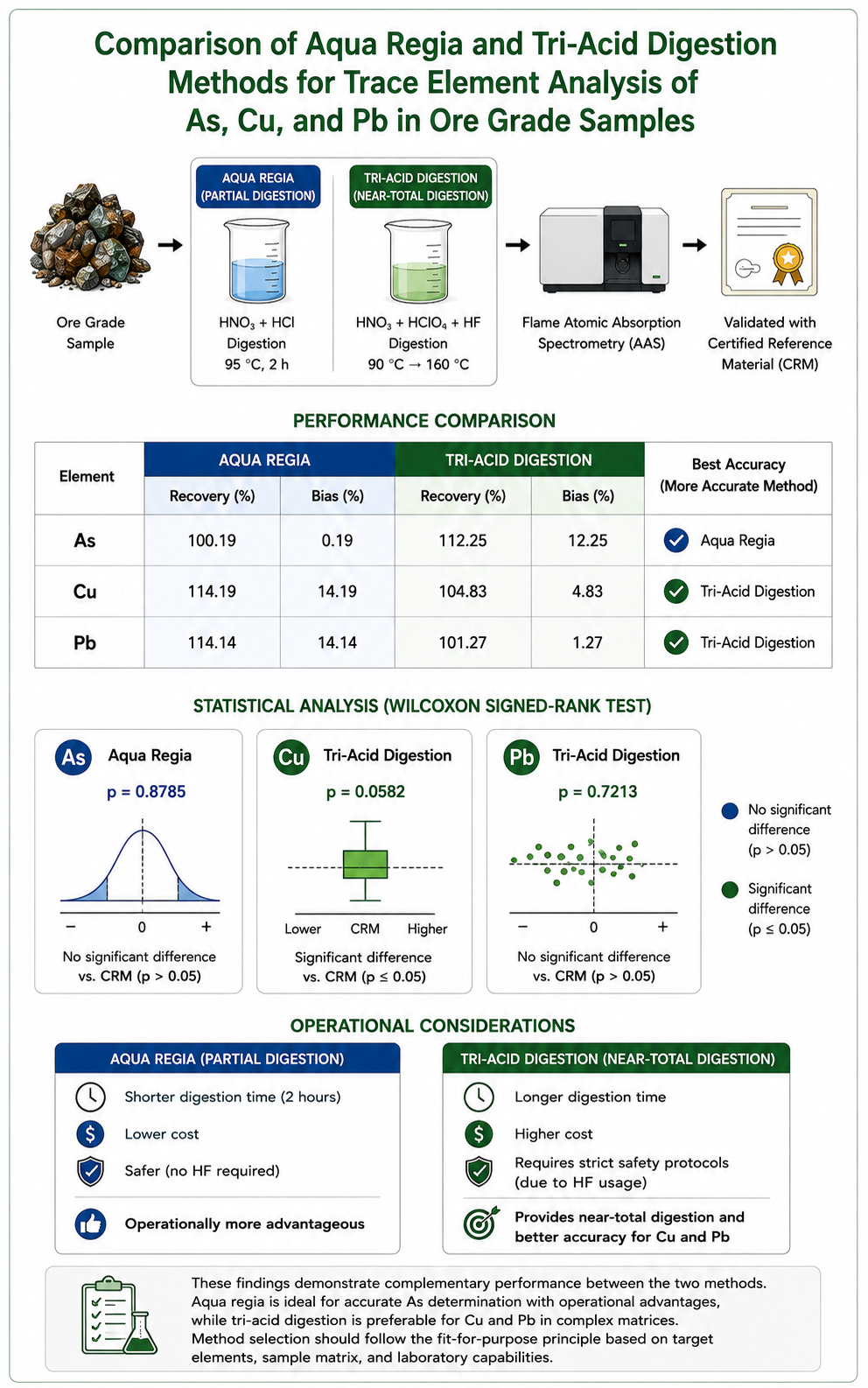
Trace element analysis in ore grade samples is critical for mineral exploration and resource evaluation. The choice of digestion method greatly influences the accuracy of results, which form the basis for mining investment decisions. This study compares the performance of aqua regia (partial digestion) and tri-acid digestion (near-total digestion) methods for determining Arsenic (As), Copper (Cu), and Lead (Pb) concentrations. Measurements were conducted using Flame Atomic Absorption Spectrometry (AAS) with Certified Reference Material (CRM) as a validation standard, while statistical analysis was performed using the Wilcoxon Signed-Rank Test. Results show complementary performance between the two methods. Aqua regia provided the best accuracy for As (recovery 100.19%, bias 0.19%), but systematically overestimated Cu (bias 14.19%) and Pb (bias 14.14%). In contrast, tri-acid digestion delivered superior accuracy for Pb (recovery 101.27%, bias 1.27%) and better results for Cu (bias 4.83%), yet overestimated As (bias 12.25%). Statistical tests confirmed that only Pb by tri-acid (p = 0.7213) and As by aqua regia (p = 0.8785) showed no significant difference from CRM values. Operationally, aqua regia is more advantageous due to shorter digestion time (2 hours), lower cost, and better safety. Tri-acid digestion requires a longer time, higher cost, and strict safety protocols due to HF usage. This study concludes that digestion method selection should follow the fit-for-purpose principle based on target elements, sample matrix, and laboratory capabilities.
How to Cite




Downloads
Copyright © 2026 Angga Pratama, Selfina Gala

This work is licensed under a Creative Commons Attribution-ShareAlike 4.0 International License.
You are free to:
Share — copy and redistribute the material in any medium or format
Adapt — remix, transform, and build upon the material for any purpose, even commercially
Under the following terms:
Attribution — You must give appropriate credit, provide a link to the license, and indicate if changes were made. You may do so in any reasonable manner, but not in any way that suggests the licensor endorses you or your use.
ShareAlike — If you remix, transform, or build upon the material, you must distribute your contributions under the same license as the original
No additional restrictions — You may not apply legal terms or technological measures that legally restrict others from doing anything the license permits
References
[1] M. L. Astolfi, M. E. Conti, E. Marconi, L. Massimi, and S. Canepari, “Effectiveness of Different Sample Treatments for the Elemental Characterization of Bees and Beehive Products,” Molecules, vol. 25, no. 18, p. 4263, Sep. 2020, https://doi.org/10.3390/molecules25184263
[2] P. G. Costa, J. L. Dal Pizzol, Y. D. Zebral, and A. Bianchini, “A reliable method to prepare milligram size environmental samples to quantify metal(loid)s by high-resolution graphite furnace atomic absorption spectrometry,” MethodsX, vol. 13, p. 102896, Dec. 2024, https://doi.org/10.1016/j.mex.2024.102896
[3] A. Chopard, P. Marion, R. Mermillod-Blondin, B. Plante, and M. Benzaazoua, “Environmental Impact of Mine Exploitation: An Early Predictive Methodology Based on Ore Mineralogy and Contaminant Speciation,” Minerals, vol. 9, no. 7, p. 397, Jun. 2019, https://doi.org/10.3390/min9070397
[4] M. Biver and M. Filella, “A general strategy for the voltammetric trace determination of tellurium in geochemical and environmental matrices after arsenic coprecipitation and critical assessment of digestion schemes,” Environmental Chemistry, vol. 17, no. 2, pp. 85–92, Nov. 2019, https://doi.org/10.1071/EN19164
[5] V. Balaram, “Current and Emerging Analytical Techniques for Geochemical and Geochronological Studies,” Geological Journal, vol. 56, no. 5, pp. 2300–2359, 2020, https://doi.org/10.1002/gj.4005
[6] S. Gaudino et al., “The role of different soil sample digestion methods on trace elements analysis: a comparison of ICP-MS and INAA measurement results,” Accred Qual Assur, vol. 12, no. 2, pp. 84–93, Feb. 2007, https://doi.org/10.1007/s00769-006-0238-1
[7] M. C. Saha, “Determination of Ag and Cd in Soil and Sediment Samples by Graphite Furnace Atomic Absorption Spectrometry (GFAAS),” At.Spectrosc., vol. 36, no. 4, pp. 177–181, Aug. 2015, https://doi.org/10.46770/AS.2015.04.005
[8] X. Tang et al., “Comparative Study on Two Pretreatment Processes for Chemical Phase Analysis of Gold in Geological Samples by Atomic Absorption Spectrometry,” Journal of Analytical Methods in Chemistry, vol. 2019, pp. 1–8, Jul. 2019, https://doi.org/10.1155/2019/1792792
[9] J. R. Bacon, O. T. Butler, W. R. L. Cairns, J. M. Cook, C. M. Davidson, and R. Mertz‐Kraus, “Atomic Spectrometry Update – A Review of Advances in Environmental Analysis,” Journal of Analytical Atomic Spectrometry, vol. 37, no. 1, pp. 9–49, 2022, https://doi.org/10.1039/d1ja90054d
[10] I. Komorowicz and D. Barałkiewicz, “Determination of total arsenic and arsenic species in drinking water, surface water, wastewater, and snow from Wielkopolska, Kujawy-Pomerania, and Lower Silesia provinces, Poland,” Environ Monit Assess, vol. 188, no. 9, p. 504, Sep. 2016, https://doi.org/10.1007/s10661-016-5477-y
Show All References (18 more)
[11] P. Robinson, “GGR Handbook of Rock and Mineral Analysis Chapter 2 (Part 1) Analysis of Geological Materials – 1: Sample Preparation Methods,” Geostandard Geoanalytic Res, vol. 49, no. 1, pp. 9–50, Mar. 2025, https://doi.org/10.1111/ggr.12555
[12] E. Mohammed, T. Mohammed, and A. Mohammed, “Optimization of an acid digestion procedure for the determination of Hg, As, Sb, Pb and Cd in fish muscle tissue,” MethodsX, vol. 4, pp. 513–523, 2017, https://doi.org/10.1016/j.mex.2017.11.006
[13] L. Daniel, D. W. Laird, and G. Hefter, “Sodium Peroxide Fusion for Reliable Determination of Gold in Ores and Metallurgical Samples,” International Journal of Mineral Processing, vol. 168, pp. 35–39, 2017, https://doi.org/10.1016/j.minpro.2017.09.001
[14] D. Vollprecht, T. Sattler, J. Kern, I. Berrer, and R. Pomberger, “Impact of thermal soil treatment on heavy metal mobility in the context of waste management,” Waste Manag Res, vol. 42, no. 9, pp. 832–841, Sep. 2024, https://doi.org/10.1177/0734242X241251398
[15] K. Shahbazi and M. Beheshti, “Comparison of three methods for measuring heavy metals in calcareous soils of Iran,” SN Appl. Sci., vol. 1, no. 12, p. 1541, Dec. 2019, https://doi.org/10.1007/s42452-019-1578-x
[16] R. López-Núñez, “Portable X-ray Fluorescence Analysis of Organic Amendments: A Review,” Applied Sciences, vol. 12, no. 14, p. 6944, Jul. 2022, https://doi.org/10.3390/app12146944
[17] E. Kabir et al., “Current Status of Trace Metal Pollution in Soils Affected by Industrial Activities,” The Scientific World Journal, vol. 2012, pp. 1–18, 2012, https://doi.org/10.1100/2012/916705
[18] C. Duran, S. O. Tumay, D. Ozdes, H. Serencam, and H. Bektas, “Simultaneous separation and preconcentration of N i( II ) and C u( II ) ions by coprecipitation without any carrier element in some food and water samples,” Int J of Food Sci Tech, vol. 49, no. 6, pp. 1586–1592, Jun. 2014, https://doi.org/10.1111/ijfs.12458
[19] N. Manousi, A. Kabir, K. Furton, G. Zachariadis, and A. Anthemidis, “Automated Solid Phase Extraction of Cd(II), Co(II), Cu(II) and Pb(II) Coupled with Flame Atomic Absorption Spectrometry Utilizing a New Sol-Gel Functionalized Silica Sorbent,” Separations, vol. 8, no. 7, p. 100, Jul. 2021, https://doi.org/10.3390/separations8070100
[20] V. Kumar et al., “Removal of Inorganic Pollutants from Wastewater: Innovative Technologies and Toxicity Assessment,” Sustainability, vol. 15, no. 23, p. 16376, Nov. 2023, https://doi.org/10.3390/su152316376
[21] A. Hubau, A. Chagnes, M. Minier, S. Touzé, S. Chapron, and A.-G. Guezennec, “Recycling-oriented methodology to sample and characterize the metal composition of waste Printed Circuit Boards,” Waste Management, vol. 91, pp. 62–71, May 2019, https://doi.org/10.1016/j.wasman.2019.04.041
[22] P. M. Kourgia, A. Argyraki, V. Paraskevopoulou, F. Botsou, E. Kelepertzis, and M. Dassenakis, “Environmental Fate of Trace Elements in Depositional Sediments after Flashflood Events: The Case of Mandra Town in Greece,” Sustainability, vol. 14, no. 4, p. 2448, Feb. 2022, https://doi.org/10.3390/su14042448
[23] F. Baraud, A. Zaiter, S. Porée, and L. Leleyter, “New approach for determination of Cd, Cu, Cr, Ni, Pb, and Zn in sewage sludges, fired brick, and sediments using two analytical methods by microwave-induced plasma optical spectrometry and induced coupled plasma optical spectrometry,” SN Appl. Sci., vol. 2, no. 9, p. 1536, Sep. 2020, https://doi.org/10.1007/s42452-020-03220-0
[24] V. Cappuyns, V. Alian, E. Vassilieva, and R. Swennen, “pH Dependent Leaching Behavior of Zn, Cd, Pb, Cu and As from Mining Wastes and Slags: Kinetics and Mineralogical Control,” Waste Biomass Valor, vol. 5, no. 3, pp. 355–368, Jun. 2014, https://doi.org/10.1007/s12649-013-9274-3
[25] S. M. Álvarez, N. E. Llamas, M. B. Álvarez, J. E. Marcovecchio, M. Garrido, and C. E. Domini, “Rapid determination of total metals: synergic effect of ultrasound energy and ionic liquids on the digestion of sediment samples,” Journal of Soils and Sediments, vol. 21, no. 11, pp. 3692–3703, Nov. 2021, https://doi.org/10.1007/s11368-021-03042-6
[26] P. M. Mählitz et al., “Characterizing the Urban Mine—Challenges of Simplified Chemical Analysis of Anthropogenic Mineral Residues,” Resources, vol. 8, no. 3, p. 132, Jul. 2019, https://doi.org/10.3390/resources8030132
[27] J. Richir, S. Bray, T. McAleese, and G. J. Watson, “Data on elemental concentrations in marine sediments from the South and South West of England,” Data in Brief, vol. 35, p. 106901, Apr. 2021, https://doi.org/10.1016/j.dib.2021.106901
[28] D. Vollprecht, C. Riegler, F. Ahr, S. Stuhlpfarrer, and M. Wellacher, “Sequential chemical extraction and mineralogical bonding of metals from Styrian soils,” Int. J. Environ. Sci. Technol., vol. 17, no. 8, pp. 3663–3676, Aug. 2020, https://doi.org/10.1007/s13762-020-02694-0