

Analysis of the Effect of Inlet Pressure and Feed pH on Permeate Conductivity Stability in a Reverse Osmosis Unit at a Coal-Fired Power Plant
Article Sidebar
Section
Issue
Published
Main Article Content


Abstract
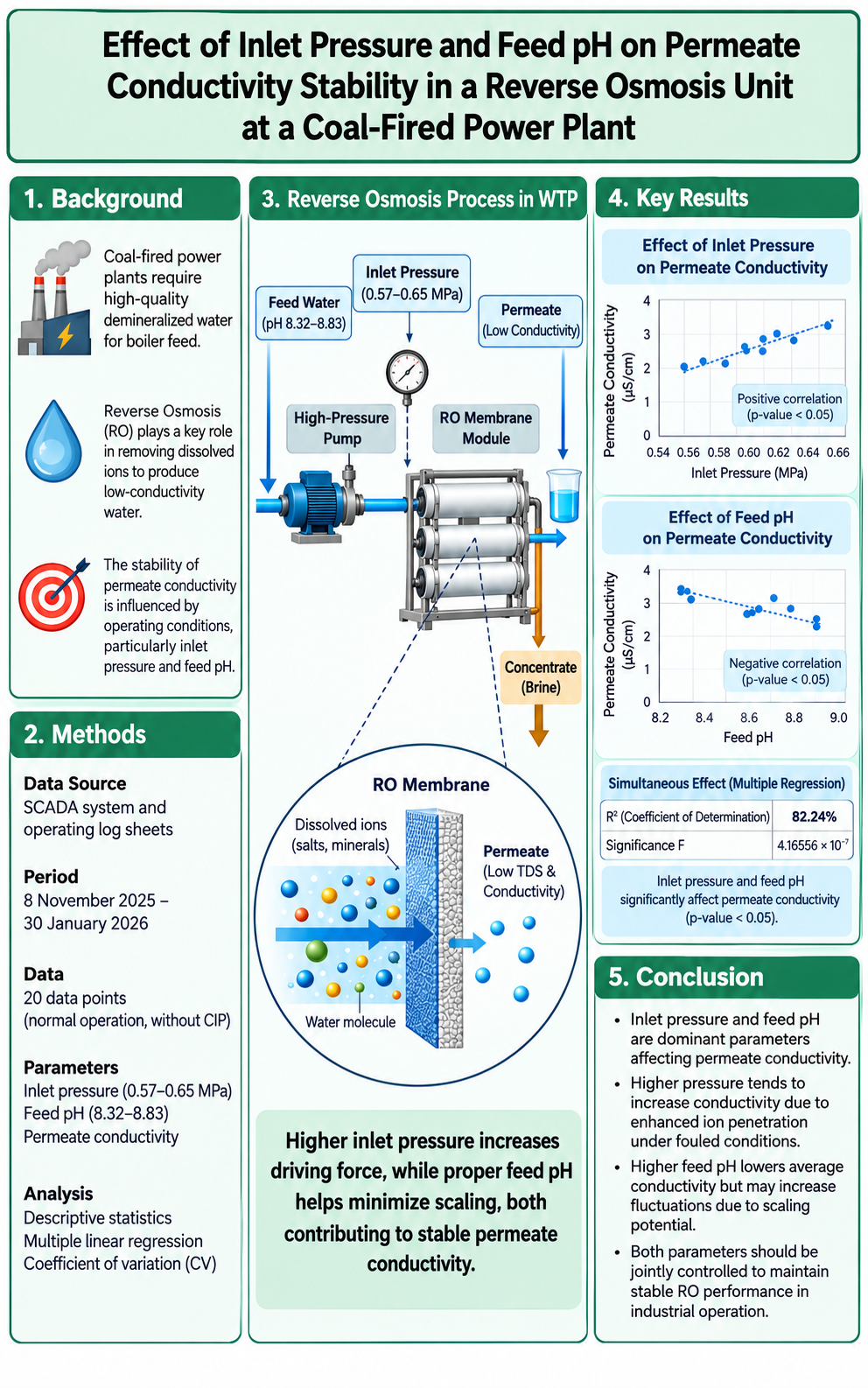
The Reverse Osmosis (RO) unit in the Water Treatment Plant (WTP) of a coal-fired power plant plays a vital role in producing low-conductivity demineralized water for boiler feed. Permeate quality stability is strongly influenced by operating conditions, particularly inlet pressure and feed pH. This study evaluates the effects of inlet pressure and feed pH, both partially and simultaneously, on permeate conductivity as an indicator of RO performance stability. A quantitative approach was applied using industrial operational data obtained from the SCADA system and log sheets from 8 November 2025 to 30 January 2026. Twenty data points under normal operating conditions without cleaning in place (CIP) were analyzed over an inlet-pressure range of 0.57-0.65 MPa and a pH range of 8.32-8.83. Multiple linear regression and coefficient of variation (CV) analysis were used. The results show that inlet pressure significantly affects permeate conductivity (p-value < 0.05) with a positive regression coefficient. Feed pH also has a significant effect (p-value < 0.05), with a negative regression coefficient (−0.5456). Simultaneously, both variables have a significant effect, with a coefficient of determination (R²) of 82.24%. These findings confirm that inlet pressure and feed pH are dominant parameters and should be jointly controlled to maintain stable permeate quality in industrial RO operation.
How to Cite




Downloads
Copyright © 2026 Andi Fajri Haryansyah, Sinardi

This work is licensed under a Creative Commons Attribution-ShareAlike 4.0 International License.
You are free to:
Share — copy and redistribute the material in any medium or format
Adapt — remix, transform, and build upon the material for any purpose, even commercially
Under the following terms:
Attribution — You must give appropriate credit, provide a link to the license, and indicate if changes were made. You may do so in any reasonable manner, but not in any way that suggests the licensor endorses you or your use.
ShareAlike — If you remix, transform, or build upon the material, you must distribute your contributions under the same license as the original
No additional restrictions — You may not apply legal terms or technological measures that legally restrict others from doing anything the license permits
References
[1] A. D. Anggraini and H. Mulyanti, “Effectiveness of Reverse Osmosis Membranes for Wastewater Treatment in the Oil and Gas Industry,” Jaring SainTek Journal, vol. 7, no. 2, pp. 81–86, 2025, [Online]. Available: http://ejurnal.ubharajaya.ac.id/index.php/jaring-saintek
[2] F. A. Essa, F. Selim, and M. S. El-Sebaey, “Performance and control of a reverse osmosis unit integrated with Pelton Wheel to supply emergency electric loads under various operating conditions,” Sustainable Environment Research, vol. 33, no. 1, Dec. 2023, https://doi.org/10.1186/s42834-023-00183-w.
[3] J. Suhartono, A. Salsabilla, and D. Rosalina, “Reduction of Total Dissolved Solids (TDS), Conductivity, and Natural Organic Matter (NOM) in Jatiluhur Dam Raw Water Using a Combination of Membrane and Ion Exchange,” Chemical Engineering Scientific Journal, vol. 8, no. 2, pp. 106–115, Aug. 2024, https://doi.org/10.32493/jitk.v8i2.38730.
[4] A. Shabib, B. Tatan, Y. Elbaz, A. Aly Hassan, M. Hamouda, and M. Maraqa, “Advancements in reverse osmosis desalination: Technology, environment, economy, and bibliometric insights,” Desalination, vol. 598, p. 118413, Dec. 2024, https://doi.org/10.1016/j.desal.2024.118413.
[5] S. Alaswad, H. Abdallah, and E. Mansor, “Integrated System of Reverse Osmosis and Forward Pressure-Assisted Osmosis from ZrO2 Base Polymer Membranes for Desalination Technology,” Technologies (Basel)., vol. 12, p. 253, Dec. 2024, https://doi.org/10.3390/technologies12120253.
[6] Febriyanti, Yuniar, S. Yuliati, and Tahdid, “Effect of Operating Pressure on a 100-Gallon-Per-Day Drinking Water Treatment Unit Based on Silvertec Double Membrane,” Chemical Engineering Journal Storage (CEJS), vol. 5, pp. 781–793, Oct. 2025, https://doi.org/10.29103/cejs.v5i05.23829.
[7] S. Alaswad, E. Mansor, H. Abdallah, and A. Shaban, “Modification of blend reverse osmosis membranes using ZrO2 for desalination process purposes,” Appl. Water Sci., vol. 15, Dec. 2024, https://doi.org/10.1007/s13201-024-02329-6.
[8] M. Hasin, D. Sukoco, and I. Munadhif, “Application of Neural Networks for Classifying the Quality of Reverse Osmosis-Filtrated Water, Journal of Electronics and Industrial Automation, vol. 11, pp. 668–679, Sep. 2024, https://doi.org/10.33795/elkolind.v11i3.6160.
[9] M. Faroon, Z. Abd Alateef, F. Albadran, and L. Ahmed, “Review on Technology-Based on Reverse Osmosis,” Anbar Journal of Engineering Sciences, vol. 14, pp. 89–97, May 2023, https://doi.org/10.37649/aengs.2023.139414.1047.
[10] S. Bayu Kriswanto et al., “Effect of Operating Pressure on a Drinking Water Treatment Unit Using Double-Membrane Reverse Osmosis,” Chemical Engineering Journal Storage, vol. 5, no. 6, pp. 1141–1153, 2025, https://doi.org/10.29103/cejs.v5i6.23834.
Show All References (15 more)
[11] A. Agrawal, D. Garg, A. Kumar, R. Kumar, and P. A. O. T. W. T. R. O. P. Rt&a, “Performance Analysis of the Water Treatment Reverse Osmosis Plant,” 2021.
[12] H. Hasnira et al., “Performance Testing of a Seawater Reverse Osmosis Membrane Before and After Maintenance at the Tanjung Uncang Combined-Cycle Power Plant,” Journal of Applied Electrical Engineering, vol. 9, pp. 37–42, Jun. 2025, https://doi.org/10.30871/jaee.v9i1.9462.
[13] A. Rifai et al., “Effect of Pressure in Reverse Osmosis on the Removal of Chloride Ions (Cl⁻) and Total Dissolved Solids (TDS) in Brackish Water Treatment,” vol. 25, no. 2, pp. 300–307, 2024.
[14] D. Restu Akbar, A. Dwi Kuspambudijaya, and I. Utami, “Demineralization of Air Conditioning Water With Membrane Reverse Osmosis,” Chemical Engineering Journal, vol. 15, no. 1, Oct. 2020.
[15] H. Nisa, “Effect of 1st RO (Reverse Osmosis) Production Flow on 2nd RO (Reverse Osmosis) Production in the Water Treatment Plant Process at a Steam Power Plant (Case Study: PT. XYZ), Samudra Industrial Journal, vol. 6, pp. 83–92, Oct. 2025, https://doi.org/10.55377/jis.v6i2.11945.
[16] M. Ahmed, S. Amin, and A. Mohamed, “Fouling in reverse osmosis membranes: monitoring, characterization, mitigation strategies and future directions,” Heliyon, vol. 9, Mar. 2023, https://doi.org/10.1016/j.heliyon.2023.e14908.
[17] M. Philibert, L. Villacorte, Y. Ekowati, A. Abushaban, and S. G. Salinas-Rodriguez, “Fouling and scaling in reverse osmosis desalination plants: A critical review of membrane autopsies, feedwater quality guidelines and assessment methods,” Desalination, vol. 592, p. 118188, Oct. 2024, https://doi.org/10.1016/j.desal.2024.118188.
[18] E. Kimani et al., “The influence of feedwater pH on membrane charge ionization and ion rejection by reverse osmosis: An experimental and theoretical study,” J. Memb. Sci., vol. 660, p. 120800, Jul. 2022, https://doi.org/10.1016/j.memsci.2022.120800.
[19] L. N. Nthunya et al., “Membrane distillation crystallization: From mechanisms and process control to sustainable production of tailored crystalline materials,” Journal of Water Process Engineering, vol. 86, p. 109935, 2026, https://doi.org/10.1016/j.jwpe.2026.109935.
[20] L. Wang, T. Cao, J. Dykstra, S. Porada, M. Biesheuvel, and M. Elimelech, “Salt and Water Transport in Reverse Osmosis Membranes: Beyond the Solution-Diffusion Model,” Environ. Sci. Technol., vol. XXXX, Dec. 2021, https://doi.org/10.1021/acs.est.1c05649.
[21] C. Fu, F. Li, H. Li, and X. Yi, “Performance Study on Brackish Water Desalination Efficiency Based on a Novel Coupled Electrodialysis–Reverse Osmosis (EDRO) System,” Water (Basel)., vol. 16, p. 794, Mar. 2024, https://doi.org/10.3390/w16060794.
[22] M. Nassr et al., “Mineral Scale Formation during Crossflow Reverse Osmosis at Constant Flux and Constant Transmembrane Pressure Conditions,” Ind. Eng. Chem. Res., vol. 64, no. 2, pp. 1295–1308, Jan. 2025, https://doi.org/10.1021/acs.iecr.4c04059.
[23] A. Fatni et al., “Characterization and mitigation strategies for inorganic scaling in reverse osmosis system treating brackish groundwater,” Sustainable Chemistry One World, vol. 5, p. 100035, 2025, https://doi.org/10.1016/j.scowo.2024.100035.
[24] M. Joy and R. Boussemaere, “Investigation of carbon dioxide for scale control in reverse osmosis systems,” J. Environ. Manage., vol. 373, p. 123837, 2025, https://doi.org/10.1016/j.jenvman.2024.123837.
[25] A. Saeed and M. Alhawaj, “Mathematical modeling of reverse osmosis system design and performance,” Water Pract. Technol., vol. 19, no. 7, pp. 2681–2692, Jul. 2024, https://doi.org/10.2166/wpt.2024.141.