
Bifurcation-Guided Optimal Control of Fluid Catalytic Cracking Systems with Productivity Enhancement

Article Sidebar
Main Article Content
Abstract
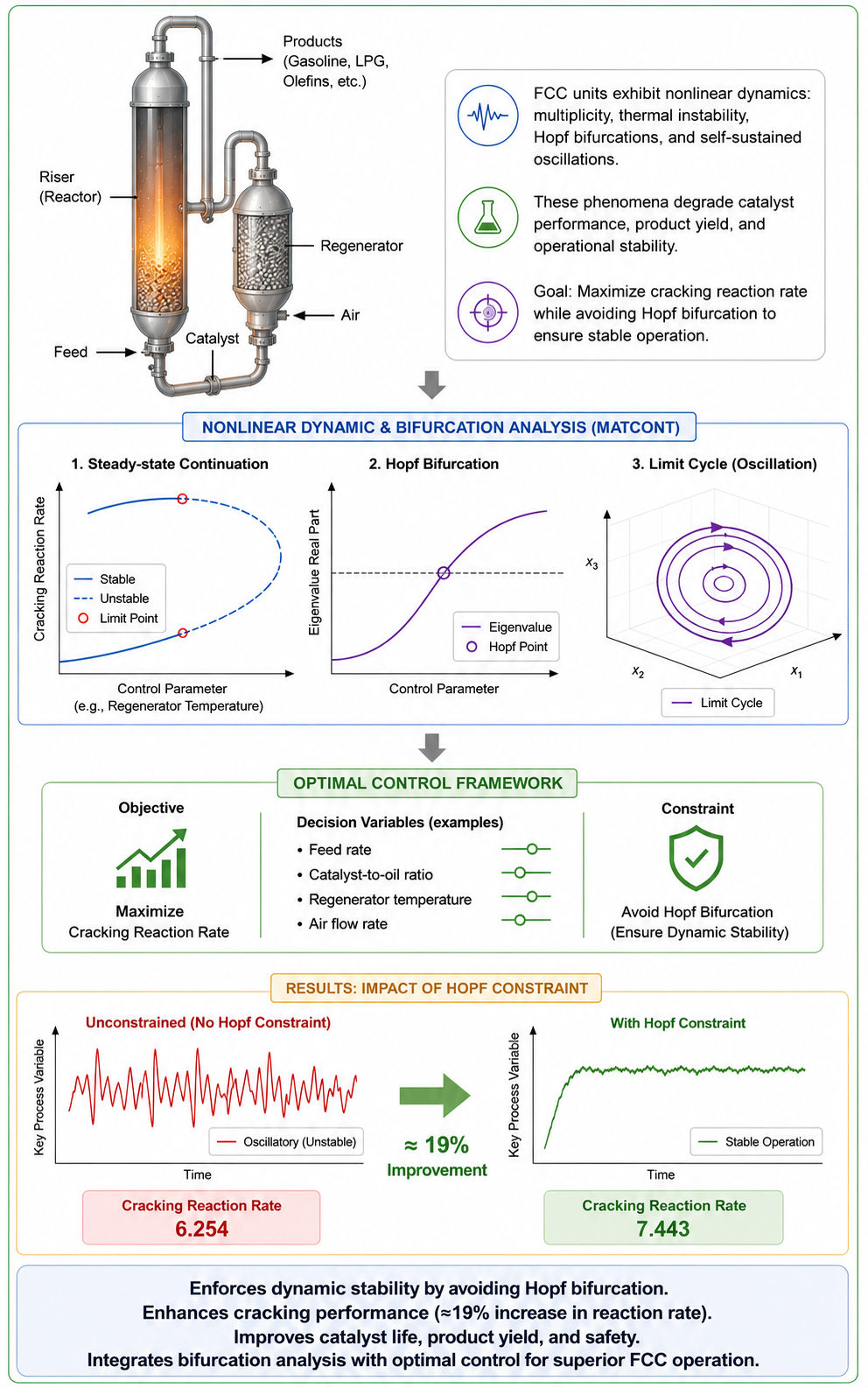
Fluid catalytic cracking (FCC) is one of the most important processes in the petroleum and petrochemical industries because it converts heavy hydrocarbons into valuable transportation fuels and petrochemical feedstocks. However, FCC units exhibit highly nonlinear behavior, including multiplicity, thermal instability, Hopf bifurcations, and self-sustained oscillations, all of which can adversely affect catalyst performance, product yield, and operational stability. A nonlinear dynamic and optimal control framework is developed for an FCC process exhibiting bifurcation-induced instability. Continuation and bifurcation analyses are performed using MATCONT to identify limit points, Hopf bifurcation points, and associated limit-cycle behavior. Based on these analyses, an optimal control problem is formulated to maximize the cracking reaction rate while incorporating a Hopf-bifurcation-avoidance constraint to ensure dynamically stable operation. The bifurcation analysis reveals multiple steady states and a subcritical Hopf bifurcation, confirming the onset of self-sustained oscillatory dynamics in the FCC process. The optimal control results demonstrate that enforcing the Hopf bifurcation constraint significantly improves process performance. Specifically, the optimized cracking reaction rate increases from 6.254 in the unconstrained case to 7.443 when the Hopf constraint is imposed, corresponding to an approximately 19% improvement while maintaining dynamic stability. The proposed framework demonstrates that integrating bifurcation analysis with optimal control provides an effective strategy for simultaneously enhancing process stability and operational performance in FCC systems. The results highlight the industrial significance of incorporating nonlinear dynamic constraints into process optimization to achieve safer, more efficient, and higher-performing FCC operation.
Downloads
Article Details
Section
Copyright © 2026 Lakshmi Sridhar

This work is licensed under a Creative Commons Attribution-ShareAlike 4.0 International License.
How to Cite




References
[1] R. C. McFarlane, R. C. Reineman, J. F. Bartee, and C. Georgakis, “Dynamic simulator for a Model IV fluid catalytic cracking unit,” Comput. Chem. Eng., vol. 17, no. 3, pp. 275–300, Mar. 1993. https://doi.org/10.1016/0098-1354(93)80021-E
[2] A. Arbel, Z. Huang, I. H. Rinard, R. Shinnar, and A. V. Sapre, “Dynamic and control of fluid catalytic crackers. Part 1: Modeling of the current generation of FCCs,” Ind. Eng. Chem. Res., vol. 34, no. 4, pp. 1228–1243, Apr. 1995. https://doi.org/10.1021/ie00043a013
[3] A. Arbel, Z. Huang, I. H. Rinard, R. Shinnar, and A. V. Sapre, “Dynamic and control of fluid catalytic crackers. Part 2: Multiple steady states and instabilities,”Ind. Eng. Chem. Res., vol. 34, no. 4, pp. 1244–1256, Apr. 1995. https://doi.org/10.1021/ie00043a014
[4] A. Arbel, Z. Huang, I. H. Rinard, R. Shinnar, and A. V. Sapre “Dynamic and control of fluid catalytic crackers. Part 3: Designing FCC units for better control properties,” Ind. Eng. Chem. Res., vol. 34, no. 4, pp. 1257–1272, Apr. 1995. https://doi.org/10.1021/ie00043a015
[5] H. Li, Q. Zhao, R. Wang, W. Xu, and T. Qiu, “Integrated hybrid modelling and surrogate model-based operation optimization of fluid catalytic cracking process,” Processes, vol. 12, no. 11, Art. no. 2474, 2024, https://doi.org/10.3390/pr12112474
[6] S. Ravi, M. S. Rao, and C. Venkateswarlu, “Digital simulation of industrial fluid catalytic cracking units-V. Static and dynamic bifurcation,” Chem. Eng. Sci., vol. 50, no. 10, pp. 1635–1644, May 1995. https://doi.org/10.1016/0009-2509(95)00012-7
[7] R. Roman, Z. K. Nagy, F. Allgöwer, and S. P. Agachi, “Dynamic modeling and nonlinear model predictive control of a fluid catalytic cracking unit,” in Computer Aided Chemical Engineering, vol. 20, L. Puigjaner and A. Espuña, Eds., Elsevier, 2005, pp. 1363–1368. https://doi.org/10.1016/S1570-7946(05)80069-0
[8] I. S. Han and C. B. Chung, “Nonlinear predictive control of fluid catalytic cracking processes,”J. Process Control, vol. 7, no. 4, pp. 251–263, Aug. 1997. https://doi.org/10.1016/S0959-1524(97)00004-5
[9] S. S. E. H. Elnashaie and S. S. Elshishini, “Modeling, simulation and optimization of industrial FCC reactors,” Appl. Math. Model., vol. 22, no. 11, pp. 875–888, Nov. 1998. https://doi.org/10.1016/S0307-904X(98)00047-6
[10] A. Oloruntoba, Y. Zhang, and C. S. Hsu, “State-of-the-art review of fluid catalytic cracking (FCC) catalyst regeneration intensification technologies,” Energies, vol. 15, no. 6, Art. no. 2061, 2022, https://doi.org/10.3390/en15062061
[11] R. A. Abou-Jeyab and Y. P. Gupta, “Constrained Multivariable Control of Fluidized Catalytic Cracking Process Using Linear Programming,” Chemical Engineering Research and Design, vol. 79, no. 3, pp. 274–282, Apr. 2001, https://doi.org/10.1205/026387601750281806
[12] R. M. Ansari and M. O. Tadé, “Constrained nonlinear multivariable control of a fluid catalytic cracking process,” Journal of Process Control, vol. 10, no. 6, pp. 539–555, Dec. 2000, https://doi.org/10.1016/S0959-1524(99)00059-1
[13] F. López-Isunza, “Dynamic modelling of an industrial fluid catalytic cracking unit,” Computers & Chemical Engineering, vol. 16, pp. S139–S148, May 1992, https://doi.org/10.1016/S0098-1354(09)80016-1
[14] T. W. Selalame, R. Patel, I. M. Mujtaba, and Y. M. John, “A review of modelling of the FCC unit-Part I: The riser,” Energies, vol. 15, no. 1, Art. no. 308, 2022, https://doi.org/10.3390/en15010308
[15] M. Ali and S. Rohani, “Dynamic optimization of fluid catalytic cracking units,” Energy & Fuels, vol. 19, no. 5, pp. 2135–2143, Sep. 2005, https://doi.org/10.1021/ef050035h
[16] A. T. Boum, A. Latifi and J. -P. Corriou, "Model predictive control of a fluid catalytic cracking unit," 2013 International Conference on Process Control (PC), Strbske Pleso, Slovakia, pp. 335-340, 2013, https://doi.org/10.1109/PC.2013.6581433
[17] J. Bremer and K. Sundmacher, “Novel multiplicity and stability criteria for non-isothermal fixed-bed reactors,” Frontiers in Energy Research, vol. 8, Art. no. 549298, 2021, https://doi.org/10.3389/fenrg.2020.549298
[18] J. Sun, H. Yu, Z. Yin, L. Jiang, L. Wang, S. Hu, and R. Zhou, “Process simulation and optimization of fluid catalytic cracking unit’s rich gas compression system and absorption stabilization system,” Processes, vol. 11, no. 7, Art. no. 2140, 2023, https://doi.org/10.3390/pr11072140
[19] C. I. C. Pinheiro, J. L. F. Monteiro, A. F. Mendes, and H. de Lasa, “Fluid catalytic cracking (FCC) process modeling, simulation and control: A review,” Ind. Eng. Chem. Res., vol. 51, no. 1, pp. 1–29, Jan. 2012. https://doi.org/10.1021/ie200743c
[20] Q. Yang, S. Li, and X. Tian, “Nonlinear Control of a Fluid Catalytic Cracking Unit,” IFAC Proceedings Volumes, vol. 37, no. 1, pp. 119–124, 2004, https://doi.org/10.1016/S1474-6670(17)38718-9
[21] E. T. C. Vogt and B. M. Weckhuysen, “Fluid catalytic cracking: Recent developments on the grand old lady of zeolite catalysis,”Chem. Soc. Rev., vol. 44, no. 20, pp. 7342–7370, 2015. https://doi.org/10.1039/c5cs00376h
[22] M. K. Khaldi, M. Al-Dhaifallah, and O. Taha, “Artificial intelligence perspectives: A systematic literature review on modeling, control, and optimization of fluid catalytic cracking,” Alexandria Eng. J., vol. 80, pp. 294–314, 2023. https://doi.org/10.1016/j.aej.2023.08.066
[23] D. E. Seborg, T. F. Edgar, D. A. Mellichamp, and F. J. Doyle III, Process Dynamics and Control, 4th ed. Hoboken, NJ, USA: Wiley, 2017.
[24] J. A. Romagnoli and A. Palazoglu, Introduction to Process Control. Boca Raton, FL, USA: CRC Press, 2006.
[25] J. Douglas, Conceptual Design of Chemical Processes. New York, NY, USA: McGraw-Hill, 1988.
26] Z. Hao, M. Haghighat, J. Liu, and H. A. Karimi, “Physics-informed machine learning: A survey on problems, methods and applications,” Machine Learning with Applications, vol. 15, Art. no. 100525, 2024. https://doi.org/10.48550/arXiv.2211.08064
[27] S. Arce Muñoz and J. D. Hedengren, “Physics-informed transfer learning for process control applications,” Industrial & Engineering Chemistry Research, vol. 63, no. 49, pp. 21432–21443, 2024. https://doi.org/10.1021/acs.iecr.4c02781
[28] P. K. Pal, A. Hens, N. Behera, and S. K. Lahiri, “Digital twins: Transforming the chemical process industry—A review,” Canadian Journal of Chemical Engineering, vol. 103, no. 8, pp. 3611–3636, 2025. https://doi.org/10.1002/cjce.25611
[29] A. Weingram and C. Cui, “A definition and taxonomy of digital twins: Case studies with machine learning and scientific applications,” Frontiers in High Performance Computing, vol. 3, Art. no. 1536501, 2025. https://doi.org/10.3389/fhpcp.2025.1536501
[30] A. Dhooge, W. Govaerts, and Y. A. Kuznetsov, “MATCONT: A MATLAB package for numerical bifurcation analysis of ODEs,” ACM Trans. Math. Softw., vol. 29, no. 2, pp. 141–164, Jun. 2003. https://doi.org/10.1145/779359.779362
[31] Y. A. Kuznetsov, Elements of Applied Bifurcation Theory, 2nd ed. New York, NY, USA: Springer-Verlag, 1998.
[32] W. Govaerts, Numerical Methods for Bifurcations of Dynamical Equilibria. Philadelphia, PA, USA: SIAM, 2000.
[33] W. E. Hart, C. D. Laird, J.-P. Watson, D. L. Woodruff, G. A. Hackebeil, B. L. Nicholson, and J. D. Siirola, Pyomo-Optimization Modeling in Python, 2nd ed. Cham, Switzerland: Springer, 2017.
[34] A. Wächter and L. T. Biegler, “On the implementation of an interior-point filter line-search algorithm for large-scale nonlinear programming,” Math. Program., vol. 106, no. 1, pp. 25–57, Mar. 2006. https://doi.org/10.1007/s10107-004-0559-y