
Polymer Membranes for Energy-Efficient Separation and Clean Energy Applications: Materials Design, Performance Trade-Offs, and Future Perspectives

Article Sidebar
Main Article Content
Abstract
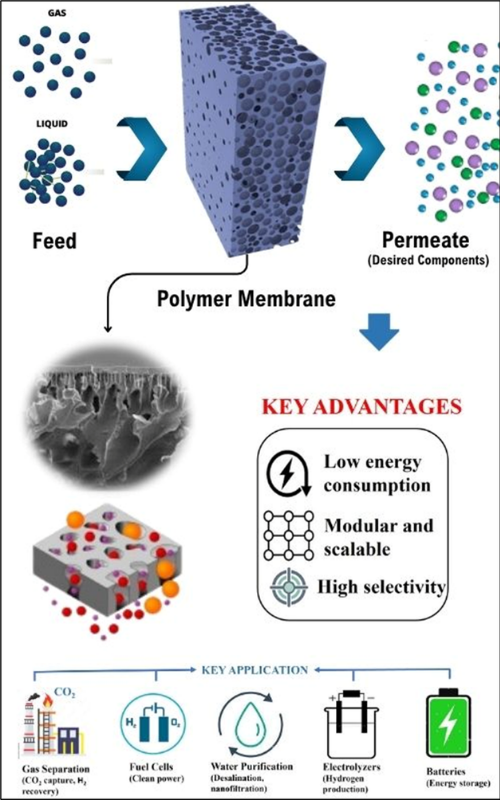
The low energy requirement, modularity, operational flexibility, and tunable transport properties of polymer membranes make them promising technologies for energy-efficient separation and clean energy applications. Compared with conventional thermal separation processes, membrane systems significantly reduce energy consumption and carbon emissions while enabling compact and scalable process integration. Recent advances in polymer chemistry and nanocomposite fabrication have expanded membrane applications in gas separation, desalination, wastewater treatment, solvent recovery, fuel cells, electrolyzers, and electrochemical energy storage systems. This review critically examines the structure–function relationships of membranes in relation to transport phenomena and key performance characteristics, including permeability, selectivity, conductivity, stability, and fouling resistance. Particular attention is given to high-performance materials such as polymers of intrinsic microporosity (PIMs), thermally rearranged polymers, ion-conductive polymers, and mixed-matrix membranes incorporating metal–organic frameworks, covalent organic frameworks, and two-dimensional nanofillers. Recent strategies to overcome the conventional permeability–selectivity trade-off are reviewed together with challenges related to physical aging, plasticization, chemical degradation, and large-scale manufacturability. In addition to material innovation, this review highlights recent developments in advanced fabrication techniques, machine learning-assisted membrane discovery, and sustainable circular manufacturing approaches. Unlike previous reviews focusing on individual applications, this work provides an integrated perspective connecting separation technologies and clean energy systems through common membrane design principles. The development of durable, scalable, and intelligent membrane platforms will be essential for advancing decarbonization, water security, and sustainable industrial production worldwide.
Downloads
Article Details
Section
Copyright © 2026 Jibrin Muhammad Yelwa, Auwal Jaji Aliyu

This work is licensed under a Creative Commons Attribution-ShareAlike 4.0 International License.
How to Cite




References
[1] Y. Yu, X. Zhang, P. Lu, D. He, L. Shen, and Y. Li, ‘Enhanced Separation Performance of Polyamide Thin-Film Nanocomposite Membranes with Interlayer by Constructed Two-Dimensional Nanomaterials: A Critical Review’, Membranes, vol. 12, no. 12, p. 1250, Dec. 2022, https://doi.org/10.3390/membranes12121250
[2] S. Tian, Q. Pan, H. Li, X. Sui, and Y. Chen, ‘Two-dimensional material membrane fabrication: progress and challenges’, Current Opinion in Chemical Engineering, vol. 39, p. 100900, Mar. 2023, https://doi.org/10.1016/j.coche.2023.100900
[3] H. B. Park, J. Kamcev, L. M. Robeson, M. Elimelech, and B. D. Freeman, ‘Maximizing the right stuff: The trade-off between membrane permeability and selectivity’, Science, vol. 356, no. 6343, p. eaab0530, Jun. 2017, https://doi.org/10.1126/science.aab0530
[4] R. Castro-Muñoz, ‘Membranes– future for sustainable gas and liquid separation?’, Current Research in Green and Sustainable Chemistry, vol. 5, p. 100326, 2022, https://doi.org/10.1016/j.crgsc.2022.100326
[5] W. Deng et al., ‘Techno-economics of polymer-membrane-based CO2 electrolysers’, Nat. Rev. Clean Technol., vol. 1, no. 4, pp. 255–268, Mar. 2025, https://doi.org/10.1038/s44359-025-00045-1
[6] C. T. Altaf, T. O. Colak, E. Karagoz, M. Kurt, N. D. Sankir, and M. Sankir, ‘A Review of the Recent Advances in Composite Membranes for Hydrogen Generation Technologies’, ACS Omega, vol. 9, no. 22, pp. 23138–23154, Jun. 2024, https://doi.org/10.1021/acsomega.4c00152
[7] M. O. Guerrero-Pérez, ‘Perspectives and State of the Art of Membrane Separation Technology as a Key Element in the Development of Hydrogen Economy’, Membranes, vol. 14, no. 11, p. 228, Oct. 2024, doi: 10.3390/membranes14110228.
[8] F. Kadirkhan et al., ‘Recent Advances of Polymeric Membranes in Tackling Plasticization and Aging for Practical Industrial CO2/CH4 Applications—A Review’, Membranes, vol. 12, no. 1, p. 71, Jan. 2022, https://doi.org/10.3390/membranes12010071
[9] E. J. Park, C. G. Arges, H. Xu, and Y. S. Kim, ‘Membrane Strategies for Water Electrolysis’, ACS Energy Lett., vol. 7, no. 10, pp. 3447–3457, Oct. 2022, https://doi.org/10.1021/acsenergylett.2c01609
[10] Z. He and N. P. Balsara, ‘Understanding the Conductivity and Transference Trade-Off in Polymer Electrolytes Using a Robeson-Inspired Upper Bound’, ACS Appl. Polym. Mater., vol. 7, no. 10, pp. 5960–5968, May 2025, https://doi.org/10.1021/acsapm.5c00288
[11] A. M. Vijesh and A. M. Isloor, ‘Review on polymeric membrane materials for gas separations which are stated above the Robeson’s trade-off upper bound’, in Current Trends and Future Developments on (Bio-) Membranes, Elsevier, 2024, pp. 3–28. https://doi.org/10.1016/B978-0-323-99311-1.00005-2
[12] R. Dangayach, N. Jeong, E. Demirel, N. Uzal, V. Fung, and Y. Chen, ‘Machine Learning-Aided Inverse Design and Discovery of Novel Polymeric Materials for Membrane Separation’, Environ. Sci. Technol., vol. 59, no. 2, pp. 993–1012, Jan. 2025, https://doi.org/10.1021/acs.est.4c08298
[13] F. Topuz, M. H. Abdellah, P. M. Budd, and M. A. Abdulhamid, ‘Advances in Polymers of Intrinsic Microporosity (PIMs)-Based Materials for Membrane, Environmental, Catalysis, Sensing and Energy Applications’, Polymer Reviews, vol. 64, no. 1, pp. 251–305, Jan. 2024, https://doi.org/10.1080/15583724.2023.2236677
[14] W. Xian, D. Wu, Z. Lai, S. Wang, and Q. Sun, ‘Advancing Ion Separation: Covalent-Organic-Framework Membranes for Sustainable Energy and Water Applications’, Acc. Chem. Res., vol. 57, no. 14, pp. 1973–1984, Jul. 2024, https://doi.org/10.1021/acs.accounts.4c00268
[15] C. Astorino, E. De Nardo, S. Lettieri, G. Ferraro, C. F. Pirri, and S. Bocchini, ‘Advancements in Gas Separation for Energy Applications: Exploring the Potential of Polymer Membranes with Intrinsic Microporosity (PIM)’, Membranes, vol. 13, no. 12, p. 903, Dec. 2023, https://doi.org/10.3390/membranes13120903
[16] J. W. Campbell, A. P. DeRegis, J. A. Laub, D. S. Sholl, and K. D. Vogiatzis, ‘Thermodynamic Labeling Enables CO2 Prediction in Polymers of Intrinsic Microporosity under Small Data Constraints’, Macromol. Rapid Commun., p. e00490, Sep. 2025, https://doi.org/10.1002/marc.202500490
[17] B. Qiu, Y. Gao, P. Gorgojo, and X. Fan, ‘Membranes of Polymer of Intrinsic Microporosity PIM-1 for Gas Separation: Modification Strategies and Meta-Analysis’, Nano-Micro Lett., vol. 17, no. 1, p. 114, Dec. 2025, https://doi.org/10.1007/s40820-024-01610-2
[18] Y. Wang, B. S. Ghanem, Y. Han, and I. Pinnau, ‘State-of-the-art polymers of intrinsic microporosity for high-performance gas separation membranes’, Current Opinion in Chemical Engineering, vol. 35, p. 100755, Mar. 2022, https://doi.org/10.1016/j.coche.2021.100755
[19] K. Friess et al., ‘A Review on Ionic Liquid Gas Separation Membranes’, Membranes, vol. 11, no. 2, p. 97, Jan. 2021, https://doi.org/10.3390/membranes11020097
[20] M. H. Mobarak et al., ‘Progress and prospects of electrospun nanofibrous membranes for water filtration: A comprehensive review’, Desalination, vol. 574, p. 117285, Apr. 2024, https://doi.org/10.1016/j.desal.2023.117285
[21] K. Ji et al., ‘Research Progress of Water Treatment Technology Based on Nanofiber Membranes’, Polymers, vol. 15, no. 3, p. 741, Jan. 2023, https://doi.org/10.3390/polym15030741
[22] A. A. Nayl et al., ‘Review of the Recent Advances in Electrospun Nanofibers Applications in Water Purification’, Polymers, vol. 14, no. 8, p. 1594, Apr. 2022, https://doi.org/10.3390/polym14081594
[23] Y. Tang et al., ‘Electrospun Nanofiber-Based Membranes for Water Treatment’, Polymers, vol. 14, no. 10, p. 2004, May 2022, https://doi.org/10.3390/polym14102004
[24] Z. Uddin et al., ‘Recent trends in water purification using electrospun nanofibrous membranes’, Int. J. Environ. Sci. Technol., vol. 19, no. 9, pp. 9149–9176, Sep. 2022, https://doi.org/10.1007/s13762-021-03603-9
[25] M. Mahdi A. Shirazi, S. Bazgir, and F. Meshkani, ‘Electrospun Nanofibrous Membranes for Water Treatment’, in Advances in Membrane Technologies, A. Abdelrasoul, Ed., IntechOpen, 2020. https://doi.org/10.5772/intechopen.87948
[26] H. A. Balogun and R. P. Lively, ‘Independent experimental measurements of diffusion, sorption, and permeability support the solution-diffusion model of membrane transport’, Journal of Membrane Science, p. 124731, Sep. 2025, https://doi.org/10.1016/j.memsci.2025.124731
[27] J. He, H. Fan, M. Elimelech, and Y. Li, ‘Molecular simulations of organic solvent transport in dense polymer membranes: Solution-diffusion or pore-flow mechanism?’, Journal of Membrane Science, vol. 708, p. 123055, Aug. 2024, https://doi.org/10.1016/j.memsci.2024.123055
[28] J. Xu, J. Ren, C. Xie, C. Qi, and M. Wang, ‘Hybrid Membrane-Thermal Seawater Desalination Engineering: Typical Technology Development and Future Prospects’, in Sustainable Development of Water and Environment, H.-Y. Jeon, Ed., in Environmental Science and Engineering. , Cham: Springer International Publishing, 2022, pp. 221–229. https://doi.org/10.1007/978-3-031-07500-1_19
[29] M. Minelli and G. C. Sarti, ‘Modeling mass transport in dense polymer membranes: cooperative synergy among multiple scale approaches’, Current Opinion in Chemical Engineering, vol. 28, pp. 43–50, Jun. 2020, https://doi.org/10.1016/j.coche.2020.01.004
[30] R. A. B. Almarjeh, J. Y. J. Yeo, Y. Atassi, S. S. Hosseini, and J. Sunarso, ‘An Improved Permeation Model for Solution–Diffusion‐Based Hollow Fiber Gas Separation Membrane: Implementation and Analysis’, Asia-Pacific J Chem Eng, vol. 20, no. 3, p. e3182, May 2025, https://doi.org/10.1002/apj.3182
[31] C. Aninwede and L. Kratky, ‘Modeling trends in multicomponent gas membrane separation process: a review’, J. Eng. Appl. Sci., vol. 72, no. 1, p. 41, Dec. 2025, https://doi.org/0.1186/s44147-025-00608-w
[32] F. Z. Najdawi and K. T. Neptune, ‘Optimizing Reverse Osmosis Membrane Parameters through the Use of the Solution-Diffusion Model: A Review’, ENG, vol. 14, no. 01, pp. 9–32, 2022, https://doi.org/10.4236/eng.2022.141002
[33] E. Ricci, M. Minelli, and M. G. De Angelis, ‘Modelling Sorption and Transport of Gases in Polymeric Membranes across Different Scales: A Review’, Membranes, vol. 12, no. 9, p. 857, Aug. 2022, https://doi.org/10.3390/membranes12090857
[34] L. Wang, T. Cao, J. E. Dykstra, S. Porada, P. M. Biesheuvel, and M. Elimelech, ‘Salt and Water Transport in Reverse Osmosis Membranes: Beyond the Solution-Diffusion Model’, Environ. Sci. Technol., vol. 55, no. 24, pp. 16665–16675, Dec. 2021, https://doi.org/10.1021/acs.est.1c05649
[35] T. M. Madumo, ‘Retracted: Industrial Wastewater Treatment Past and Future Perspectives in Technological Advances for Mitigation of Cr(VI) Pollutant’, in Wastewater Treatment and Sludge Management Systems - The Gutter-to-Good Approaches, B. Kılıç Taşeli, E. Jacob-Lopes, L. Queiroz Zepka, and M. Costa Deprá, Eds, IntechOpen, 2024. https://doi.org/10.5772/intechopen.1004933
[36] R. M. DuChanois, C. J. Porter, C. Violet, R. Verduzco, and M. Elimelech, ‘Membrane Materials for Selective Ion Separations at the Water–Energy Nexus’, Advanced Materials, vol. 33, no. 38, p. 2101312, Sep. 2021, https://doi.org/10.1002/adma.202101312
[37] A. Shiohara, B. Prieto-Simon, and N. H. Voelcker, ‘Porous polymeric membranes: fabrication techniques and biomedical applications’, J. Mater. Chem. B, vol. 9, no. 9, pp. 2129–2154, 2021, https://doi.org/10.1039/D0TB01727B
[38] A. Siekierka, K. Smolińska-Kempisty, and J. Wolska, ‘Enhanced Specific Mechanism of Separation by Polymeric Membrane Modification—A Short Review’, Membranes, vol. 11, no. 12, p. 942, Nov. 2021, https://doi.org/10.3390/membranes11120942
[39] M. Liu, F. Yu, L. Niu, and H. Chi, ‘Advances in nanofiltration membrane pore size adjustment techniques: A review’, Environmental Functional Materials, p. S2773058125000109, Feb. 2025, https://doi.org/10.1016/j.efmat.2025.02.002
[40] K. Zhao et al., ‘Tuning Pore Size in Graphene in the Angstrom Regime for Highly Selective Ion–Ion Separation’, ACS Nano, p. acsnano.3c11068, Feb. 2024, https://doi.org/10.1021/acsnano.3c11068
[41] W. Wang et al., ‘High-surface-area functionalized nanolaminated membranes for energy-efficient nanofiltration and desalination in forward osmosis’, Nat Water, vol. 1, no. 2, pp. 187–197, Feb. 2023, https://doi.org/10.1038/s44221-023-00036-1
[42] M. Yuan et al., ‘Metal-organic frameworks for high performance desalination through thickness control and structural fine-tuning’, Water Research, vol. 230, p. 119576, Feb. 2023, https://doi.org/10.1016/j.watres.2023.119576
[43] K. Wang et al., ‘Tailored design of nanofiltration membranes for water treatment based on synthesis–property–performance relationships’, Chem. Soc. Rev., vol. 51, no. 2, pp. 672–719, 2022, https://doi.org/10.1039/D0CS01599G
[44] R. Epsztein, R. M. DuChanois, C. L. Ritt, A. Noy, and M. Elimelech, ‘Towards single-species selectivity of membranes with subnanometre pores’, Nat. Nanotechnol., vol. 15, no. 6, pp. 426–436, Jun. 2020, https://doi.org/10.1038/s41565-020-0713-6
[45] V. Ganesan and E. Zofchak, ‘Ligand-Functionalized Polymer Membranes for Selective Ion Separations’, ACS Macro Lett., pp. 1684–1693, Oct. 2025, https://doi.org/10.1021/acsmacrolett.5c00572
[46] A. I. Osman et al., ‘Membrane Technology for Energy Saving: Principles, Techniques, Applications, Challenges, and Prospects’, Adv Energy and Sustain Res, vol. 5, no. 5, p. 2400011, May 2024, https://doi.org/10.1002/aesr.202400011
[47] W. Xu, A. Lindbråthen, X. Wang, Z. Dai, and L. Deng, ‘Facilitated Transport Nanocomposite Membranes for CO2 /H2 Separation: The Effect of Mobile Carriers’, Ind. Eng. Chem. Res., vol. 62, no. 37, pp. 15202–15211, Sep. 2023, https://doi.org/10.1021/acs.iecr.3c02400
[48] Y. Shi, B. Liang, R.-B. Lin, C. Zhang, and B. Chen, ‘Gas Separation via Hybrid Metal–Organic Framework/Polymer Membranes’, Trends in Chemistry, vol. 2, no. 3, pp. 254–269, Mar. 2020, https://doi.org/10.1016/j.trechm.2020.01.002
[49] L. Yang, S. Qian, X. Wang, X. Cui, B. Chen, and H. Xing, ‘Energy-efficient separation alternatives: metal–organic frameworks and membranes for hydrocarbon separation’, Chem. Soc. Rev., vol. 49, no. 15, pp. 5359–5406, 2020, https://doi.org/10.1039/C9CS00756C
[50] Z. Lin et al., ‘Wide-Temperature Electrolytes for Aqueous Alkali Metal-Ion Batteries: Challenges, Progress, and Prospects’, Nano-Micro Lett., vol. 18, no. 1, p. 27, Dec. 2026, https://doi.org/10.1007/s40820-025-01865-3
[51] J. I. Lopez, H. Zhi, S. Yang, J. Ma, and J. Tang, ‘Cellulose ionic conductors for sustainable ion transport in next-generation electrochemical devices’, J. Mater. Res., Oct. 2025, https://doi.org/10.1557/s43578-025-01722-4
[52] H. K. Jun and F. W. Low, Materials for Energy Conversion and Storage, 1st edn. Boca Raton: CRC Press, 2024. https://doi.org/10.1201/9781003314424
[53] S. Feng, X. Du, J. Luo, Y. Zhuang, J. Wang, and Y. Wan, ‘A review on facilitated transport membranes based on π-complexation for carbon dioxide separation’, Separation and Purification Technology, vol. 309, p. 122972, Mar. 2023, https://doi.org/10.1016/j.seppur.2022.122972
[54] X. Zhang et al., ‘Zn ion-modulated polyamide membrane with enhanced facilitated transport effect for CO2 separation’, Separation and Purification Technology, vol. 292, p. 121051, Jul. 2022, https://doi.org/10.1016/j.seppur.2022.121051
[55] A. Klemm, Y.-Y. Lee, H. Mao, and B. Gurkan, ‘Facilitated Transport Membranes With Ionic Liquids for CO2 Separations’, Front. Chem., vol. 8, p. 637, Aug. 2020, https://doi.org/10.3389/fchem.2020.00637
[56] W. Feng et al., ‘Proton Exchange Membrane Water Splitting: Advances in Electrode Structure and Mass‐Charge Transport Optimization’, Advanced Materials, vol. 37, no. 15, p. 2416012, Apr. 2025, https://doi.org/10.1002/adma.202416012
[57] H. Lu et al., ‘Light-enhanced ion transport and fouling resistance properties of metal/semiconductor heterojunction nanochannel membranes for osmotic energy recovery in real-world conditions’, Water Research, vol. 276, p. 123243, May 2025, https://doi.org/10.1016/j.watres.2025.123243
[58] B. Adigun, B. P. Thapaliya, H. Luo, and S. Dai, ‘Ionic liquid-based extraction of metal ions via polymer inclusion membranes: a critical review’, RSC Sustainability, vol. 2, no. 10, pp. 2768–2780, 2024, https://doi.org/10.1039/D4SU00297K
[59] N. Zheng, Y. Xu, Q. Zhao, and T. Xie, ‘Dynamic Covalent Polymer Networks: A Molecular Platform for Designing Functions beyond Chemical Recycling and Self-Healing’, Chem. Rev., vol. 121, no. 3, pp. 1716–1745, Feb. 2021, https://doi.org/10.1021/acs.chemrev.0c00938
[60] C. Y. Loh, T. Pang, D. Zhang, A. D. Burrows, and M. Xie, ‘Dynamic Covalent Chemistry Enabled Closed-Loop Recycling of Thermally Modified Polymer Membrane’, ACS Appl. Polym. Mater., vol. 7, no. 12, pp. 7824–7835, Jun. 2025, https://doi.org/10.1021/acsapm.5c00491
[61] R. Wang, R. Duddu, and S. Lin, ‘Extended Donnan-Manning theory for selective ion partition and transport in ion exchange membrane’, Journal of Membrane Science, vol. 681, p. 121782, Sep. 2023, https://doi.org/10.1016/j.memsci.2023.121782
[62] L. Wu, T. Luo, X. Yang, H. Zhao, X. Wang, and Z. Zhang, ‘Impact of the Donnan electrolytes on selectivity of cation exchange membranes evaluated via the ionic membrane conductivity’, Separation and Purification Technology, vol. 316, p. 123816, Jul. 2023, https://doi.org/10.1016/j.seppur.2023.123816
[63] Z. Peng et al., ‘Cation exchange membranes based on the Donnan exclusion effect for aqueous organic redox flow batteries’, J. Mater. Chem. A, vol. 13, no. 28, pp. 22772–22782, 2025, https://doi.org/10.1039/D5TA02794B
[64] A. Breytus, D. Hasson, R. Semiat, and H. Shemer, ‘Ion exchange membrane adsorption in Donnan dialysis’, Separation and Purification Technology, vol. 226, pp. 252–258, Nov. 2019, https://doi.org/10.1016/j.seppur.2019.05.084
[65] K. Khoiruddin, D. Ariono, S. Subagjo, and I. G. Wenten, ‘The effect of heterogeneity in ion-exchange membrane structure on Donnan Exclusion’, J. Phys.: Conf. Ser., vol. 1090, p. 012045, Sep. 2018, https://doi.org/10.1088/1742-6596/1090/1/012045
[66] G. Das, J.-H. Choi, P. K. T. Nguyen, D.-J. Kim, and Y. S. Yoon, ‘Anion Exchange Membranes for Fuel Cell Application: A Review’, Polymers, vol. 14, no. 6, p. 1197, Mar. 2022, https://doi.org/10.3390/polym14061197
[67] H. G. Kuppusamy et al., ‘Anion Exchange Membranes for Alkaline Polymer Electrolyte Fuel Cells—A Concise Review’, Materials, vol. 15, no. 16, p. 5601, Aug. 2022, https://doi.org/10.3390/ma15165601
[68] Z. Zhao et al., ‘Strong and Flexible High-Performance Anion Exchange Membranes with Long-Distance Interconnected Ion Transport Channels for Alkaline Fuel Cells’, ACS Appl. Mater. Interfaces, vol. 14, no. 33, pp. 38132–38143, Aug. 2022, https://doi.org/10.1021/acsami.2c05872
[69] M. Hren, M. Božič, D. Fakin, K. S. Kleinschek, and S. Gorgieva, ‘Alkaline membrane fuel cells: anion exchange membranes and fuels’, Sustainable Energy Fuels, vol. 5, no. 3, pp. 604–637, 2021, https://doi.org/10.1039/D0SE01373K
[70] L. Ge, H. Song, J. Zhu, Y. Zhang, Z. Zhou, and B. Van Der Bruggen, ‘Metal/covalent–organic framework based thin film nanocomposite membranes for advanced separations’, J. Mater. Chem. A, vol. 12, no. 14, pp. 7975–8013, 2024, https://doi.org/10.1039/D4TA00578C
[71] M. Alhoshan, A. K. Shukla, T. H. Mana, F. A. A. Ali, and J. Alam, ‘An Evolving MOF Thin-Film Nanocomposite Tubular Ceramic Membrane for Desalination Pretreatment’, J Inorg Organomet Polym, vol. 33, no. 2, pp. 337–352, Feb. 2023, https://doi.org/10.1007/s10904-022-02501-y
[72] S. Lim et al., ‘Covalent organic framework incorporated outer-selective hollow fiber thin-film nanocomposite membranes for osmotically driven desalination’, Desalination, vol. 485, p. 114461, Jul. 2020, https://doi.org/10.1016/j.desal.2020.114461
[73] J. A. Pinem, A. K. Wardani, P. T. P. Aryanti, K. Khoiruddin, and I. G. Wenten, ‘Hydrophilic Modification of Polymeric Membrane using Graft Polymerization Method: A Mini Review’, IOP Conf. Ser.: Mater. Sci. Eng., vol. 547, no. 1, p. 012054, Aug. 2019, https://doi.org/10.1088/1757-899X/547/1/012054
[74] H. Dou et al., ‘Microporous framework membranes for precise molecule/ion separations’, Chem. Soc. Rev., vol. 50, no. 2, pp. 986–1029, 2021, https://doi.org/10.1039/D0CS00552E
[75] W. H. Lee, J. G. Seong, X. Hu, and Y. M. Lee, ‘Recent progress in microporous polymers from thermally rearranged polymers and polymers of intrinsic microporosity for membrane gas separation: Pushing performance limits and revisiting trade‐off lines’, Journal of Polymer Science, vol. 58, no. 18, pp. 2450–2466, Sep. 2020, https://doi.org/10.1002/pol.20200110
[76] T. A. Otitoju, A. L. Ahmad, and B. S. Ooi, ‘Recent advances in hydrophilic modification and performance of polyethersulfone (PES) membrane via additive blending’, RSC Adv., vol. 8, no. 40, pp. 22710–22728, 2018, https://doi.org/10.1039/C8RA03296C.
[77] F. H. Memon et al., ‘Transition Metal Dichalcogenide-based Membranes for Water Desalination, Gas Separation, and Energy Storage’, Separation & Purification Reviews, vol. 52, no. 1, pp. 43–57, Jan. 2023, https://doi.org/10.1080/15422119.2022.2037000
[78] H. Qiu, M. Xue, C. Shen, Z. Zhang, and W. Guo, ‘Graphynes for Water Desalination and Gas Separation’, Advanced Materials, vol. 31, no. 42, p. 1803772, Oct. 2019, https://doi.org/10.1002/adma.201803772
[79] G. M. Geise, ‘Experimental characterization of polymeric membranes for selective ion transport’, Current Opinion in Chemical Engineering, vol. 28, pp. 36–42, Jun. 2020, https://doi.org/10.1016/j.coche.2020.01.002
[80] I. Stenina, D. Golubenko, V. Nikonenko, and A. Yaroslavtsev, ‘Selectivity of Transport Processes in Ion-Exchange Membranes: Relationship with the Structure and Methods for Its Improvement’, IJMS, vol. 21, no. 15, p. 5517, Aug. 2020, https://doi.org/10.3390/ijms21155517
[81] X. Du, Y. Shi, V. Jegatheesan, and I. U. Haq, ‘A Review on the Mechanism, Impacts and Control Methods of Membrane Fouling in MBR System’, Membranes, vol. 10, no. 2, p. 24, Feb. 2020, https://doi.org/10.3390/membranes10020024
[82] J. Kucera, ‘Biofouling of Polyamide Membranes: Fouling Mechanisms, Current Mitigation and Cleaning Strategies, and Future Prospects’, Membranes, vol. 9, no. 9, p. 111, Aug. 2019, https://doi.org/10.3390/membranes9090111
[83] J. Wen et al., ‘Electrolyzing Outside the Box: Non‐Traditional Approaches to Electrochemical Water Splitting’, Small Methods, p. 2500634, May 2025, https://doi.org/10.1002/smtd.202500634
[84] M. Shaban, A. Morsy, A. S. Mahmoud, and H. Abdel-Hamid, ‘Membrane Separation Processes: Principles, Structures, Materials, and Future Prospects’, in Environmental Sciences, vol. 26, H. Xu, X. Gu, Q. Li, H. Wang, and Y. Sun, Eds, IntechOpen, 2024. https://doi.org/10.5772/intechopen.1006562
[85] D. M. Fidalgo, M. D. Contin, A. A. Kolender, and N. D’Accorso, ‘Polymeric Biocomposites from Renewable and Sustainable Natural Resources’, in Polymeric and Natural Composites, M. S. Hasnain, A. K. Nayak, and S. Alkahtani, Eds, in Advances in Material Research and Technology. , Cham: Springer International Publishing, 2022, pp. 65–108. https://doi.org/10.1007/978-3-030-70266-3_3
[86] M. Sandru et al., ‘An integrated materials approach to ultrapermeable and ultraselective CO2 polymer membranes’, Science, vol. 376, no. 6588, pp. 90–94, Apr. 2022, https://doi.org/10.1126/science.abj9351
[87] P. Zhang, Z. Li, S. Zhang, and G. Shao, ‘Recent Advances in Effective Reduction of Graphene Oxide for Highly Improved Performance Toward Electrochemical Energy Storage’, Energy & Environ Materials, vol. 1, no. 1, pp. 5–12, Mar. 2018, https://doi.org/10.1002/eem2.12001
[88] S. Sultana, D. Chakraborty, M. A. Parvez, M. R. Chandan, and M. Rahaman, ‘Polymeric Membranes for Advanced Separation and Sensing: Materials and Mechanisms for Emerging Applications–A Review’, Chemistry An Asian Journal, vol. 20, no. 18, p. e00714, Sep. 2025, https://doi.org/10.1002/asia.202500714
[89] A. Wang, M. Zhao, Y. Weng, and C. Zhang, ‘Nonlinear learning-enhanced MLP-driven design of PIMs gas separation membranes beyond Robeson upper bounds’, Journal of Membrane Science, vol. 730, p. 124172, Jul. 2025, https://doi.org/10.1016/j.memsci.2025.124172
[90] Y. Saadat, S. M. Tabatabaei, K. Kim, and R. Foudazi, ‘Self-Assembled Nanofiltration Membranes with Thermo- and pH-Responsive Behavior’, ACS EST Eng., vol. 4, no. 6, pp. 1454–1468, Jun. 2024, https://doi.org/10.1021/acsestengg.4c00033
[91] A. Nowik-Zając and V. Sabadash, ‘Recent Developments in Polymer Inclusion Membranes: Advances in Selectivity, Structural Integrity, Environmental Applications and Sustainable Fabrication’, Membranes, vol. 15, no. 8, p. 249, Aug. 2025, https://doi.org/10.3390/membranes15080249
[92] T. Su, X. Li, Z.-M. Yang, and L.-F. Liu, ‘A novel polyamide thin-film nanocomposite reverse osmosis membrane constructed by a 3D multi-layer graphene oxide assembled with 1,3-diamino-2-propanol’, Journal of Membrane Science, vol. 681, p. 121773, Sep. 2023, https://doi.org/10.1016/j.memsci.2023.121773
[93] D. Kumar et al., ‘Advancements in Ether-free Poly(arylene) Proton Exchange Membranes: Pyridine and Piperidine-Based Architectures for High-Temperature Fuel Cells’, ACS Appl. Polym. Mater., vol. 7, no. 16, pp. 10328–10357, Aug. 2025, https://doi.org/10.1021/acsapm.5c01724
[94] A. A. Wani et al., ‘Critical Review on Composite-Based Polymer Electrolyte Membranes toward Fuel Cell Applications: Progress and Perspectives’, Energy Fuels, vol. 38, no. 19, pp. 18169–18193, Oct. 2024, https://doi.org/10.1021/acs.energyfuels.4c02516
[95] M. T. Aminzai and E. Yabalak, ‘Advanced polymeric membranes for environmental remediation: emerging roles of hydrochar and biochar composites’, J Mater Sci, vol. 60, no. 40, pp. 18710–18733, Oct. 2025, https://doi.org/10.1007/s10853-025-11508-y
[96] D. Sachdev, S. Gupta, N. K. Bhullar, and G. Verma, ‘Recent Progress on the Correlation Between Hydrophobicity and the Water Absorption of Different Materials’, J Inorg Organomet Polym, vol. 35, no. 7, pp. 5261–5286, Jul. 2025, https://doi.org/10.1007/s10904-024-03586-3
[97] A. Rahimi et al., ‘Amphiphilic Balance: Effect of the Hydrophilic–Hydrophobic Ratio on Fouling-Release Surfaces’, Langmuir, vol. 40, no. 1, pp. 1117–1129, Jan. 2024, https://doi.org/10.1021/acs.langmuir.3c03478
[98] Z. P. Madzarevic, H. Schut, J. Čížek, and T. J. Dingemans, ‘Free Volume in Poly(ether imide) Membranes Measured by Positron Annihilation Lifetime Spectroscopy and Doppler Broadening of Annihilation Radiation’, Macromolecules, vol. 51, no. 23, pp. 9925–9932, Dec. 2018, https://doi.org/10.1021/acs.macromol.8b01723
[99] N. Singha et al., ‘Structures, Properties, and Performances—Relationships of Polymeric Membranes for Pervaporative Desalination’, Membranes, vol. 9, no. 5, p. 58, May 2019, https://doi.org/10.3390/membranes9050058
[100] M. Chen et al., ‘Merging polymers of intrinsic microporosity and porous carbon-based zinc oxide composites in novel mixed matrix membranes for efficient gas separation’, Green Energy & Environment, vol. 10, no. 1, pp. 203–213, Jan. 2025, https://doi.org/10.1016/j.gee.2024.03.002
[101] B. Arundhathi, M. Pabba, S. S. Raj, N. Sahu, and S. Sridhar, ‘Advancements in Mixed-Matrix Membranes for Various Separation Applications: State of the Art and Future Prospects’, Membranes, vol. 14, no. 11, p. 224, Oct. 2024, https://doi.org/10.3390/membranes14110224
[102] T. Chakrabarty, A. K. Giri, and S. Sarkar, ‘Mixed‐matrix gas separation membranes for sustainable future: A mini review’, Polymers for Advanced Techs, vol. 33, no. 6, pp. 1747–1761, Jun. 2022, https://doi.org/10.1002/pat.5645
[103] S. H. Goh, H. S. Lau, and W. F. Yong, ‘Metal–Organic Frameworks (MOFs)‐Based Mixed Matrix Membranes (MMMs) for Gas Separation: A Review on Advanced Materials in Harsh Environmental Applications’, Small, vol. 18, no. 20, p. 2107536, May 2022, https://doi.org/10.1002/smll.202107536
[104] D. Wu, Y. Zhu, W. Shan, J. Wang, Q. Liu, and G. Zhou, ‘Revealing an Intermediate Cu–O/OH Superstructure on Cu(110)’, J. Phys. Chem. Lett., vol. 13, no. 10, pp. 2396–2403, Mar. 2022, https://doi.org/10.1021/acs.jpclett.1c04145
[105] E. Kacem et al., ‘Exploring 3D Printing and Electrospinning Technologies for Advanced Porous Membrane Fabrication: A Review’, Adv Materials Technologies, vol. 10, no. 17, p. 70032, Sep. 2025, https://doi.org/10.1002/admt.20240200
[106] L. R. Rubio, R. Teijido, A. Veloso-Fernández, S. Pérez-Yáñez, and J. L. Vilas-Vilela, ‘Polymeric Nanocomposite Membranes for Water Remediation: From Classic Approaches to 3D Printing’, in Advances in Nanocomposite Materials for Environmental and Energy Harvesting Applications, A. E. Shalan, A. S. Hamdy Makhlouf, and S. Lanceros‐Méndez, Eds, in Engineering Materials. , Cham: Springer International Publishing, 2022, pp. 191–243. https://doi.org/10.1007/978-3-030-94319-6_8
[107] S. Shi et al., ‘Recent Progress in Protective Membranes Fabricated via Electrospinning: Advanced Materials, Biomimetic Structures, and Functional Applications’, Advanced Materials, vol. 34, no. 17, p. 2107938, Apr. 2022, https://doi.org/10.1002/adma.202107938
[108] A. Vaseashta, D. Demir, B. Sakım, M. Aşık, and N. Bölgen, ‘Hierarchical Integration of 3D Printing and Electrospinning of Nanofibers for Rapid Prototyping’, in Electrospun Nanofibers, A. Vaseashta and N. Bölgen, Eds, Cham: Springer International Publishing, 2022, pp. 631–655. https://doi.org/10.1007/978-3-030-99958-2_22
[109] L. Long, C. Wu, S. Shao, Z. Yang, P. Sarkar, and C. Y. Tang, ‘Assessment of permeance and selectivity of thin-film composite polyamide membranes for diverse applications’, Nat Water, vol. 3, no. 6, pp. 668–682, May 2025, https://doi.org/10.1038/s44221-025-00431-w
[110] E. A. M. Saleh et al., ‘Recent advances in thin film composite (TFC) membrane development: materials and modification methods’, Environ. Sci.: Water Res. Technol., vol. 11, no. 5, pp. 1059–1085, 2025, https://doi.org/10.1039/D4EW01011F
[111] G. D. Sulka, ‘Electrochemistry of Thin Films and Nanostructured Materials’, Molecules, vol. 28, no. 10, p. 4040, May 2023, https://doi.org/10.3390/molecules28104040
[112] Y. Liu, N. Li, X. Cui, W. Yan, J. Su, and L. Jin, ‘A Review on the Morphology and Material Properties of the Gas Separation Membrane: Molecular Simulation’, Membranes, vol. 12, no. 12, p. 1274, Dec. 2022, https://doi.org/10.3390/membranes12121274
[113] L. Guo et al., ‘Recent progress in thermally rearranged (TR) polymer based membranes for sustainable gas separations’, Separation and Purification Technology, vol. 355, p. 129690, Mar. 2025, https://doi.org/10.1016/j.seppur.2024.129690
[114] M. Ayub et al., ‘Research and Development Journey and Future Trends of Hollow Fiber Membranes for Purification Applications (1970–2020): A Bibliometric Analysis’, Membranes, vol. 11, no. 8, p. 600, Aug. 2021, https://doi.org/10.3390/membranes11080600
[115] F. Jiang et al., ‘Enhanced natural gas purification by a mixed-matrix membrane with a soft MOF that has a CO2-adapted nanochannel’, Journal of Membrane Science, vol. 708, p. 123080, Aug. 2024, https://doi.org/2010.1016/j.memsci.2024.123080
[116] Z. Kang et al., ‘Scalable crystalline porous membranes: current state and perspectives’, Chem. Soc. Rev., vol. 50, no. 3, pp. 1913–1944, 2021, https://doi.org/10.1039/D0CS00786B
[117] R. M. Cywar, N. A. Rorrer, C. B. Hoyt, G. T. Beckham, and E. Y.-X. Chen, ‘Bio-based polymers with performance-advantaged properties’, Nat Rev Mater, vol. 7, no. 2, pp. 83–103, Sep. 2021, https://doi.org/10.1038/s41578-021-00363-3
[118] C.-X. Yao et al., ‘A visual and reversible nanoprobe for rapid and on-site determination of hexavalent chromium and lysine based on dual-emission carbon quantum dots coupled with smartphone’, Microchim Acta, vol. 189, no. 9, p. 354, Sep. 2022, https://doi.org/10.1007/s00604-022-05370-x
[119] L. Zhang et al., ‘Buried palaeo-polygonal terrain detected underneath Utopia Planitia on Mars by the Zhurong radar’, Nat Astron, vol. 8, no. 1, pp. 69–76, Nov. 2023, https://doi.org/10.1038/s41550-023-02117-3
[120] S. Amiri, V. Vatanpour, and T. He, ‘Antifouling thin-film nanocomposite NF membrane with polyvinyl alcohol-sodium alginate-graphene oxide nanocomposite hydrogel coated layer for As(III) removal’, Chemosphere, vol. 322, p. 138159, May 2023, https://doi.org/10.1016/j.chemosphere.2023.138159
[121] P. Shandilya, S. Sambyal, R. Sharma, P. Mandyal, and B. Fang, ‘Properties, optimized morphologies, and advanced strategies for photocatalytic applications of WO3 based photocatalysts’, Journal of Hazardous Materials, vol. 428, p. 128218, Apr. 2022, https://doi.org/10.1016/j.jhazmat.2022.128218
[122] G. Goel, C. Hélix-Nielsen, H. M. Upadhyaya, and S. Goel, ‘A bibliometric study on biomimetic and bioinspired membranes for water filtration’, npj Clean Water, vol. 4, no. 1, p. 41, Jul. 2021, https://doi.org/10.1038/s41545-021-00131-4
[123] H. Singh, M. Khatri, and N. Bhardwaj, ‘Polymer-Based Nanocomposites for Water Remediation: From Adsorption to Photodegradation’, in Engineering Applications of Polymer-Based Nanocomposites, vol. 237, P. M. Visakh, Ed., in Advanced Structured Materials, vol. 237. , Cham: Springer Nature Switzerland, 2025, pp. 87–109. https://doi.org/10.1007/978-3-031-93463-6_5
[124] Z. Wang, X. Luo, J. Zhang, F. Zhang, W. Fang, and J. Jin, ‘Polymer membranes for organic solvent nanofiltration: Recent progress, challenges and perspectives’, Advanced Membranes, vol. 3, p. 100063, 2023, https://doi.org/10.1016/j.advmem.2023.100063
[125] J.-H. Xin et al., ‘Interfacial polymerization at unconventional interfaces: an emerging strategy to tailor thin-film composite membranes’, Chem. Commun., vol. 59, no. 89, pp. 13258–13271, 2023, https://doi.org/10.1039/D3CC04171A
[126] X. Dong, D. Lu, T. A. L. Harris, and I. C. Escobar, ‘Polymers and Solvents Used in Membrane Fabrication: A Review Focusing on Sustainable Membrane Development’, Membranes, vol. 11, no. 5, p. 309, Apr. 2021, https://doi.org/10.3390/membranes11050309
[127] A. H. Jatoi et al., ‘Functionalized graphene oxide-based lamellar membranes for organic solvent nanofiltration applications’, RSC Adv., vol. 13, no. 19, pp. 12695–12702, 2023, https://doi.org/10.1039/D3RA00223C
[128] A. Akbar Heidari and H. Mahdavi, ‘Recent Advances in the Support Layer, Interlayer and Active Layer of TFC and TFN Organic Solvent Nanofiltration (OSN) Membranes: A Review’, The Chemical Record, vol. 23, no. 12, p. e202300189, Dec. 2023, https://doi.org/10.1002/tcr.202300189
[129] L. Liu, S. Liu, E. Wang, and B. Su, ‘Hollow Fiber Membrane for Organic Solvent Nanofiltration: A Mini Review’, Membranes, vol. 12, no. 10, p. 995, Oct. 2022, https://doi.org/10.3390/membranes12100995
[130] N. H. Jawad et al., ‘Fuel Cell Types, Properties of Membrane, and Operating Conditions: A Review’, Sustainability, vol. 14, no. 21, p. 14653, Nov. 2022, https://doi.org/10.3390/su142114653
[131] D. Wu, C. Peng, C. Yin, and H. Tang, ‘Review of System Integration and Control of Proton Exchange Membrane Fuel Cells’, Electrochem. Energ. Rev., vol. 3, no. 3, pp. 466–505, Sep. 2020, https://doi.org/10.1007/s41918-020-00068-1
[132] E. Asadipour, K. Sharma, S. A. Sahadevan, and V. Ramani, ‘Recent advances in membranes and ionomers for high and low-temperature electrochemical hydrogen pumps’, Indian Chemical Engineer, vol. 67, no. 4, pp. 521–546, Jul. 2025, https://doi.org/10.1080/00194506.2024.2433079
[133] C. M. R. Madhuranthakam, W. S. K. Abudaqqa, and M. Fowler, ‘Advances in Polyvinyl Alcohol-Based Membranes for Fuel Cells: A Comprehensive Review on Types, Synthesis, Modifications, and Performance Optimization’, Polymers, vol. 16, no. 13, p. 1775, Jun. 2024, https://doi.org/10.3390/polym16131775
[134] M. Segale, T. Seadira, R. Sigwadi, T. Mokrani, and G. Summers, ‘A new frontier towards the development of efficient SPEEK polymer membranes for PEM fuel cell applications: a review’, Mater. Adv., vol. 5, no. 20, pp. 7979–8006, 2024, https://doi.org/10.1039/D4MA00628C
[135] N. A. M. Harun and N. Shaari, ‘A review on sulfonated poly (ether ether ketone) BASED‐MEMBRANE in direct borohydride fuel cell applications’, Intl J of Energy Research, vol. 46, no. 13, pp. 17873–17898, Oct. 2022, https://doi.org/10.1002/er.8470
[136] R. R. R. S., R. W., K. M., W. W. Y., and P. J., ‘Recent Progress in the Development of Aromatic Polymer-Based Proton Exchange Membranes for Fuel Cell Applications’, Polymers, vol. 12, no. 5, p. 1061, May 2020, https://doi.org/10.3390/polym12051061
[137] Y. Wang, C. Guan, H. Li, Y. Zhao, C. Wang, and W. He, ‘Flow field configuration design for a large-scale hydrogen polymer electrolyte membrane fuel cell’, Applied Energy, vol. 351, p. 121852, Dec. 2023, https://doi.org/10.1016/j.apenergy.2023.121852
[138] A. Abaspour, N. Tadrisi Parsa, and M. Sadeghi, ‘A New Feedback Linearization-NSGA-II based Control Design for PEM Fuel Cell’, IJCA, vol. 97, no. 10, pp. 25–32, Jul. 2014, https://doi.org/10.5120/17044-7354
[139] S. C. Ramírez and R. R. Paz, ‘Hydroxide Transport in Anion-Exchange Membranes for Alkaline Fuel Cells’, in New Trends in Ion Exchange Studies, S. Karakuş, Ed., InTech, 2018. https://doi.org/10.5772/intechopen.77148
[140] M. F. Ahmad Kamaroddin et al., ‘Membrane-Based Electrolysis for Hydrogen Production: A Review’, Membranes, vol. 11, no. 11, p. 810, Oct. 2021, https://doi.org/10.3390/membranes11110810
[141] A. Khouya, ‘Hydrogen production costs of a polymer electrolyte membrane electrolysis powered by a renewable hybrid system’, International Journal of Hydrogen Energy, vol. 46, no. 27, pp. 14005–14023, Apr. 2021, https://doi.org/10.1016/j.ijhydene.2021.01.213
[142] B. Yuzer, H. Selcuk, G. Chehade, M. E. Demir, and I. Dincer, ‘Evaluation of hydrogen production via electrolysis with ion exchange membranes’, Energy, vol. 190, p. 116420, Jan. 2020, https://doi.org/10.1016/j.energy.2019.116420
[143] F. M. Sapountzi, J. M. Gracia, C. J. (Kees-J. Weststrate, H. O. A. Fredriksson, and J. W. (Hans) Niemantsverdriet, ‘Electrocatalysts for the generation of hydrogen, oxygen and synthesis gas’, Progress in Energy and Combustion Science, vol. 58, pp. 1–35, Jan. 2017, https://doi.org/10.1016/j.pecs.2016.09.001
[144] I. A. Khan et al., ‘Development of Membranes and Separators to Inhibit Cross‐Shuttling of Sulfur in Polysulfide‐Based Redox Flow Batteries: A Review’, The Chemical Record, vol. 24, no. 1, p. e202300171, Jan. 2024, https://doi.org/10.1002/tcr.202300171
[145] P. Xiong, L. Zhang, Y. Chen, S. Peng, and G. Yu, ‘A Chemistry and Microstructure Perspective on Ion‐Conducting Membranes for Redox Flow Batteries’, Angew Chem Int Ed, vol. 60, no. 47, pp. 24770–24798, Nov. 2021, https://doi.org/10.1002/anie.202105619.
[146] K.-D. Kreuer and A. Münchinger, ‘Fast and Selective Ionic Transport: From Ion-Conducting Channels to Ion Exchange Membranes for Flow Batteries’, Annu. Rev. Mater. Res., vol. 51, no. 1, pp. 21–46, Jul. 2021, https://doi.org/10.1146/annurev-matsci-080619-010139
[147] S. K. Sharma et al., ‘Progress in electrode and electrolyte materials: path to all-solid-state Li-ion batteries’, Energy Adv., vol. 1, no. 8, pp. 457–510, 2022, https://doi.org/10.1039/D2YA00043A
[148] A. Arabi Shamsabadi, M. Rezakazemi, F. Seidi, H. Riazi, T. Aminabhavi, and M. Soroush, ‘Next generation polymers of intrinsic microporosity with tunable moieties for ultrahigh permeation and precise molecular CO2 separation’, Progress in Energy and Combustion Science, vol. 84, p. 100903, May 2021, https://doi.org/10.1016/j.pecs.2021.100903
[149] X. Liu, Y. Li, X. Fang, Z. Zhang, S. Li, and J. Sun, ‘Healable and Recyclable Polymeric Materials with High Mechanical Robustness’, ACS Materials Lett., vol. 4, no. 4, pp. 554–571, Apr. 2022, https://doi.org/10.1021/acsmaterialslett.1c00795
[150] A. Junaidi, N. Sazali, T. Gunawan, and N. Widiastuti, ‘A Mini Review on Advancements in Membrane Technologies for CO2 Separation: The Role of Polyphenylene Sulfide Fillers’, JAMST, vol. 29, no. 1, pp. 1–17, Mar. 2025, https://doi.org/10.11113/jamst.v29n1.305
[151] R. Muñoz, L. Meier, I. Diaz, and D. Jeison, ‘A review on the state-of-the-art of physical/chemical and biological technologies for biogas upgrading’, Rev Environ Sci Biotechnol, vol. 14, no. 4, pp. 727–759, Dec. 2015, https://doi.org/10.1007/s11157-015-9379-1
[152] N. B. McKeown, ‘The structure-property relationships of Polymers of Intrinsic Microporosity (PIMs)’, Current Opinion in Chemical Engineering, vol. 36, p. 100785, Jun. 2022, https://doi.org/10.1016/j.coche.2021.100785
[153] S. Rao, B. Prasad, Y. Han, and W. S. W. Ho, ‘Polymeric Membranes for H2S and CO2 Removal from Natural Gas for Hydrogen Production: A Review’, Energies, vol. 16, no. 15, p. 5713, Jul. 2023, https://doi.org/10.3390/en16155713
[154] A. Imtiaz et al., ‘Challenges, Opportunities and Future Directions of Membrane Technology for Natural Gas Purification: A Critical Review’, Membranes, vol. 12, no. 7, p. 646, Jun. 2022, https://doi.org/10.3390/membranes12070646
[155] K. S. Lakshmy et al., ‘Pervaporation as a Successful Tool in the Treatment of Industrial Liquid Mixtures’, Polymers, vol. 14, no. 8, p. 1604, Apr. 2022, https://doi.org/10.3390/polym14081604
[156] J. E. Park et al., ‘High-performance proton-exchange membrane water electrolysis using a sulfonated poly(arylene ether sulfone) membrane and ionomer’, Journal of Membrane Science, vol. 620, p. 118871, Feb. 2021, https://doi.org/10.1016/j.memsci.2020.118871
[157] X. Chen and R. Holze, ‘Polymer Electrolytes for Supercapacitors’, Polymers, vol. 16, no. 22, p. 3164, Nov. 2024, https://doi.org/10.3390/polym16223164
[158] B. Majid-Nateri, R. Abedini, and A. Amiri, ‘Mixed matrix membrane of poly(4-methyl-1-pentyne) and ZIF-8 for enhanced CO2 separation over H2 and CH4’, Sci Rep, vol. 15, no. 1, p. 14418, Apr. 2025, https://doi.org/10.1038/s41598-025-95237-x
[159] T. M. Neves, L. D. Pollo, N. R. Marcilio, and I. C. Tessaro, ‘Effects of a Natural Zeolite on Carbon Membrane Gas Separation Performance’, Chem Eng & Technol, vol. 48, no. 9, p. e70090, Sep. 2025, https://doi.org/10.1002/ceat.70090
[160] M. H. D. Othman, A. khan, M. Younas, H. Seema, and Z. Khan, ‘Nanomaterials as Key Drivers for Enhanced CO₂ Separation in Mixed Matrix Membranes.’, JMSR, no. Online First, Aug. 2025, https://doi.org/10.22079/jmsr.2025.2047316.1692
[161] A. Prasad, ‘CO₂ Separation Using Zeolite-Based Adsorbents and Mixed Matrix Membranes’, Jul. 02, 2025, Chemistry. https://doi.org/10.26434/chemrxiv-2025-dsr7r
[162] A. Prasad, ‘Tuning the Polymer–Zeolite Interface in Mixed Matrix Membranes for Enhanced CO₂ Separation’, Aug. 04, 2025, Chemistry and Materials Science. https://doi.org/10.20944/preprints202508.0210.v1
[163] D. Refaat, M. Yahia, and J. Coronas, ‘Thin film nanocomposite membranes based on renewable polymer Pebax® and zeolitic imidazolate frameworks for CO2/CH4 separation’, Process Safety and Environmental Protection, vol. 192, pp. 401–411, Dec. 2024, https://doi.org/10.1016/j.psep.2024.10.053
[164] S. A. Abdollahi, A. Andarkhor, A. Pourahmad, A. H. Alibak, F. Alobaid, and B. Aghel, ‘Simulating and Comparing CO₂/CH₄ Separation Performance of Membrane–Zeolite Contactors by Cascade Neural Networks’, 2023, https://doi.org/10.26083/TUPRINTS-00024092
[165] D. Wang and T. Li, ‘Toward MOF@Polymer Core–Shell Particles: Design Principles and Potential Applications’, Acc. Chem. Res., vol. 56, no. 4, pp. 462–474, Feb. 2023, https://doi.org/10.1021/acs.accounts.2c00695
[166] X. Sun, Y.-T. Pan, W. Wang, and R. Yang, ‘Surface modification of MOFs towards flame retardant polymer composites’, RSC Appl. Interfaces, vol. 2, no. 1, pp. 14–24, 2025, https://doi.org/10.1039/D4LF00252K
[167] X. Zhang, P. Liang, Y. Pan, and G. Wang, ‘Fabrication of hydrophilic defective MOF-801 thin-film nanocomposite membranes via interfacial polymerization for efficient chromium removal from water’, Journal of Environmental Management, vol. 384, p. 125561, Jun. 2025, https://doi.org/10.1016/j.jenvman.2025.125561
[168] W.-N. Wu et al., ‘Engineering the Polymer–MOF Interface in Microporous Composites to Address Complex Mixture Separations’, ACS Appl. Mater. Interfaces, p. acsami.3c11300, Nov. 2023, https://doi.org/10.1021/acsami.3c11300
[169] D. Fan, A. Ozcan, O. Shekhah, R. Semino, M. Eddaoudi, and G. Maurin, ‘Engineering MOF surface defects in mixed matrix membranes: An effective strategy to enhance MOF/polymer adhesion and control interfacial gas transport’, Journal of Membrane Science Letters, vol. 2, no. 2, p. 100029, Nov. 2022, https://doi.org/10.1016/j.memlet.2022.100029
[170] V. Orts Mercadillo et al., ‘Electrically Conductive 2D Material Coatings for Flexible and Stretchable Electronics: A Comparative Review of Graphenes and MXenes’, Adv Funct Materials, vol. 32, no. 38, p. 2204772, Sep. 2022, https://doi.org/10.1002/adfm.202204772
[171] N. Noorani, A. Mehrdad, A. Fatehi-mollayousef, and A. Niaei, ‘The advancements in mixed matrix membranes containing MOFs and ionic liquids for CO2/N2 separation’, Sci Rep, vol. 15, no. 1, p. 26271, Jul. 2025, https://doi.org/10.1038/s41598-025-11724-1
[172] Y. Cho, J. W. Baek, M. Sagong, S. Ahn, J. S. Nam, and I. Kim, ‘Electrospinning and Nanofiber Technology: Fundamentals, Innovations, and Applications’, Advanced Materials, vol. 37, no. 28, p. 2500162, Jul. 2025, https://doi.org/10.1002/adma.202500162
[173] D. Jeon, M. Sagong, M. S. Kim, J. S. Nam, H. Park, and I. Kim, ‘Electrospun Carbon Nanofibers for Clean Energy Applications: A Comprehensive Review’, EcoMat, vol. 7, no. 2, p. e12517, Feb. 2025, https://doi.org/10.1002/eom2.12517
[174] F. Kamran, H. Afshar, H. Moshiri, and F. Shahi, ‘Revolutionizing Energy Technologies With Electrospun‐Polymer Nanofibers: From Lithium‐Ion Batteries to Self‐Powered Systems’, Polymer Engineering & Sci, vol. 65, no. 9, pp. 4490–4523, Sep. 2025, https://doi.org/10.1002/pen.70038
[175] W. Wang, L. Xu, D. Wang, A. Zhang, and J. Zhang, ‘Electrospun Elastomeric Nanofibers Enabled Advanced Flexible Wearable Self‐Powered Integrated Sensors: A Review’, Small, vol. 21, no. 34, p. 2504424, Aug. 2025, https://doi.org/10.1002/smll.202504424
[176] X. Cheng and J. Bae, ‘Recent Advancements in Fabrication, Separation, and Purification of Hierarchically Porous Polymer Membranes and Their Applications in Next-Generation Electrochemical Energy Storage Devices’, Polymers, vol. 16, no. 23, p. 3269, Nov. 2024, https://doi.org/10.3390/polym16233269
[177] J. Wang et al., ‘Electrospinning engineering of gas electrodes for high‐performance lithium–gas batteries’, Carbon Energy, vol. 6, no. 10, p. e572, Oct. 2024, https://doi.org/10.1002/cey2.572
[178] J. Wang, C. You, Y. Xu, T. Xie, and Y. Wang, ‘Research Advances in Electrospun Nanofiber Membranes for Non-Invasive Medical Applications’, Micromachines, vol. 15, no. 10, p. 1226, Sep. 2024, https://doi.org/10.3390/mi15101226
[179] M. J. Talukder, A. S. Alshami, A. Tayyebi, N. Ismail, and X. Yu, ‘Membrane Science Meets Machine Learning: Future and Potential Use in Assisting Membrane Material Design and Fabrication’, Separation & Purification Reviews, vol. 53, no. 2, pp. 216–229, Apr. 2024, doi: 10.1080/15422119.2023.2212295.
[180] A. K. Verma and B. B. Sharma, ‘Experimental and Theoretical Insights into Interfacial Properties of 2D Materials for Selective Water Transport Membranes: A Critical Review’, Langmuir, vol. 40, no. 15, pp. 7812–7834, Apr. 2024, https://doi.org/10.1021/acs.langmuir.4c00061
[181] J. Guo et al., ‘Application of computational approaches in biomembranes: From structure to function’, WIREs Comput Mol Sci, vol. 13, no. 6, p. e1679, Nov. 2023, https://doi.org/10.1002/wcms.1679
[182] C. N. M. Ouma, K. O. Obodo, and D. Bessarabov, ‘Computational Approaches to Alkaline Anion-Exchange Membranes for Fuel Cell Applications’, Membranes, vol. 12, no. 11, p. 1051, Oct. 2022, https://doi.org/10.3390/membranes12111051
[183] A. Mollahosseini et al., ‘Polymeric membranes in carbon capture, utilization, and storage: current trends and future directions in decarbonization of industrial flue gas and climate change mitigation’, Energy Environ. Sci., vol. 18, no. 11, pp. 5025–5092, 2025, https://doi.org/10.1039/D4EE05328A
[184] S. Karki, G. Hazarika, D. Yadav, and P. G. Ingole, ‘Polymeric membranes for industrial applications: Recent progress, challenges and perspectives’, Desalination, vol. 573, p. 117200, Mar. 2024, https://doi.org/10.1016/j.desal.2023.117200
[185] J. Luo, R. Qiao, and B. Ding, ‘Enhancement of ion selectivity and permeability in two-dimensional material membranes’, Matter, vol. 7, no. 10, pp. 3351–3389, Oct. 2024, https://doi.org/10.1016/j.matt.2024.07.006
[186] D. Refaat et al., ‘Mixed matrix membranes of PIM-1 incorporating MOF-808 functionalized with amino acids for enhanced CO2 /CH4 separation’, J. Mater. Chem. A, p. 10.1039.D5TA04211A, 2025, https://doi.org/10.1039/D5TA04211A
[187] C. Rizzuto et al., ‘Enhancement of the gas separation performance of mixed matrix membranes (MMMs) with functionalized triptycene hypercrosslinked polymers of intrinsic microporosity (HCP-PIMs)’, Separation and Purification Technology, p. 135814, Oct. 2025, https://doi.org/10.1016/j.seppur.2025.135814
[188] S. A. Ali et al., ‘Review on Synthesis and Characterization of Advanced Nanomaterials-based Mixed Matrix Membranes (MMMs) for CO2 Capture: Progress, Challenges, and Prospects’, Energy Fuels, vol. 38, no. 19, pp. 18330–18366, Oct. 2024, https://doi.org/10.1021/acs.energyfuels.4c03305
[189] M. Cai et al., ‘Breaking the Permeability-Selectivity Trade-Off: Advanced carbon molecular sieve membranes derived from thermally rearranged Mixed-Matrix membrane precursors’, Separation and Purification Technology, vol. 335, p. 126163, May 2024, https://doi.org/10.1016/j.seppur.2023.126163
[190] A. Torres et al., ‘Enhancing Permeability: Unraveling the Potential of Microporous Organic Polymers in Mixed Matrix Membranes’, ACS Appl. Polym. Mater., vol. 6, no. 15, pp. 9088–9098, Aug. 2024, https://doi.org/10.1021/acsapm.4c01379
[191] L. Li, X. Zhang, Y. Lu, X. Chen, H. Cheng, and Y. Lu, ‘Recent Advances and Future Perspectives of Membranes in Iron-Based Aqueous Redox Flow Batteries’, Energy Mater Adv, vol. 5, p. 0118, Jan. 2024, https://doi.org/10.34133/energymatadv.0118.
[192] E. Cevik, A. Iqbal, A. Mustafa, T. F. Qahtan, M. Zeeshan, and O. Isik, ‘Metal organic frameworks embedded polymeric membranes: A comprehensive review on application in water purification and seawater desalination’, Journal of Environmental Chemical Engineering, vol. 13, no. 3, p. 116215, Jun. 2025, https://doi.org/10.1016/j.jece.2025.116215
[193] E. Mahendiravarman, N. Rajamohan, M. Rajasimman, S. S. Rameshwar, and I. Abrar, ‘Advancements in tailored polymeric membranes for microbial fuel cells: a comprehensive review of recent developments and challenges’, RSC Adv., vol. 15, no. 20, pp. 15842–15869, 2025, https://doi.org/10.1039/D5RA01149C
[194] A. K. Pandey, ‘Soft materials engineered synthetic polymer membranes: Bridging design and application’, Mol. Syst. Des. Eng., p. 10.1039.D5ME00121H, 2025, https://doi.org/10.1039/D5ME00121H
[195] S. Ajith, F. Almomani, and H. Qiblawey, ‘Emerging 2D MXene-based polymeric membranes for water treatment and desalination’, Journal of Environmental Chemical Engineering, vol. 12, no. 2, p. 112078, Apr. 2024, https://doi.org/10.1016/j.jece.2024.112078
[196] H. Farahani, M. Haghighi, M. M. Behvand Usefi, and M. Ghasemi, ‘Overview of Sustainable Water Treatment Using Microbial Fuel Cells and Microbial Desalination Cells’, Sustainability, vol. 16, no. 23, p. 10458, Nov. 2024, https://doi.org/10.3390/su162310458
[197] K. Khoiruddin, I. G. Wenten, and U. W. R. Siagian, ‘Advancements in Bipolar Membrane Electrodialysis Techniques for Carbon Capture’, Langmuir, vol. 40, no. 18, pp. 9362–9384, May 2024, https://doi.org/10.1021/acs.langmuir.3c03873
[198] Q. A. Nwabueze and S. Leggett, ‘Advancements in the Application of CO2 Capture and Utilization Technologies—A Comprehensive Review’, Fuels, vol. 5, no. 3, pp. 508–532, Sep. 2024, https://doi.org/10.3390/fuels5030028
[199] W. Zhang, M. Liu, X. Gu, Y. Shi, Z. Deng, and N. Cai, ‘Water Electrolysis toward Elevated Temperature: Advances, Challenges and Frontiers’, Chem. Rev., vol. 123, no. 11, pp. 7119–7192, Jun. 2023, https://doi.org/10.1021/acs.chemrev.2c00573
[200] S. H. Alkandari and B. Castro-Dominguez, ‘Advanced and sustainable manufacturing methods of polymer-based membranes for gas separation: a review’, Front. Membr. Sci. Technol., vol. 3, p. 1390599, May 2024, https://doi.org/10.3389/frmst.2024.1390599
[201] C. Thamaraiselvan and R. Wickramasinghe, ‘Recent progress on sustainable membrane manufacturing with green solvents and biopolymers’, Current Opinion in Chemical Engineering, vol. 47, p. 101092, Mar. 2025, https://doi.org/10.1016/j.coche.2025.101092
[202] F. Abuhatab and S. W. Hasan, ‘Green fabrication methods and performance evaluation of eco-friendly membranes for enhanced oil-water separation’, Journal of Environmental Chemical Engineering, vol. 12, no. 5, p. 113993, Oct. 2024, https://doi.org/10.1016/j.jece.2024.113993
[203] A. R. Borah, P. Hazarika, R. Duarah, R. Goswami, and S. Hazarika, ‘Biodegradable Electrospun Membranes for Sustainable Industrial Applications’, ACS Omega, vol. 9, no. 10, pp. 11129–11147, Mar. 2024, https://doi.org/10.1021/acsomega.3c09564
[204] X. Liu, G. Zhang, K. B. Al Mohawes, and N. M. Khashab, ‘Smart membranes for separation and sensing’, Chem. Sci., vol. 15, no. 45, pp. 18772–18788, 2024, doi: 10.1039/D4SC04793A.
[205] Y. Shymborska et al., ‘Switching it Up: The Promise of Stimuli‐Responsive Polymer Systems in Biomedical Science’, The Chemical Record, vol. 24, no. 2, p. e202300217, Feb. 2024, https://doi.org/10.1002/tcr.202300217
[206] S. Uredat, A. Gujare, J. Runge, D. Truzzolillo, J. Oberdisse, and T. Hellweg, ‘A review of stimuli-responsive polymer-based gating membranes’, Phys. Chem. Chem. Phys., vol. 26, no. 4, pp. 2732–2744, 2024, https://doi.org/10.1039/D3CP05143A
[207] S. Porporato et al., ‘On the Use of Recycled PVB to Develop Sustainable Separators for Greener Li‐Ion Batteries’, Advanced Sustainable Systems, vol. 9, no. 1, p. 2400569, Jan. 2025, https://doi.org/10.1002/adsu.202400569
[208] X. Tian et al., ‘Enhancing Membrane Materials for Efficient Li Recycling and Recovery’, Advanced Materials, vol. 37, no. 5, p. 2402335, Feb. 2025, https://doi.org/10.1002/adma.202402335
[209] Y. Ding, Y. Jiang, C. Zeng, and H. Jin, ‘Recent progress of advanced separators for Li-ion batteries’, J Mater Sci, vol. 59, no. 27, pp. 12154–12176, Jul. 2024, https://doi.org/10.1007/s10853-024-09895-9
[210] J. He et al., ‘Electrospun PVDF-Based Polymers for Lithium-Ion Battery Separators: A Review’, Polymers, vol. 16, no. 20, p. 2895, Oct. 2024, https://doi.org/10.3390/polym16202895
[211] L. Li and Y. Duan, ‘Engineering Polymer-Based Porous Membrane for Sustainable Lithium-Ion Battery Separators’, Polymers, vol. 15, no. 18, p. 3690, Sep. 2023, https://doi.org/10.3390/polym15183690
[212] A. I. Osman et al., ‘Machine learning for membrane design in energy production, gas separation, and water treatment: a review’, Environ Chem Lett, vol. 22, no. 2, pp. 505–560, Apr. 2024, https://doi.org/10.1007/s10311-023-01695-y
[213] T. Wu, J. Zhang, Q. Yan, J. Wang, and H. Yang, ‘Machine Learning in the Design and Performance Prediction of Organic Framework Membranes: Methodologies, Applications, and Industrial Prospects’, Membranes, vol. 15, no. 6, p. 178, Jun. 2025, https://doi.org/10.3390/membranes15060178