
Technical Assessment and Optimization of Off-Gas Cooling in Nickel Matte Pyrometallurgy Based on Carbon Variation

Article Sidebar
Main Article Content


Abstract
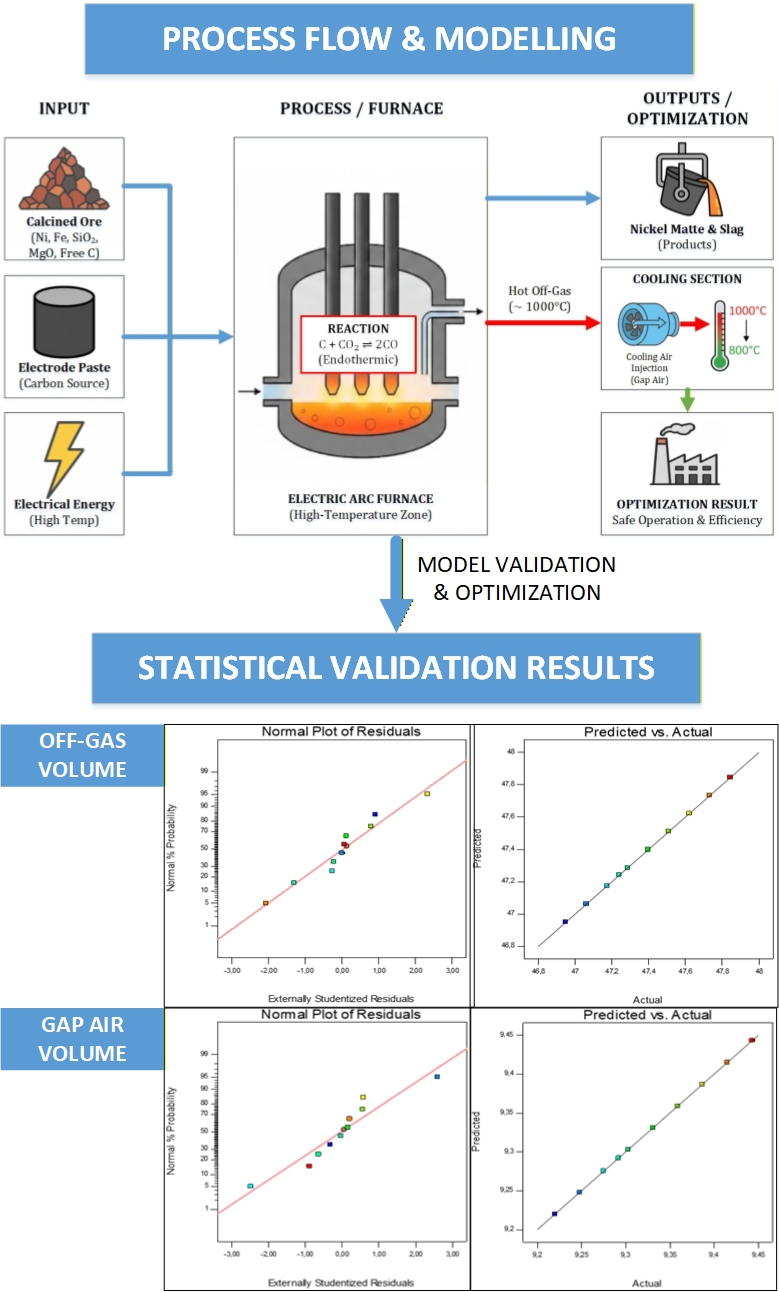
Exhaust gas emission management is a critical aspect of pyrometallurgical nickel smelting because it directly affects energy efficiency, operational safety, and overall process sustainability. This study investigates the influence of calcine carbon content on exhaust gas formation and determines the required cooling air volume in an industrial electric furnace operating at approximately 150 tons per hour. The research is based on deterministic mass and energy balance modelling developed from actual operational data obtained from a nickel smelting facility. The analysis quantifies the relationship between carbon oxidation reactions and off-gas generation during the smelting process. Results reveal a strong linear correlation between increasing calcine carbon content and exhaust gas volume. At an average carbon content of 1.96 %, the furnace produces 47,241 Nm³/h of exhaust gas. Under these operating conditions, a cooling air injection of 9,292 Nm³/h is required to reduce the gas temperature from 1000 °C to 800 °C in order to maintain safe furnace operation. The findings demonstrate that precise control of calcine carbon content and optimised cooling air design are essential for improving operational safety and efficiency in nickel smelting. The developed model provides a quantitative basis for designing safer and more efficient industrial off-gas control systems.
Downloads
Article Details
Section
Copyright © 2026 Sabrianah Badaruddin, Alif Nur Laili Rachmah, Muhammad Ikhsan Taipabu, Farida Diyah Hapsari, Esther Muatiara Santallum Ekklesia Tibalia

This work is licensed under a Creative Commons Attribution-ShareAlike 4.0 International License.
How to Cite




References
[1] Q. Fan, S. Yuan, J. Wen, and J. He, “Review on comprehensive utilization of nickel laterite ore,” Miner. Eng., vol. 218, p. 109044, Nov. 2024, doi: https://doi.org/10.1016/j.mineng.2024.109044.
[2] J. Li, T. Yu, C. Li, X. Han, and J. Gao, “Efficient and selective leaching of nickel and cobalt from nickel laterite ore by a combined atmospheric acid leaching-ferric chloride solution leaching process: optimization and mechanism,” RSC Adv., vol. 15, no. 36, pp. 29176–29189, Aug. 2025, doi: https://doi.org/10.1039/d5ra04469c.
[3] D. A. Quintero-Coronel et al., “Large- and Particle-Scale energy assessment of reduction roasting of nickel laterite ore for Ferronickel production via the rotary Kiln-Electric furnace process,” Thermal Science and Engineering Progress, vol. 32, p. 101331, Jul. 2022, doi: https://doi.org/10.1016/j.tsep.2022.101331.
[4] H. Tian, J. Pan, D. Zhu, C. Yang, Z. Guo, and Y. Xue, “Improved beneficiation of nickel and iron from a low-grade saprolite laterite by addition of limonitic laterite ore and CaCO3,” Journal of Materials Research and Technology, vol. 9, no. 2, pp. 2578–2589, Mar. 2020, doi: https://doi.org/10.1016/j.jmrt.2019.12.088.
[5] R. Sekaringgalih, A. Nur Laili Rachmah, S. Hakim Raharjo, and A. Ansori, “Synthesis and Characterization of Calcium Carbonate Precipitate from Eggshell Waste through Carbonation Method,” Jurnal Rekayasa Material, Manufaktur dan Energi, vol. 8, no. 2, 2025, doi: https://doi.org/10.30596/rmme.v8i2.24583.
[6] A. Aladin, T. Syarif, D. Darnengsih, S. Badaruddin, and N. Ridwan, “The Effect of Soaking Time on the Preservative Power of Katombong Fish in Grade 1 Corn Cob Liquid Smoke Solution from Pyrolysis Results,” Journal of Chemical Process Engineering, vol. 6, 2021, doi: https://doi.org/10.33536/jcpe.v6i2.819.
[7] A. N. L. Rachmah, B. Ruliana, S. Badaruddin, R. C. F. Ratumanan, and R. D. Hukubun, “The Effect of Corn Cob Ash Substitution as Pozzolan in Composite Portland Cement on the Compressive Strength of Mortar,” INSOLOGI: Jurnal Sains dan Teknologi, vol. 4, no. 4, pp. 860–872, Aug. 2025, doi: https://doi.org/10.55123/insologi.v4i4.6142.
[8] X. Zhao et al., “The role of reverse Boudouard reaction during integrated CO2 capture and utilisation via dry reforming of methane,” Chemical Engineering Journal, vol. 491, p. 151668, Jul. 2024, doi: https://doi.org/10.1016/j.cej.2024.151668.
[9] Y. Yan et al., “Carbon dioxide-focused greenhouse gas emissions from petrochemical plants and associated industries: Critical overview, recent advances and future prospects of mitigation strategies,” Process Safety and Environmental Protection, vol. 188, no. 10, pp. 406–421, Aug. 2024, doi: https://doi.org/10.1016/j.psep.2024.05.136.
[10] A. N. L. Rachmah, A. Fatmawati, and A. Widjaja, “Impact of surfactant-aided subcritical water pretreatment process conditions on the reducing sugar production from oil palm empty fruit bunch,” in IOP Conference Series: Earth and Environmental Science, IOP Publishing Ltd, Jan. 2022. doi: https://doi.org/10.1088/1755-1315/963/1/012005.
[11] S. Badaruddin, A. N. L. Rachmah, R. C. F. Ratumanan, R. D. Hukubun, and T. C. Trisnantari, “ Antioxidant Extraction Process from Kalanchoe pinnata Leaves: Study of the Effect of Particle Size and Maceration Kinetics,” INSOLOGI: Jurnal Sains dan Teknologi, vol. 4, no. 4, pp. 956–968, Aug. 2025, doi: https://doi.org/10.55123/insologi.v4i4.6183.
[12] S. Suherman, A. C. Kumoro, K. Anam, E. E. Susanto, and S. Badaruddin, “Development of Effervescent Tablets Based on Red Ginger (Zingiber Officinale Rosc. Var. Rubrum) And Rosella Flower (Hibiscus Sabdariffa L.),” Int. J. Adv. Res. (Indore)., vol. 9, no. 09, pp. 720–727, Sep. 2021, doi: https://doi.org/10.21474/IJAR01/13473.
[13] H. chuan Ren et al., “Modelling of copper matte smelting process with improved equilibrium constant method,” Transactions of Nonferrous Metals Society of China, vol. 35, no. 12, pp. 4281–4293, Dec. 2025, doi: https://doi.org/10.1016/S1003-6326(25)66944-5.
[14] O. V. Dickson, T. Deleau, F. Espitalier, C. Coquelet, and J. Lombart, “Multilevel factorial optimisation of Acid-to-Ore ratio and solids concentration in hydrometallurgical recovery of nickel from laterite ore,” Results in Engineering, vol. 27, p. 106744, Sep. 2025, doi: https://doi.org/10.1016/j.rineng.2025.106744.
[15] W. Chen et al., “Advances in graphene reinforced metal matrix nanocomposites: Mechanisms, processing, modelling, properties and applications,” Nanotechnology and Precision Engineering, vol. 3, no. 4, pp. 189–210, Dec. 2020, doi: https://doi.org/10.1016/j.npe.2020.12.003.
[16] M. Schneider, M. Steinhausen, H. Nicolai, and C. Hasse, “Modeling of effusion cooling air-flame interaction using thermochemical manifolds,” Proceedings of the Combustion Institute, vol. 40, no. 1–4, p. 105453, Jan. 2024, doi: https://doi.org/10.1016/j.proci.2024.105453.
[17] M. Greifenstein and A. Dreizler, “Influence of effusion cooling air on the thermochemical state of combustion in a pressurized model single sector gas turbine combustor,” Combust. Flame, vol. 226, pp. 455–466, Apr. 2021, doi: https://doi.org/10.1016/j.combustflame.2020.12.031.
[18] F. Shen, L. Ye, H. Guan, and Y. He, “Enhanced control structure design for an industrial off-gas system: Simple reconfigurations benefit the economy,” Heliyon, vol. 9, no. 1, p. e12934, Jan. 2023, doi: https://doi.org/10.1016/j.heliyon.2023.e12934.
[19] Y. Y. Ghadi et al., “Reconfiguration and displacement of DG and EVs in distribution networks using a hybrid GA–SFLA multi-objective optimization algorithm,” Front. Energy Res., vol. 11, p. 112101, Jan. 2023, doi: https://doi.org/10.3389/fenrg.2023.1304055.
[20] J. Xu et al., “Mechanism of solid–liquid reaction in magnesium smelting by silicothermic process,” Ceram. Int., vol. 50, no. 9, pp. 14830–14841, May 2024, doi: https://doi.org/10.1016/j.ceramint.2024.01.397.
[21] H. Long et al., “A critical review on metallurgical recovery of iron from iron ore tailings,” J. Environ. Chem. Eng., vol. 12, no. 2, p. 112140, Apr. 2024, doi: https://doi.org/10.1016/j.jece.2024.112140.
[22] H. chuan REN et al., “Modelling of copper matte smelting process with improved equilibrium constant method,” Transactions of Nonferrous Metals Society of China, vol. 35, no. 12, pp. 4281–4293, Dec. 2025, doi: https://doi.org/10.1016/S1003-6326(25)66944-5.
[23] S. Yuan, G. Reniers, and M. Yang, “Integrated management of safety and security barriers in chemical plants to cope with emerging cyber-physical attack risks under uncertainties,” Reliab. Eng. Syst. Saf., vol. 250, p. 110320, Oct. 2024, doi: https://doi.org/10.1016/j.ress.2024.110320.
[24] S. Safie and R. Khairil, “Regulatory, technical, and safety considerations for UAV-based inspection in chemical process plants: A systematic review of current practice and future directions,” Transp. Res. Interdiscip. Perspect., vol. 30, no. 3, p. 101343, Mar. 2025, doi: https://doi.org/10.1016/j.trip.2025.101343.
[25] C. Barón, J. Perpiñán, M. Bailera, and B. Peña, “Techno-economic assessment of glassmaking decarbonization through integration of calcium looping carbon capture and power-to-gas technologies,” Sustain. Prod. Consum., vol. 41, pp. 121–133, Oct. 2023, doi: https://doi.org/10.1016/j.spc.2023.07.029.
[26] J. Lehmusto et al., “Interactions of sulfur-containing gas with magnesia-chromite refractory in nickel flash smelting furnace,” Ceram. Int., vol. 51, no. 9, pp. 11363–11371, Apr. 2025, doi: https://doi.org/10.1016/j.ceramint.2024.12.555.
[27] G. Acquah, G. Abaka-Wood, W. Skinner, J. Addai-Mensah, and R. Asamoah, “Effect of mechanical activation on nickel and cobalt extraction in refractory nickel laterite ore,” Powder Technol., vol. 468, p. 121655, Jan. 2026, doi: https://doi.org/10.1016/j.powtec.2025.121655.
[28] X. Xuan, Y. Bai, G. Sikka, C. Weng, and X. Deng, “A land–water–energy–greenhouse gas nexus framework informs climate change mitigation in agriculture: A case study in the North China Plain,” Geography and Sustainability, vol. 6, no. 6, p. 100354, Dec. 2025, doi: https://doi.org/10.1016/j.geosus.2025.100354.
[29] A. Akbari, H. Sarvi, M. Maleki, S. Bahreyni, R. Azimi, and A. Radpour, “Characteristics, emissions, capture, storage, and utilization of carbon dioxide: A comprehensive review of challenges and technologies for greenhouse gas mitigation,” Petroleum Research, vol. 28, no. 20, Jul. 2025, doi: https://doi.org/10.1016/j.ptlrs.2025.07.001.