

Synthesis, In Vitro Antimicrobial Activity, and Molecular Docking Study of Novel Benzylidene Ketamine Analogues as Potential Elongation Factor Tu Inhibitors
Article Sidebar
Section
Issue
Published
Main Article Content
Abstract
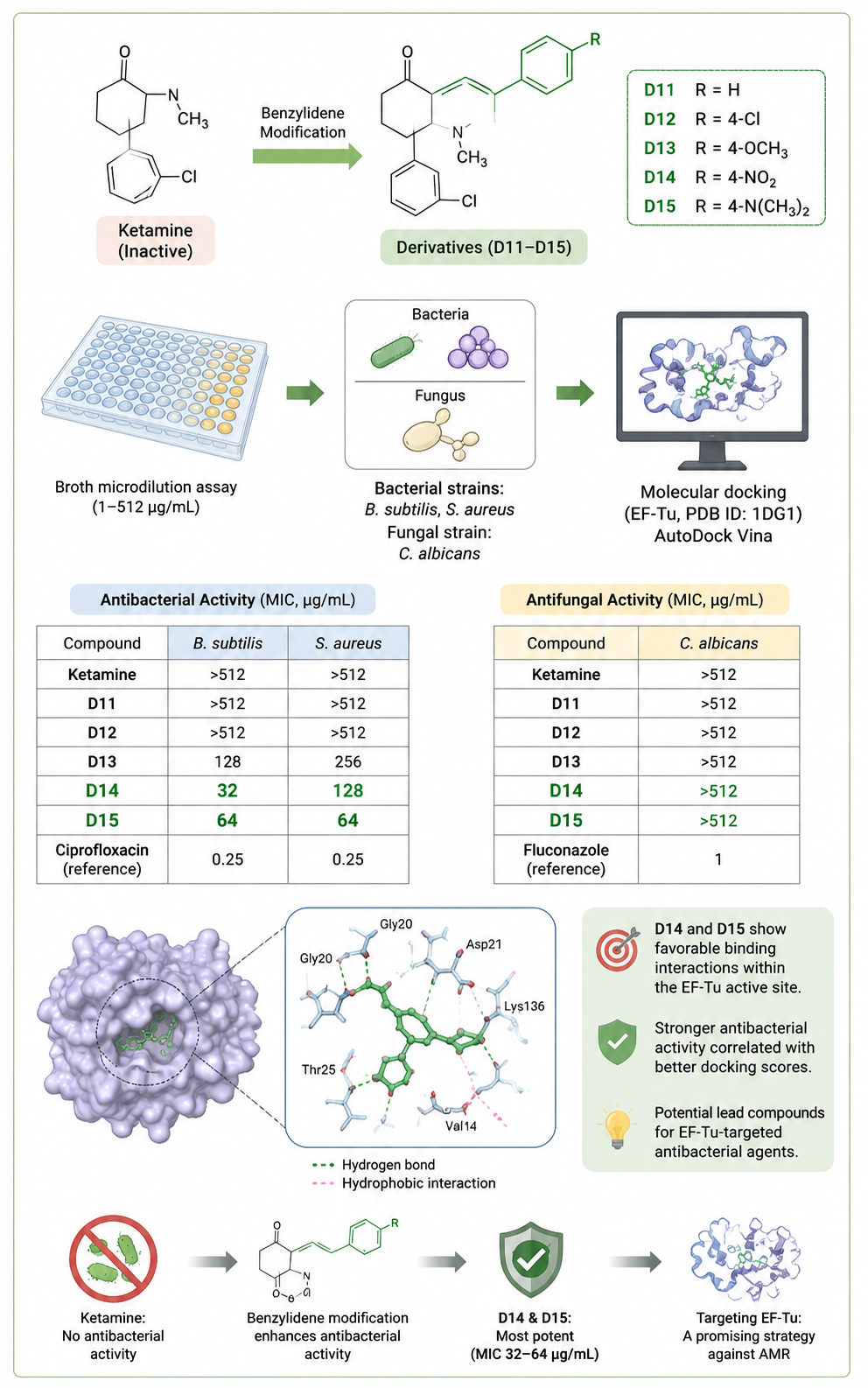
The rapid emergence of antimicrobial resistance (AMR) has become a critical global health challenge, leading to prolonged hospitalization, increased healthcare costs, and higher mortality rates. The declining efficacy of conventional antibiotics highlights the urgent need for novel antimicrobial agents with alternative mechanisms of action. This study evaluated the antimicrobial activity of newly synthesized benzylidene ketamine derivatives and explored their potential interactions with bacterial elongation factor Tu (EF-Tu), an essential protein involved in bacterial protein synthesis. Antibacterial and antifungal activities of ketamine and its derivatives (D11-D15) were determined using the broth microdilution method at concentrations ranging from 1 to 512 μg/mL. Ciprofloxacin and fluconazole served as reference antibacterial and antifungal agents, respectively. Molecular docking against EF-Tu (PDB ID: 1DG1) was performed using AutoDock Vina to predict ligand–protein binding affinity. Among the tested compounds, D14 and D15 exhibited the strongest antibacterial activities, with minimum inhibitory concentrations (MICs) of 32 μg/mL against Bacillus subtilis and 64 μg/mL against Staphylococcus aureus, respectively, whereas ketamine showed no detectable antibacterial activity. None of the synthesized compounds inhibited the growth of Candida albicans, while fluconazole displayed an MIC of 1 μg/mL. Docking analysis indicated favorable binding interactions between the active derivatives and the EF-Tu binding site. These findings suggest that benzylidene modification of ketamine enhances antibacterial activity and identifies D14 and D15 as promising lead compounds for the development of EF-Tu-targeted antibacterial agents.
How to Cite




Downloads
Copyright © 2026 Abraham Sisein Eboh, Azibanasamesa D. C. Owaba, Darlington D. Eboh, Okpenkuwo G. Francis, Charis Tiemo, Laura O. Edward

This work is licensed under a Creative Commons Attribution-ShareAlike 4.0 International License.
You are free to:
Share — copy and redistribute the material in any medium or format
Adapt — remix, transform, and build upon the material for any purpose, even commercially
Under the following terms:
Attribution — You must give appropriate credit, provide a link to the license, and indicate if changes were made. You may do so in any reasonable manner, but not in any way that suggests the licensor endorses you or your use.
ShareAlike — If you remix, transform, or build upon the material, you must distribute your contributions under the same license as the original
No additional restrictions — You may not apply legal terms or technological measures that legally restrict others from doing anything the license permits
References
[1] S. A. Hassan and M. N. Abdullah, “Synthesis of new 4-thiazolidinone bearing thiazole, assess anticancer, and antimicrobial activities: Insights from DFT, and molecular docking,” Journal of Molecular Structure, vol. 1346, p. 143181, Dec. 2025, https://doi.org/10.1016/j.molstruc.2025.143181.
[2] S. A. Hassan et al., “Synthesis and characterization of Azo-Azomethine derivatives bearing thiazole moiety: In vitro antimicrobial, in vitro and in vivo anti-inflammatory, and cytotoxicity assessment, accompanied by computational molecular docking, RDG, ELF, DFT, and MEP analysis,” Journal of Molecular Structure, vol. 1318, p. 139294, Dec. 2024, https://doi.org/10.1016/j.molstruc.2024.139294.
[3] U. Farwa and M. A. Raza, “Heterocyclic compounds as a magic bullet for diabetes mellitus: a review,” RSC Adv., vol. 12, no. 35, pp. 22951–22973, 2022, https://doi.org/10.1039/D2RA02697J.
[4] D. A. Elsayed et al., “Synthesis and radiolabelled evaluation of novel pyrimidine derivatives as dual α-amylase inhibitors and GIT-targeted molecular imaging probe,” RSC Adv., vol. 15, no. 36, pp. 29544–29559, 2025, https://doi.org/10.1039/D5RA04955E.
[5] K. A. Othman, S. G. Taher, and M. N. Abdullah, “Multicomponent synthesis, characterization, and dual antibacterial–wound healing activity of fluorescent benzylidene thiazolopyrimidinones with in silico evaluation,” Journal of Molecular Structure, vol. 1353, p. 144670, Feb. 2026, https://doi.org/10.1016/j.molstruc.2025.144670.
[6] W. Yu et al., “Cold plasma modification of natural polysaccharides: mechanisms, regulatory factors, and biological activity enhancement,” Food Chemistry, vol. 518, p. 149609, Jul. 2026, https://doi.org/10.1016/j.foodchem.2026.149609.
[7] Y. Xiao et al., “A comprehensive review of Stropharia rugosoannulata polysaccharides: Extraction methods, isolation and purification, structural features, chemical modification, biological activities, and application prospects,” Carbohydrate Research, vol. 566, p. 109980, Aug. 2026, https://doi.org/10.1016/j.carres.2026.109980.
[8] A. Mosca et al., “Treatment and management approaches for ketamine misuse: A systematic review of medical interventions,” Journal of Substance Use and Addiction Treatment, p. 210061, Jul. 2026, https://doi.org/10.1016/j.josat.2026.210061.
[9] S. Shenoy, V. S. Belle, R. N. Munoli, M. Sharma, and S. K. Praharaj, “Short-term effects of oral ketamine for the treatment of depression: A systematic review and meta-analysis of randomized controlled trials,” Asian Journal of Psychiatry, vol. 121, p. 105014, Jul. 2026, https://doi.org/10.1016/j.ajp.2026.105014.
[10] J. Zhao et al., “Low-dose ketamine inhibits neuronal apoptosis and neuroinflammation in PC12 cells via α7nAChR mediated TLR4/MAPK/NF-κB signaling pathway,” International Immunopharmacology, vol. 117, p. 109880, Apr. 2023, https://doi.org/10.1016/j.intimp.2023.109880.
Show All References (21 more)
[11] S. A. Hassan et al., “Synthesis and pharmacological profiling of mono imine Schiff bases: Dual anti-inflammatory and antibacterial activity with computational insights,” Journal of Molecular Structure, vol. 1351, p. 144096, Feb. 2026, https://doi.org/10.1016/j.molstruc.2025.144096.
[12] Afrasiyab, R. Zhou, K. Raziq, T. Xue, and D. Sun, “Photodynamic antibacterial therapy by metal complex mediators: A new promise for eliminating drug-Resistant infectious microorganisms,” Inorganica Chimica Acta, vol. 587, p. 122818, Nov. 2025, https://doi.org/10.1016/j.ica.2025.122818.
[13] I. Ali et al., “Synthesis and characterization of pyridine-based organic salts: Their antibacterial, antibiofilm and wound healing activities,” Bioorganic Chemistry, vol. 100, p. 103937, Jul. 2020, https://doi.org/10.1016/j.bioorg.2020.103937.
[14] G. Cai, J. Zhang, J. Jiao, Z. Du, and M. Yan, “Eukaryotic elongation factor 2 kinase (eEF2K): Mechanisms and pharmacological significance in metabolic diseases,” International Journal of Biological Macromolecules, vol. 356, p. 151385, Apr. 2026, https://doi.org/10.1016/j.ijbiomac.2026.151385.
[15] R. W. Mohammady et al., “Targeting eukaryotic elongation factor 2 (eEF2)/eEF2 kinase in neurological and neuropsychiatric Disorders: Mechanisms, therapeutic Implications, and translational challenges,” Brain Research, vol. 1886, p. 150368, Sep. 2026, https://doi.org/10.1016/j.brainres.2026.150368.
[16] J. W. A. Rossen, A. W. Friedrich, and J. Moran-Gilad, “Practical issues in implementing whole-genome-sequencing in routine diagnostic microbiology,” Clinical Microbiology and Infection, vol. 24, no. 4, pp. 355–360, Apr. 2018, https://doi.org/10.1016/j.cmi.2017.11.001.
[17] F. Liu, H. Wang, S. Cao, C. Jiang, and J. Hou, “Characterization of antibacterial activity and mechanisms of two linear derivatives of bactenecin,” LWT, vol. 107, pp. 89–97, Jun. 2019, https://doi.org/10.1016/j.lwt.2019.02.073.
[18] X. Jia et al., “Cross-interactions of aroma compounds in Magnolia biondii essential oil revealed by dual-ligand molecular docking and sensory evaluation,” Food Chemistry, vol. 524, p. 150275, Sep. 2026, https://doi.org/10.1016/j.foodchem.2026.150275.
[19] A. Zervosen, W.-P. Lu, Z. Chen, R. E. White, T. P. Demuth, and J.-M. Frère, “Interactions between Penicillin-Binding Proteins (PBPs) and Two Novel Classes of PBP Inhibitors, Arylalkylidene Rhodanines and Arylalkylidene Iminothiazolidin-4-ones,” Antimicrob Agents Chemother, vol. 48, no. 3, pp. 961–969, Mar. 2004, https://doi.org/10.1128/AAC.48.3.961-969.2004.
[20] F. Liu, H. Wang, S. Cao, C. Jiang, and J. Hou, “Characterization of antibacterial activity and mechanisms of two linear derivatives of bactenecin,” LWT, vol. 107, pp. 89–97, Jun. 2019, https://doi.org/10.1016/j.lwt.2019.02.073.
[21] H. Javid et al., “Metabolic profiling and antimicrobial activity of Bistorta amplexicaulis D. don by in-vitro implicated through computational studies,” Front. Pharmacol., vol. 16, p. 1575727, Jul. 2025, https://doi.org/10.3389/fphar.2025.1575727.
[22] M. F. Chellat, L. Raguž, and R. Riedl, “Targeting Antibiotic Resistance,” Angew Chem Int Ed, vol. 55, no. 23, pp. 6600–6626, Jun. 2016, https://doi.org/10.1002/anie.201506818.
[23] K. Majewska-Smolarek and A. Kowalewska, “Essential Oils as Green Antibacterial Modifiers of Polymeric Materials,” Polymers, vol. 17, no. 21, p. 2924, Oct. 2025, https://doi.org/10.3390/polym17212924.
[24] U. Kanjee, K. Ogata, and W. A. Houry, “Direct binding targets of the stringent response alarmone (p)ppGpp,” Molecular Microbiology, vol. 85, no. 6, pp. 1029–1043, Sep. 2012, https://doi.org/10.1111/j.1365-2958.2012.08177.x.
[25] W. R. Mir et al., “Molecular docking analysis and evaluation of the antimicrobial properties of the constituents of Geranium wallichianum D. Don ex Sweet from Kashmir Himalaya,” Sci Rep, vol. 12, no. 1, p. 12547, Jul. 2022, https://doi.org/10.1038/s41598-022-16102-9.
[26] C. Maracci and M. V. Rodnina, “Review: Translational GTPases,” Biopolymers, vol. 105, no. 8, pp. 463–475, Aug. 2016, https://doi.org/10.1002/bip.22832.
[27] J. Poziemski, A. Yurkevych, and P. Siedlecki, “Assessment of molecular dynamics time series descriptors in protein–ligand affinity prediction,” Digital Discovery, vol. 5, no. 4, pp. 1888–1899, 2026, https://doi.org/10.1039/D5DD00452G.
[28] Y. Wang, “SURFS and AlphaFold Reveal Ribosome Footprint Shift Caused by EF-Tu D81 Mutation”.
[29] J. W. Cruz, F. P. Rothenbacher, T. Maehigashi, W. S. Lane, C. M. Dunham, and N. A. Woychik, “Doc Toxin Is a Kinase That Inactivates Elongation Factor Tu,” Journal of Biological Chemistry, vol. 289, no. 11, pp. 7788–7798, Mar. 2014, https://doi.org/10.1074/jbc.M113.544429.
[30] G. Wang, Y. Kong, Y. Fu, G. Li, and C. Cao, “IHGCN-PLA: An interpretable heterogeneous graph convolutional network for protein–ligand binding affinity prediction with multimodal interaction fusion,” Journal of Biomedical Informatics, vol. 180, p. 105061, Aug. 2026, https://doi.org/10.1016/j.jbi.2026.105061.
[31] G. Wang, Y. Kong, Y. Fu, G. Li, and C. Cao, “IHGCN-PLA: An interpretable heterogeneous graph convolutional network for protein–ligand binding affinity prediction with multimodal interaction fusion,” Journal of Biomedical Informatics, vol. 180, p. 105061, Aug. 2026, https://doi.org/10.1016/j.jbi.2026.105061.