

The Effect of Impurities on Nickel Content In Ore Samples Using Oven and Roasted Preparation Methods
Article Sidebar
Section
Issue
Published
Main Article Content
Abstract
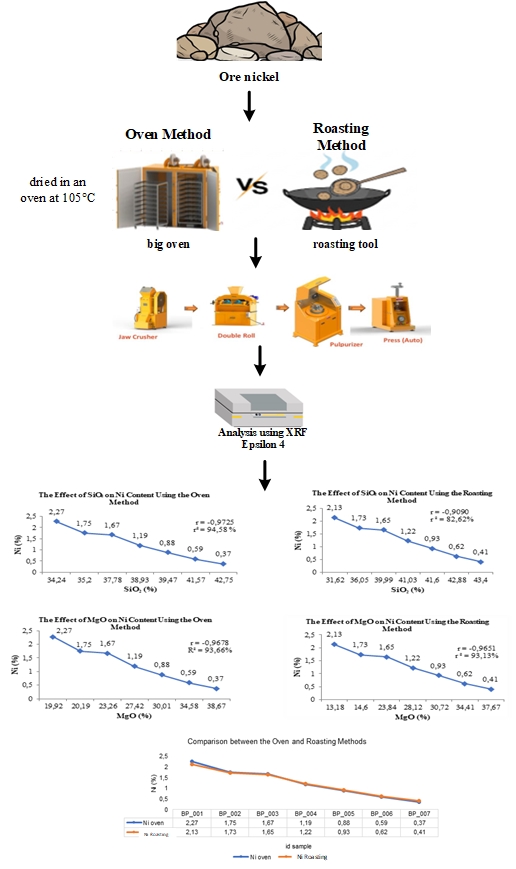
This research was conducted using two sample drying methods: the oven method and the roasting method. Elemental analysis was carried out using the X-Ray Fluorescence (XRF) Epsilon 4 instrument. The study investigated the influence of impurity metals on nickel (Ni) content, particularly the presence of silica (SiO₂) and magnesium oxide (MgO). The results showed that silica (SiO₂) plays a significant role in affecting nickel content. The higher the silica content, the lower the detected nickel content. This is supported by negative correlation coefficients of -0.9725 for the oven method and -0.9090 for the roasting method. The coefficients of determination were 94.58% and 82.62%, respectively, indicating a strong relationship between silica and nickel content. In addition, the relationship between MgO and Ni also showed a negative trend. An increase in MgO content was followed by a decrease in Ni content. The correlation coefficients were -0.9678 for the oven method and -0.9651 for the roasting method, with coefficients of determination of 93.66% and 93.13%. These results confirm a very strong influence of MgO on Ni content. A t-test was conducted to determine whether there was a significant difference between the two drying methods in nickel content measurement. The calculated t-value was 0.013, while the critical t-value was 2.18. Since the calculated value is lower, the null hypothesis (H₀) is accepted, indicating no significant difference between the oven and roasting methods
How to Cite




Downloads
Copyright © 2025 Aqilah Az zahirah, A. Eka Nur Afni Oktaviana

This work is licensed under a Creative Commons Attribution-ShareAlike 4.0 International License.
You are free to:
Share — copy and redistribute the material in any medium or format
Adapt — remix, transform, and build upon the material for any purpose, even commercially
Under the following terms:
Attribution — You must give appropriate credit, provide a link to the license, and indicate if changes were made. You may do so in any reasonable manner, but not in any way that suggests the licensor endorses you or your use.
ShareAlike — If you remix, transform, or build upon the material, you must distribute your contributions under the same license as the original
No additional restrictions — You may not apply legal terms or technological measures that legally restrict others from doing anything the license permits