

Calibration-Based Screening of Diethyl Ether Concentration during Ethanol Dehydration over CuO/ZnO/γ-Al₂O₃
Article Sidebar
Section
Issue
Published
Main Article Content


Abstract
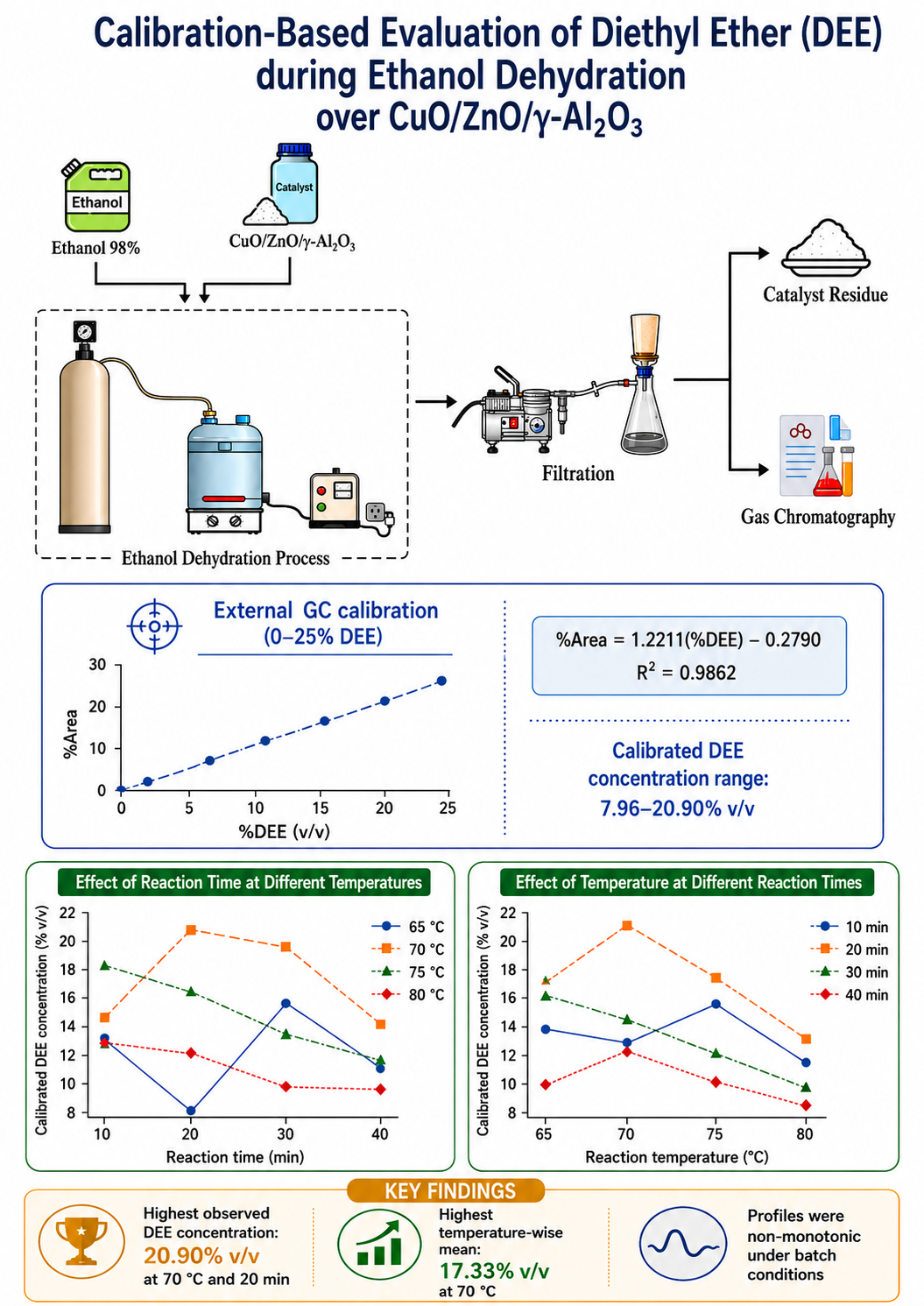
Diethyl ether (DEE) is a valuable solvent and fuel additive produced by catalytic ethanol dehydration, but many reported studies use vapor-phase reactors operated above 80 0C. This study evaluated the DEE concentration obtained from liquid-phase ethanol dehydration over a CuO/ZnO/γ-Al₂O₃ catalyst in a batch reactor at lower temperatures. Each run used 500 mL of absolute ethanol and 15 g of catalyst (nominal mass ratio 1:1:1) in a 5 L reactor pressurized with nitrogen to an initial 2 bar, at 65, 70, 75, and 80 0C for 10-40 min. DEE in the liquid product was quantified by gas chromatography with a flame ionization detector (GC-FID) using a six-level external calibration over 0-25% (v/v), with a linear calibration relationship (%Area = 1.2211(%DEE) - 0.2790; R² = 0.9862). Single determinations at the 16 operating conditions gave calibrated DEE concentrations of 7.96-20.90% (v/v). The highest observed concentration was recorded at 70 0C and 20 min, and 70 0C also gave the highest descriptive mean across the four reaction times (17.33% v/v), whereas longer reaction times did not consistently increase the DEE concentration. These results provide a calibration-based screening of DEE concentration in liquid products at 65-80 0C and identify 70 0C as the condition to prioritize in replicate experiments. Conversion, selectivity, and replicate-based statistics require a complete product balance and replicate experiments in future work.
How to Cite




Downloads
Copyright © 2026 Alif Nur Laili Rachmah, Sabrianah Badaruddin, Muhammad Ikhsan Taipabu, Farida Diyah Hapsari, Esther Mutiara Santallum Ekklesia Tibalia

This work is licensed under a Creative Commons Attribution-ShareAlike 4.0 International License.
You are free to:
Share — copy and redistribute the material in any medium or format
Adapt — remix, transform, and build upon the material for any purpose, even commercially
Under the following terms:
Attribution — You must give appropriate credit, provide a link to the license, and indicate if changes were made. You may do so in any reasonable manner, but not in any way that suggests the licensor endorses you or your use.
ShareAlike — If you remix, transform, or build upon the material, you must distribute your contributions under the same license as the original
No additional restrictions — You may not apply legal terms or technological measures that legally restrict others from doing anything the license permits
References
[1] T. K. Phung and G. Busca, “Diethyl ether cracking and ethanol dehydration: Acid catalysis and reaction paths,” Chem. Eng. J., vol. 272, pp. 92–101, 2015. https://doi.org/10.1016/j.cej.2015.03.008
[2] T. Kamsuwan, P. Praserthdam, and B. Jongsomjit, “Diethyl ether production during catalytic dehydration of ethanol over Ru- and Pt-modified H-beta zeolite catalysts,” J. Oleo Sci., vol. 66, no. 2, pp. 199–207, 2017. https://doi.org/10.5650/jos.ess16108
[3] D. H. Qi, H. Chen, L. M. Geng, and Y. Z. Bian, “Effect of diethyl ether and ethanol additives on the combustion and emission characteristics of biodiesel-diesel blended fuel engine,” Renew. Energy, vol. 36, no. 4, pp. 1252–1258, 2011. https://doi.org/10.1016/j.renene.2010.09.021
[4] C. Kumar, “A biomass-derived ternary fuel approach for reducing urban diesel engine emissions: Experimental assessment of diesel-diethyl ether-ethanol blends,” Sustain. Cities Soc. Adv., vol. 2, p. 100058, 2026. https://doi.org/10.1016/j.scsadv.2026.100058
[5] A. I. EL-Seesy, A. S. Attia, R. M. EL-Zohairy, and M. I. H. Ali, “Solubility and combustion characterization of methanol/Jet A-1 blends enhanced with n-octanol and diethyl ether in lean prevaporized premixed burner,” Fuel Process. Technol., vol. 276, p. 108278, 2025. https://doi.org/10.1016/j.fuproc.2025.108278
[6] J. K. Pandey, G. Varghese, S. K, and A. Kumari, “Studying the behavior of ethanol-diethyl ether-based flex fuels in a direct injection SI engine,” Energy, vol. 336, p. 138390, 2025. https://doi.org/10.1016/j.energy.2025.138390
[7] B. Hoblos, Z. Serinyel, G. Dayma, and P. Dagaut, “Enhancing cool-flame oxidation of cyclic ethers via linear ether addition: A case study on tetrahydrofuran and diethyl ether in a jet-stirred reactor,” Proc. Combust. Inst., vol. 42, p. 106230, 2026. https://doi.org/10.1016/j.proci.2026.106230
[8] M. Zhou, Y. Suzuki, and M. Lee, “Species-dependent NTC behavior during the evolution of wall-stabilized diethyl ether cool flames,” Proc. Combust. Inst., vol. 42, p. 106240, 2026. https://doi.org/10.1016/j.proci.2026.106240
[9] E. Chaichana, N. Boonsinvarothai, N. Chitpong, and B. Jongsomjit, “Catalytic dehydration of ethanol to ethylene and diethyl ether over alumina catalysts containing different phases with boron modification,” J. Porous Mater., vol. 26, pp. 599–610, 2019. https://doi.org/10.1007/s10934-018-0663-7
[10] D. Varisli, T. Dogu, and G. Dogu, “Ethylene and diethyl-ether production by dehydration reaction of ethanol over different heteropolyacid catalysts,” Chem. Eng. Sci., vol. 62, no. 18–20, pp. 5349–5352, 2007. https://doi.org/10.1016/j.ces.2007.01.017
Show All References (20 more)
[11] C. Autthanit, N. Likitpiriya, P. Praserthdam, and B. Jongsomjit, “Development of a new ternary Al2O3-HAP-Pd catalyst for diethyl ether and ethylene production using the preferential dehydration of ethanol,” ACS Omega, vol. 6, pp. 19911–19923, 2021. https://doi.org/10.1021/acsomega.1c02818
[12] J. F. DeWilde, H. Chiang, D. A. Hickman, C. R. Ho, and A. Bhan, “Kinetics and mechanism of ethanol dehydration on gamma-Al2O3: The critical role of dimer inhibition,” ACS Catal., vol. 3, no. 4, pp. 798–807, 2013. https://doi.org/10.1021/cs400051k
[13] H. Chiang and A. Bhan, “Catalytic consequences of hydroxyl group location on the rate and mechanism of parallel dehydration reactions of ethanol over acidic zeolites,” J. Catal., vol. 271, no. 2, pp. 251–261, 2010. https://doi.org/10.1016/j.jcat.2010.01.021
[14] K. Wijaya et al., “Effectively synthesizing SO4/TiO2 catalyst and its performance for converting ethanol into diethyl ether (DEE),” Catalysts, vol. 11, no. 12, p. 1492, 2021. https://doi.org/10.3390/catal11121492
[15] A. Swies, A. Kowalczyk, B. Gil, and L. Chmielarz, “Dehydration of methanol and ethanol over ferrierite originated layered zeolites-the role of acidity and porous structure,” RSC Adv., vol. 12, no. 15, pp. 9395–9403, 2022. https://doi.org/10.1039/D2RA00334A
[16] D. T. Sarve, S. K. Singh, and J. D. Ekhe, “Ethanol dehydration to diethyl ether over ZSM-5 and beta-zeolite supported Ni-W catalyst,” Inorg. Chem. Commun., vol. 139, p. 109397, 2022. https://doi.org/10.1016/j.inoche.2022.109397
[17] A. Rahmanian and H. S. Ghaziaskar, “Continuous dehydration of ethanol to diethyl ether over aluminum phosphate-hydroxyapatite catalyst under sub- and supercritical condition,” J. Supercrit. Fluids, vol. 78, pp. 34–41, 2013. https://doi.org/10.1016/j.supflu.2013.03.021
[18] T. K. R. de Oliveira, M. Rosset, and O. W. Perez-Lopez, “Ethanol dehydration to diethyl ether over Cu-Fe/ZSM-5 catalysts,” Catal. Commun., vol. 104, pp. 32–36, 2018. https://doi.org/10.1016/j.catcom.2017.10.013
[19] R. Suerz et al., “Application of microreactor technology to dehydration of bio-ethanol,” Chem. Eng. Sci., vol. 229, p. 116030, 2021. https://doi.org/10.1016/j.ces.2020.116030
[20] P. D. Srinivasan, K. Khivantsev, J. M. M. Tengco, H. Zhu, and J. J. Bravo-Suarez, “Enhanced ethanol dehydration on gamma-Al2O3 supported cobalt catalyst,” J. Catal., vol. 373, pp. 276–296, 2019. https://doi.org/10.1016/j.jcat.2019.03.024
[21] M. Limlamthong, N. Chitpong, and B. Jongsomjit, “Influence of phosphoric acid modification on catalytic properties of Al2O3 catalysts for dehydration of ethanol to diethyl ether,” Bull. Chem. React. Eng. Catal., vol. 14, no. 1, pp. 1–8, 2019. https://doi.org/10.9767/bcrec.14.1.2436.1-8
[22] A. P. Kagyrmanova, V. A. Chumachenko, V. N. Korotkikh, V. N. Kashkin, and A. S. Noskov, “Catalytic dehydration of bioethanol to ethylene: Pilot-scale studies and process simulation,” Chem. Eng. J., vol. 176–177, pp. 188–194, 2011. https://doi.org/10.1016/j.cej.2011.06.049
[23] C. Autthanit, C. Khaochartchai, P. Praserthdam, and B. Jongsomjit, “Elucidation of Pd modification effect on catalytic behaviors of gamma-Al2O3-P catalysts toward ethanol dehydration and dehydrogenation,” Catal. Commun., vol. 148, p. 106169, 2021. https://doi.org/10.1016/j.catcom.2020.106169
[24] L. Kuterasinski, U. Filek, M. Gackowski, M. Zimowska, M. Ruggiero-Mikolajczyk, and P. J. Jodlowski, “Sonochemically prepared hierarchical MFI-type zeolites as active catalysts for catalytic ethanol dehydration,” Ultrason. Sonochem., vol. 74, p. 105581, 2021. https://doi.org/10.1016/j.ultsonch.2021.105581
[25] R. A. Pratika et al., “The potency of hydrothermally prepared sulfated silica (SO4/SiO2) as a heterogeneous acid catalyst for ethanol dehydration into diethyl ether,” Chemosphere, vol. 341, p. 139822, 2023. https://doi.org/10.1016/j.chemosphere.2023.139822
[26] I. A. Muna, F. Kurniawansyah, M. Mahfud, and A. Roesyadi, “Temperature and Cr-Co ratio on Production of Diethyl Ether from Ethanol Dehydration using Cr-Co/γ-Al2O3 Catalyst,” Bull. Chem. React. Eng. Catal., vol. 19, no. 4, pp. 658–667, 2024. https://doi.org/10.9767/bcrec.20237
[27] A. Chumaidi, D. Moentamaria, and A. Murdani, “Dehidrasi metanol menjadi dimetil eter dengan memodifikasi katalis CuO-ZnO/gamma-Al2O3,” in Proc. SENTIA 2016, 2016, pp. G1–G6.
[28] A. Chumaidi, D. Moentamaria, and H. Dewajani, “Pemodelan kinetika reaksi seri etana-etanol-dietil eter,” in Proc. Seminar Nasional Teknik Kimia Kejuangan, Yogyakarta, Indonesia, 2019, pp. E7-1–E7-8.
[29] F. Bressolle, M. Bromet-Petit, and M. Audran, “Validation of liquid chromatographic and gas chromatographic methods. Applications to pharmacokinetics,” J. Chromatogr. B Biomed. Sci. Appl., vol. 686, no. 1, pp. 3–10, 1996. https://doi.org/10.1016/S0378-4347(96)00088-6
[30] M. Rambla-Alegre, J. Esteve-Romero, and S. Carda-Broch, “Is it really necessary to validate an analytical method or not? That is the question,” J. Chromatogr. A, vol. 1232, pp. 101–109, 2012. https://doi.org/10.1016/j.chroma.2011.10.050