
Reduced-Order Modeling, Hopf Bifurcation, and Bifurcation-Aware Optimal Control in Nonlinear Reacting Fluid Systems

Article Sidebar
Main Article Content


Abstract
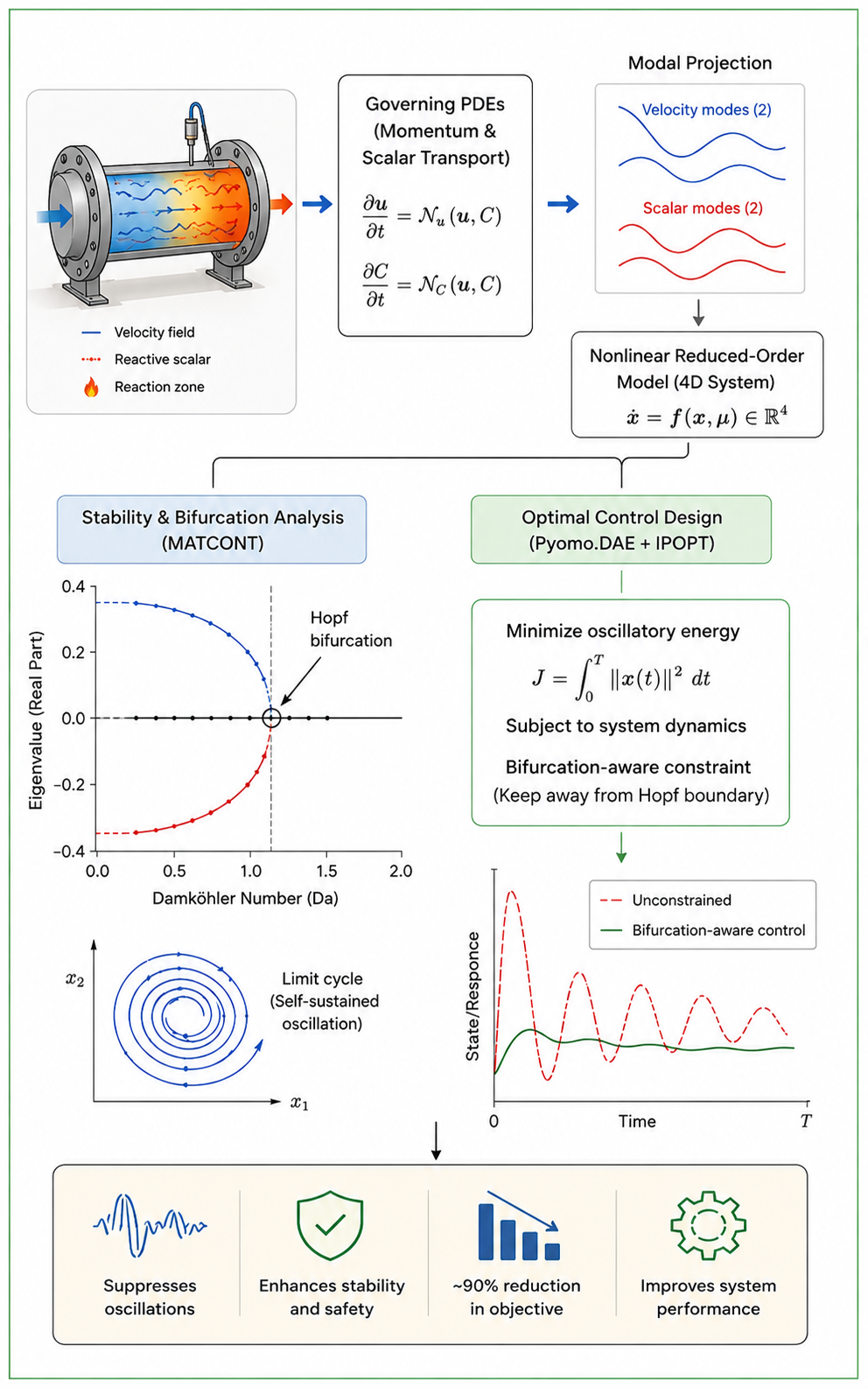
Oscillatory instabilities arising from the nonlinear interaction of reaction and transport processes can significantly degrade the performance, stability, and safety of reacting fluid systems. Reduced-order models provide an efficient framework for capturing the essential nonlinear dynamics while enabling systematic bifurcation analysis and optimal control design. A nonlinear reduced-order framework is developed by projecting the governing partial differential equations describing coupled momentum and scalar transport onto a low-dimensional modal basis, resulting in a four-dimensional dynamical system with two velocity modes and two reactive scalar modes. Stability and bifurcation analyses are performed using MATCONT to identify Hopf bifurcation points and limit cycle dynamics. An optimal control problem is subsequently formulated in Pyomo.DAE and solved using IPOPT to minimize oscillatory energy while incorporating a bifurcation-aware constraint that prevents operation near the Hopf boundary. The bifurcation analysis identifies a Hopf bifurcation at a critical Damköhler number, where a complex conjugate pair of eigenvalues crosses the imaginary axis. The optimal control results demonstrate that incorporating the Hopf bifurcation avoidance constraint suppresses oscillatory dynamics, achieving approximately a 90% reduction in the objective function compared with the unconstrained formulation. The proposed reduced-order modeling and control framework provides a low-dimensional, physically motivated representation for investigating oscillatory instabilities in reacting fluid systems. Integrating bifurcation analysis with optimal control provides a computational strategy for maintaining stable operation and suppressing self-sustained oscillations. The present model is intended as a conceptual proof-of-principle framework; validation against full-resolution simulations or experimental reacting-flow data remains an important direction for future work.
Downloads
Article Details
Section
Copyright © 2026 Lakshmi Sridhar

This work is licensed under a Creative Commons Attribution-ShareAlike 4.0 International License.
How to Cite




References
[1] C. Meneveau and J. Katz, “Scale-invariance and turbulence models for large-eddy simulation,” Annual Review of Fluid Mechanics, vol. 32, pp. 1-32, 2000.
[2] Z. Warhaft, “Passive scalar in turbulent flows,” Annual Review of Fluid Mechanics, vol. 32, pp. 203–240, 2000.
[3] N. Peters, “Turbulent Combustion”. Cambridge, U.K.: Cambridge University Press, 2000.
[4] S. B. Pope, “Turbulent Flows”. Cambridge, U.K.: Cambridge University Press, 2000.
[5] S. R. Turns, “An Introduction to Combustion”. New York, NY, USA: McGraw-Hill, 2000.
[6] T. Poinsot and D. Veynante, “Theoretical and Numerical Combustion”. Philadelphia, PA, USA: R. T. Edwards Publishing, 2001.
[7] R. O. Fox, “Computational Models for Turbulent Reacting Flows”. Cambridge, U.K.: Cambridge University Press, 2003.
[8] D. Veynante and L. Vervisch, “Turbulent combustion modeling,” Progress in Energy and Combustion Science, vol. 28, pp. 193-266, 2002.
[9] D. Livescu and C. Madnia, “Flame-turbulence interaction in compressible flow,” Physics of Fluids, vol. 14, pp. 2367–2378, 2002.
[10] C. Meneveau and J. Katz, “Large eddy simulation of turbulence,” Annual Review of Fluid Mechanics, vol. 32, pp. 1–32, 2000.
[11] S. B. Pope, “Laminar flamelet models for mixing and reaction,” Combustion Theory and Modelling, vol. 8, pp. 1–33, 2004.
[12] L. Selle *et al.*, “Coupling chemistry and turbulence in reacting flows,” Combustion and Flame, vol. 137, pp. 489–505, 2004.
[13] N. Peters, “Turbulent combustion fundamentals,” Proceedings of the Combustion Institute, vol. 29, pp. 1–25, 2001.
[14] E. R. Hawkes and J. H. Chen, “Direct numerical simulation of hydrogen-air flames,” Combustion and Flame, vol. 144, pp. 112-136, 2006.
[15] H. Pitsch, “Large-eddy simulation of turbulent combustion,” Annual Review of Fluid Mechanics, vol. 38, pp. 453–482, 2006.
[16] C. K. Law, “Combustion Physics”. Cambridge, U.K.: Cambridge University Press, 2006.
[17] J. Warnatz, U. Maas, and R. W. Dibble, “Combustion: Physical and Chemical Fundamentals, Modeling and Simulation, Experiments, Pollutant Formation”. Berlin, Germany: Springer, 2006.
[18] J. F. Driscoll, “Turbulent premixed combustion: Flame structure and quenching,” Progress in Energy and Combustion Science, vol. 34, pp. 91–134, 2008.
[19] A. J. Aspden, M. S. Day, and J. B. Bell, “Turbulent premixed combustion in thin reaction zones,” Journal of Fluid Mechanics, vol. 660, pp. 457–494, 2010.
[20] G. Bruneaux, “Scalar transport in reacting flows,” Combustion and Flame, vol. 154, pp. 625–638, 2008.
[21] A. Donini and D. Veynante, “Scalar dissipation in turbulent reacting flows,” Combustion and Flame, vol. 156, pp. 200–215, 2009.
[22] S. Balachandar and J. K. Eaton, “Turbulent dispersed multiphase flow,” Annual Review of Fluid Mechanics, vol. 42, pp. 111-133, 2010.
[23] N. Peters, “Reaction zones in turbulent combustion,” Combustion and Flame, vol. 157, pp. 129–145, 2010.
[24] J. H. Chen, “Petascale direct numerical simulation of turbulent combustion,” Proceedings of the Combustion Institute, vol. 33, pp. 99-123, 2011.
[25] T. Poinsot and D. Veynante, “Theoretical and Numerical Combustion”, 3rd ed. Toulouse, France: R. T. Edwards Publishing, 2011.
[26] S. B. Pope, “Self-conditioned fields for turbulent reacting flows,” Journal of Fluid Mechanics, vol. 719, pp. 154–194, 2013.
[27] N. Peters, “Turbulent combustion review,” Combustion and Flame, vol. 157, pp. 1–25, 2013.
[28] C. Celis and L. F. F. da Silva, “Lagrangian mixing models for turbulent combustion,” Flow, Turbulence and Combustion, vol. 94, pp. 643–689, 2015.
[29] O. B. Shende and A. Mani, “Closures for multi-component reacting flows,” arXiv preprint arXiv:2111.10551, 2021.
[30] A. Dhooge, W. Govaerts, and Y. A. Kuznetsov, “MATCONT: A MATLAB package for numerical bifurcation analysis of ODEs,” ACM Transactions on Mathematical Software, vol. 29, no. 2, pp. 141–164, 2003.
[31] Y. A. Kuznetsov,. “Elements of Applied Bifurcation Theory”, 2nd ed. New York, NY, USA: Springer, 1998.
[32] W. J. F. Govaerts, “Numerical Methods for Bifurcations of Dynamical Equilibria”. Philadelphia, PA, USA: Society for Industrial and Applied Mathematics (SIAM), 2000.
[33] W. E. Hart, C. D. Laird, J.-P. Watson, D. L. Woodruff, G. A. Hackebeil, B. L. Nicholson, and J. D. Siirola, Pyomo-Optimization Modeling in Python, 2nd ed., vol. 67. Cham, Switzerland: Springer, 2017.
[34] A. Wächter and L. T. Biegler, “On the implementation of an interior-point filter line-search algorithm for large-scale nonlinear programming,” Mathematical Programming, vol. 106, pp. 25–57, 2006, https://doi.org/10.1007/s10107-004-0559-y
[35] C. Huang, K. Duraisamy, and C. L. Merkle, “Investigations and improvement of robustness of reduced-order models of reacting flow,” AIAA Journal, vol. 57, no. 4, pp. 1–13, 2019, https://doi.org/10.2514/1.J058392
[36] M. Ihme, “Requirements towards predictive simulations of turbulent reacting flows,” Annual Review of Fluid Mechanics, vol. 52, pp. 1–31, 2020.
[37] C. R. Wentland and K. Duraisamy, “PERFORM: A Python package for developing reduced-order models for reacting fluid flows,” Journal of Open Source Software, vol. 7, no. 79, p. 3428, 2022, https://doi.org/10.21105/joss.03428
[38] K. Zdybał, M. R. Malik, A. Coussement, J. C. Sutherland, and A. Parente, “Reduced-order modeling of reacting flows using data-driven approaches,” in Machine Learning and Its Applications to Reacting Flows, Lecture Notes in Energy. Cham, Switzerland: Springer, pp. 245–278, 2023, https://doi.org/10.1007/978-3-031-16248-0_9
[39] M. R. Malik, R. Khamedov, F. E. Hernández Pérez, A. Coussement, A. Parente, and H. G. Im, “Dimensionality reduction and unsupervised classification for high-fidelity reacting flow simulations,” Proceedings of the Combustion Institute, vol. 39, no. 4, pp. 5155–5163, 2023, https://doi.org/10.1016/j.proci.2022.06.017