
Optimization of Biodegradable Films from Avocado Seed Starch Using Response Surface Methodology

Article Sidebar
Main Article Content


Abstract
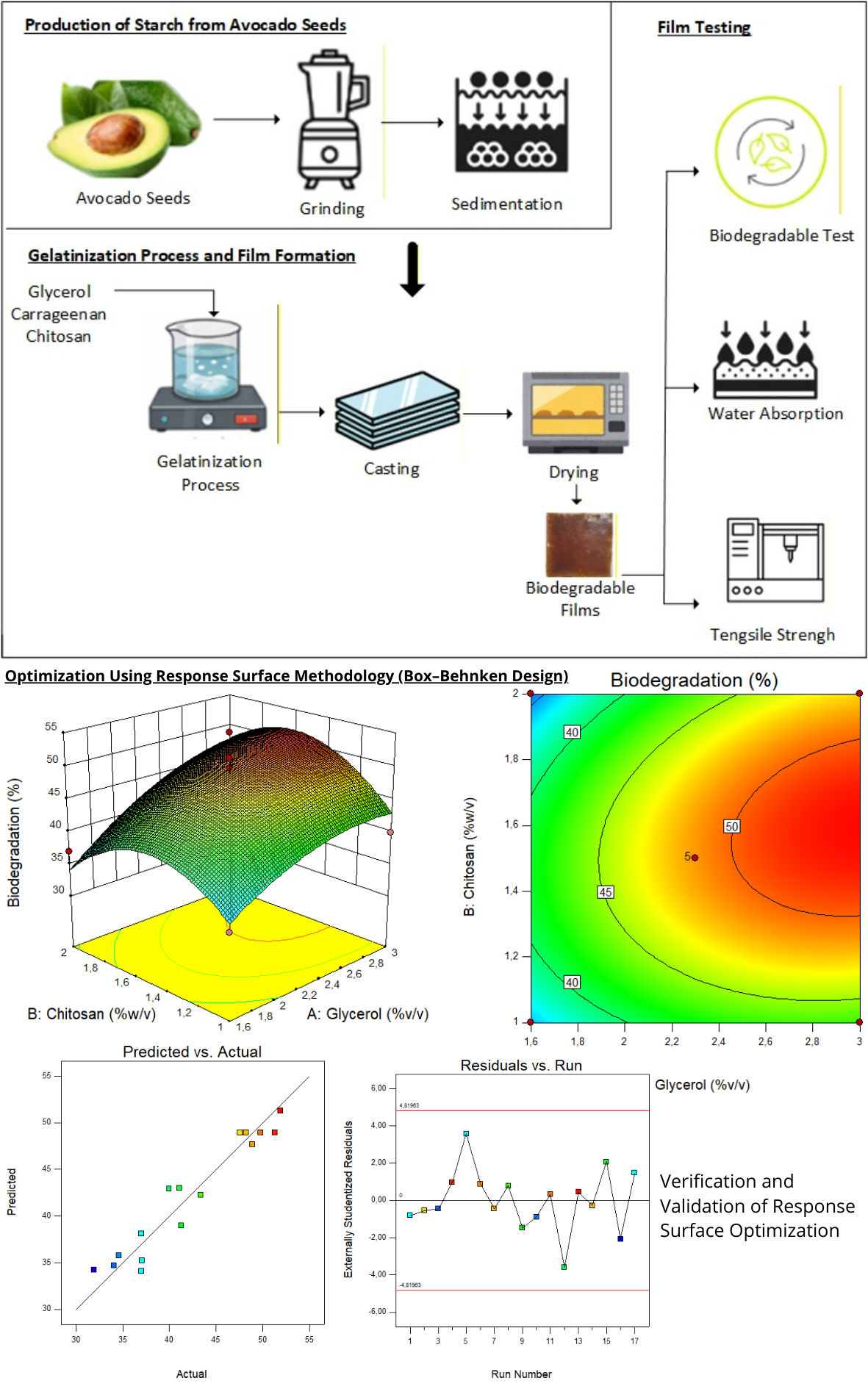
This study aimed to develop and optimize biodegradable films based on avocado seed starch (Persea americana) using glycerol as a plasticizer and chitosan and carrageenan as fillers. The film formulation was optimized using Response Surface Methodology (RSM) with a Box–Behnken Design to evaluate the effects of formulation variables on biodegradability and mechanical properties. The biodegradability values ranged from 31.93 % to 51.94 %, indicating that all films were biodegradable. Increasing glycerol and carrageenan concentrations significantly increased biodegradability, while higher chitosan concentration improved tensile strength but reduced biodegradability. The optimal formulation was obtained at 2.96 % glycerol, 1.56 % chitosan, and 2.85 % carrageenan, with a predicted biodegradability of 53.11 %. The results indicate a trade-off between mechanical strength and biodegradability, where higher plasticizer content enhances degradation but reduces tensile strength. This study demonstrates that RSM optimization is effective in producing biodegradable films with balanced mechanical and environmental performance, highlighting the potential of avocado seed starch as a sustainable packaging material.
Downloads
Article Details
Section
Copyright © 2026 Alif Nur Laili Rachmah, Sabrianah Badaruddin, Tamaratritania Citta Trisnantari, Geraldi Rahanra, Ratri Sekaringgalih

This work is licensed under a Creative Commons Attribution-ShareAlike 4.0 International License.
How to Cite




References
[1] A. N. Huda, M. Asfar, F. Bastian, and A. Syarifuddin, “Extraction of fish oil from Sardinella longiceps and pectin from Dillenia serrata fruit peel and theirs usage in gum Arabic edible film,” Food Chem. Adv., vol. 7, no. May, 2025, doi: https://doi.org/10.1016/j.focha.2025.101026.
[2] D. Merino, L. Bertolacci, U. C. Paul, R. Simonutti, and A. Athanassiou, “Avocado Peels and Seeds: Processing Strategies for the Development of Highly Antioxidant Bioplastic Films,” ACS Appl. Mater. Interfaces, vol. 13, no. 32, pp. 38688–38699, 2021, doi: https://doi.org/10.1021/acsami.1c09433.
[3] S. W. I. Marcet and M. R. M. Díaz, “Edible Films from the Laboratory to Industry : A Review of the Different Production Methods,” Food Bioprocess Technol., pp. 3245–3271, 2025, doi: https://doi.org/10.1007/s11947-024-03641-4
[4] A. Ansori, A. N. L. Rachmah, and R. Sekaringgalih, “ Making Biodegradable Film from Avocado Seeds (Persea Americana): Optimization with Box-Behnken Design,” J. Teknol. Kim. Miner., vol. 3, no. 1, pp. 43–52, 2024, doi: https://doi.org/10.61844/jtkm.v3i1.833.
[5] Suhartini et al., “Synthesis and Characterization of Nano Chitosan-Avocado Seed Starch As Edible Films,” J. Kim. Ris., vol. 8, no. 1, pp. 49–58, 2023, doi: https://doi.org/10.20473/jkr.v8i1.43394.
[6] I. Usman et al., “Recent progress in edible films and coatings: Toward green and sustainable food packaging technologies,” Appl. Food Res., vol. 5, no. 2, p. 101070, 2025, doi: https://doi.org/10.1016/j.afres.2025.101070.
[7] E. Susilowati and A. E. Lestari, “Preparation of chitosan-avocado seed starch (CASS) edible film as jenang dodol packaging,” AIP Conf. Proc., vol. 2194, 2019, doi: https://doi.org/10.1063/1.5139855.
[8] N. A. Taslim et al., “Functional food candidate from Indonesian green algae Caulerpa racemosa (Försskal) J. Agardh by two extraction methods: Metabolite profile, antioxidant activity, and cytotoxic properties,” J. Agric. Food Res., vol. 18, no. November, 2024, doi: https://doi.org/10.1016/j.jafr.2024.101513.
[9] N. Orellana, E. Sánchez, D. Benavente, P. Prieto, J. Enrione, and C. A. Acevedo, “A new edible film to produce in vitro meat,” Foods, vol. 9, no. 2, pp. 1–14, 2020, doi: https://doi.org/10.3390/foods9020185.
[10] E. Díaz-Montes and R. Castro-Muñoz, “Películas y recubrimientos comestibles como conservantes de calidad alimentaria: una visión general,” Foods, vol. 10, no. 2, pp. 1–26, 2021.
[11] N. Rasidi, T. Rochman, S. Sumardi, and F. Purnomo, “Structural behavior of lightweight interlocking brick system,” IOP Conf. Ser. Mater. Sci. Eng., vol. 732, no. 1, 2020, doi: https://doi.org/10.1088/1757-899X/732/1/012026.
[12] I. Dewi et al., “Anthocyanin extraction from roselle ( Hibiscus sabdariffa L .) calyces : A microwave-assisted approach using Box-Behnken design,” J. Agric. Food Res., vol. 18, no. August, p. 101480, 2024, doi: https://doi.org/10.1016/j.jafr.2024.101480.
[13] M. Ulum, M. F. F. Mu’tamar, and A. Asfan, “Characteristics of Edible Film Made from a Combination of Avocado Seed Starch (Persea Americana Mill.) and Corn Starch (Amilum maydis),” Rekayasa, vol. 11, no. 2, p. 132, 2018, doi: https://doi.org/10.21107/rekayasa.v11i2.4419.
[14] A. Hartanti, M. N. Wahyudi, M. F. Hakim, A. R. Aeni, and D. A. Sari, “Characterization of Biodegradable Avocado Seed Starch Films Reinforced with Chitosan and Plasticized with Glycerol,” pp. 1–10, 2025, doi: https://doi.org/10.24252/al-kimia.v13i1.55008.
[15] A. Kocira, K. Kozłowicz, K. Panasiewicz, M. Staniak, E. Szpunar-Krok, and P. Hortyńska, Polysaccharides as edible films and coatings: Characteristics and influence on fruit and vegetable quality—a review, vol. 11, no. 5. 2021.
[16] M. H. S. Ginting, R. Hasibuan, M. Lubis, F. Alanjani, F. A. Winoto, and R. C. Siregar, “Utilization of avocado seeds as bioplastic films filler chitosan and ethylene glycol Plasticizer,” Asian J. Chem., vol. 30, no. 7, pp. 1569–1573, 2018, doi: https://doi.org/10.14233/ajchem.2018.21254.
[17] D. Silvia, D. Syahkiella, A. Supriyadi, N. Salma, and A. Evalina, “Development of Eco-Friendly Spoons Made from Avocado Seed Waste as a Plastic Substitute Abstract,” vol. 4, no. 1, pp. 852–857.
[18] K. G. Kaushani, G. Priyadarshana, N. Katuwavila, R. A. Jayasinghe, and A. H. L. R. Nilmini, “Exploring the Antimicrobial Efficacy and Preservation Potential of Alginate-Based Edible Films Enriched with Cinnamon and Lemongrass Essential Oils on Minimally Processed Carrots,” J. Futur. Foods, pp. 0–41, 2025, doi: https://doi.org/10.1016/j.jfutfo.2025.01.010.
[19] F. A. Nababan, H. Nasution, and Z. Masyithah, “Utilization of Cellulose from Sugar Cane Bagasse ( Saccharum officinarum ) in the Provision of Bioplastics Based on Durian Seed Starch ( Durio zibethinus Murr ) which is Biodegradable,” Jurnal Teknik Kimia USU., vol. 14, no. 2, pp. 47–56, 2025.
[20] M. Fauzan, S. Sumaiyah, L. Donna, and K. Fitri, “Application of Box-Behnken design for optimization of Vernonia amygdalina stem bark extract in relation to its antioxidant and anti-colon cancer activity,” Arab. J. Chem., vol. 17, no. 4, p. 105702, 2024, doi: https://doi.org/10.1016/j.arabjc.2024.105702.
[21] L. D. Pérez-Vergara, M. T. Cifuentes, A. P. Franco, C. E. Pérez-Cervera, and R. D. Andrade-Pizarro, “Development and characterization of edible films based on native cassava starch, beeswax, and propolis,” NFS J., vol. 21, no. September, pp. 39–49, 2020, doi: https://doi.org/10.1016/j.nfs.2020.09.002.
[22] A. Nur, L. Rachmah, B. Ruliana, S. Badaruddin, and R. C. F. Ratumanan, “The Effect of Corn Cob Ash Substitution as Pozzolan in Composite Portland Cement on the Compressive Strength of Mortar,” vol. 4, no. 4, pp. 860–872, 2025, doi: https://doi.org/10.55123/insologi.v4i4.6142.
[23] C. E. Agbangba, E. Sacla Aide, H. Honfo, and R. Glèlè Kakai, “On the use of post-hoc tests in environmental and biological sciences: A critical review,” Heliyon, vol. 10, no. 3, p. e25131, 2024, doi: https://doi.org/10.1016/j.heliyon.2024.e25131.
[24] R. Ramesh, H. Palanivel, S. Venkatesa Prabhu, B. Z. Tizazu, and A. A. Woldesemayat, “Process Development for Edible Film Preparation Using Avocado Seed Starch: Response Surface Modeling and Analysis for Water-Vapor Permeability,” Adv. Mater. Sci. Eng., vol. 2021, 2021, doi: https://doi.org/10.1155/2021/7859658.
[25] I. C. Emeji and B. Patel, “Box-Behnken assisted RSM and ANN modelling for biodiesel production over titanium supported zinc-oxide catalyst,” Energy, vol. 308, no. August, p. 132765, 2024, doi: https://doi.org/10.1016/j.energy.2024.132765.
[26] A. N. L. Rachmah, A. Fatmawati, and A. Widjaja, “Impact of surfactant-aided subcritical water pretreatment process conditions on the reducing sugar production from oil palm empty fruit bunch,” IOP Conf. Ser. Earth Environ. Sci., vol. 963, no. 1, 2022, doi: https://doi.org/10.1088/1755-1315/963/1/012005.
[27] S. Badaruddin, A. Nur, L. Rachmah, R. C. F. Ratumanan, and R. Darlly, “Proses Ekstraksi Antioksidan dari Daun Kalanchoe pinnata : Studi Pengaruh Ukuran Partikel dan Kinetika Maserasi,” vol. 4, no. 4, pp. 956–968, 2025, doi: https://doi.org/10.55123/insologi.v4i4.6183.
[28] Suherman, A. C. Kumoro, K. Anam, E. E. Susanto, and S. Badaruddin, “Development of Effervescent Tablets Based on Red Ginger (Zingiber Officinale Rosc. Var. Rubrum) and Rosella Flower (Hibiscus Sabdariffa L.),” Int. J. Adv. Res., vol. 9, no. 09, pp. 720–727, 2021, doi: https://doi.org/10.21474/ijar01/13473.
[29] X. Zhang, C. Gan, H. Zhang, Q. Shi, Y. Lin, and X. Yu, “Plasmonic bismuth-modified gelatin-based photothermal antimicrobial edible films for enhanced tomato preservation,” Lwt, vol. 228, no. June, p. 118088, 2025, doi: https://doi.org/10.1016/j.lwt.2025.118088.
[30] R. Sekaringgalih and Alif Nur Laili Rachmah, “Treatment of the Gelatin Wastewater With Ozone Peroxide Advanced Oxidation Process,” Menara J. Tek. Sipil, vol. 18, no. 2, pp. 130–137, 2023, doi: https://doi.org/10.21009/jmenara.v18i2.35143.