

An Evaluation of Supply Chain Reliability Strategies in the Garment Industry Based on the SCOR 14.0 Racetrack Framework
Article Sidebar
Section
Issue
Published
Main Article Content
Abstract
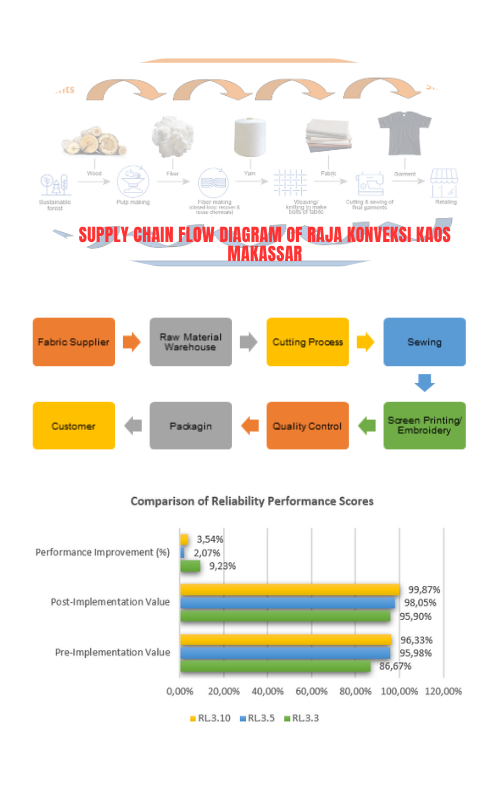
This study presents an evaluation of supply chain reliability strategies in the garment industry by utilizing the SCOR 14.0 Racetrack Framework. The research was conducted at Raja Konveksi Kaos Makassar, a garment manufacturing company that has encountered recurring issues related to delayed deliveries, inaccurate order documentation, and poor product conditions upon customer receipt. To identify the underlying causes, a Fishbone Diagram was employed for structured root cause analysis. Based on the insights gained, a portfolio of ten improvement projects was formulated, adopting best practices outlined by the Association for Supply Chain Management (ASCM). These projects were classified according to SCOR process categories and then prioritized using a Prioritization Matrix to ensure alignment with organizational goals and resource allocation. Each prioritized project was executed using a Project Charter approach, supported by a Gantt Chart to track implementation timelines and manage activities efficiently. The evaluation phase indicated significant improvements in key SCOR reliability metrics: RL.3.3 improved by 9.23%, RL.3.5 by 2.07%, and RL.3.10 by 3.54%. These results demonstrate that the implemented strategies effectively enhanced supply chain reliability, operational performance, and service quality. Overall, this study affirms the value of the SCOR 14.0 Racetrack Framework as a practical and data-driven tool for evaluating and improving supply chain reliability in the garment industry, offering relevant insights for both academics and practitioners.
How to Cite




Downloads
|
|


|
|


Copyright © 2025 Asrul Fole, Takdir Alisyahbana, Nur Ihwan Safutra, Muh. Ridzwan, Alifah Dwi Wulandari Putri

This work is licensed under a Creative Commons Attribution-ShareAlike 4.0 International License.
You are free to:
Share — copy and redistribute the material in any medium or format
Adapt — remix, transform, and build upon the material for any purpose, even commercially
Under the following terms:
Attribution — You must give appropriate credit, provide a link to the license, and indicate if changes were made. You may do so in any reasonable manner, but not in any way that suggests the licensor endorses you or your use.
ShareAlike — If you remix, transform, or build upon the material, you must distribute your contributions under the same license as the original
No additional restrictions — You may not apply legal terms or technological measures that legally restrict others from doing anything the license permits