
Usability Evaluation of an Appropriate Technology-Based Corn Sheller Using Performance Metrics and Physiological Responses

Article Sidebar
Main Article Content
Abstract
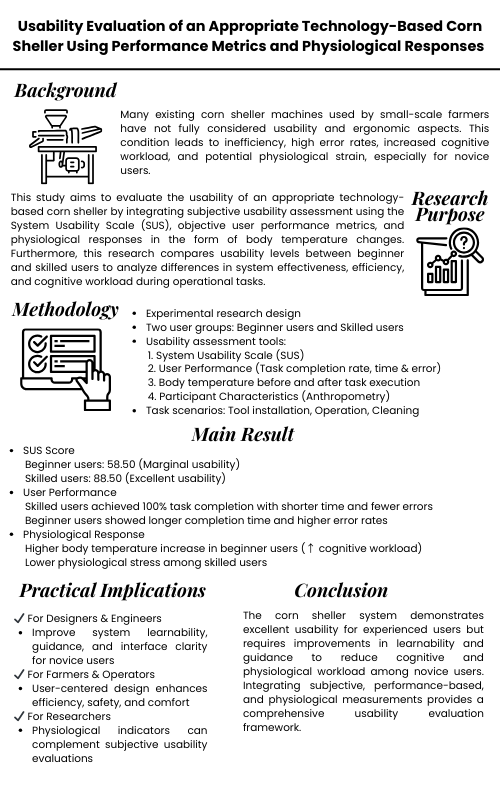
Appropriate Technology (AT) is widely applied in the agricultural sector to improve post-harvest productivity, including the use of corn shellers. However, many existing corn shellers have not fully considered usability and ergonomic aspects, which may lead to inefficiency, errors, and increased cognitive and physical workload for users. This study aims to evaluate the usability of a corn sheller and identify physiological parameters that indicate usability levels. An experimental method was employed involving two groups of participants, namely novice users and experienced users. Usability evaluation was conducted using the System Usability Scale (SUS), user performance indicators (task completion rate, task completion time, and error rate), and physiological measurements in the form of body temperature changes before and after task execution. The results showed that experienced users achieved a higher average SUS score (88.50, excellent usability) compared to novice users (58.50, marginal usability). Experienced users completed tasks faster, achieved a 100% task completion rate, and made fewer errors. Novice users required longer completion times, showed higher error rates, and experienced greater increases in body temperature. The findings indicate that usability is strongly influenced by user experience and cognitive factors. Body temperature changes can be used as an objective physiological indicator of usability and workload. Improvements in system learnability and user guidance are recommended to enhance usability for novice users.
Downloads
Article Details
Section
Copyright © 2025 Irma Nur Afiah, Dirgahayu Lantara, Muhammad Budi Adiputra Reski, Nursalbiah Nasir, Fahrul Hidayat Bannya

This work is licensed under a Creative Commons Attribution-ShareAlike 4.0 International License.
How to Cite