

Thermal Analysis of the Exhaust Gas Temperature Increase Phenomenon in the Starboard Main Engine Mitsubishi S6R2-T2MTK3L
Article Sidebar
Section
Issue
Published
Main Article Content
Abstract
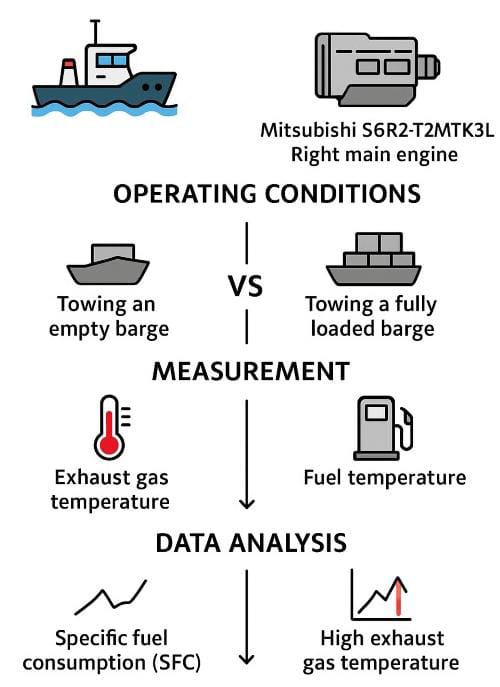
This study aims to analyze the thermal performance of the starboard main engine on a tugboat, specifically a Mitsubishi type S6R2-T2MTK3L, by focusing on the phenomenon of exhaust gas temperature increase. Measurements were conducted over six days under two operational conditions: towing an empty barge and towing a fully loaded barge. The results indicate that the exhaust gas temperature was significantly high in both conditions, with a temperature difference of 40 °C at low engine speed and up to 100 °C at high speed. These findings suggest incomplete combustion, indicating the need for further improvement in the engine's combustion process. Meanwhile, fuel temperature remained relatively stable in both conditions, with a maximum difference of only 3 °C at medium and high engine speeds, suggesting that the fuel delivery system is operating safely. The analysis of specific fuel consumption (SFC) revealed inconsistent trends in relation to engine speed. The highest SFC was recorded at 600 rpm while towing a fully loaded barge, at 0.01855 l/kWh. The highest engine torque was 7523.885 Nm at medium speed, while the lowest torque was 7165.605 Nm at high speed. This study concludes that high exhaust gas temperatures serve as a primary indicator of combustion inefficiency in the starboard main engine, requiring further evaluation to maintain operational efficiency and safety of the tugboat.
How to Cite




Downloads
|
|


|
|


Copyright © 2025 Muhammad Arham, Muhammad Zainuddin, Husni Mubarak, Akhsan Hamka, Syarifuddin

This work is licensed under a Creative Commons Attribution-ShareAlike 4.0 International License.
You are free to:
Share — copy and redistribute the material in any medium or format
Adapt — remix, transform, and build upon the material for any purpose, even commercially
Under the following terms:
Attribution — You must give appropriate credit, provide a link to the license, and indicate if changes were made. You may do so in any reasonable manner, but not in any way that suggests the licensor endorses you or your use.
ShareAlike — If you remix, transform, or build upon the material, you must distribute your contributions under the same license as the original
No additional restrictions — You may not apply legal terms or technological measures that legally restrict others from doing anything the license permits