
Geochemical Analysis to Determine the Quality of Limestone in the Mario Riaja Area, Soppeng Regency, South Sulawesi Province

Article Sidebar
Main Article Content
Abstract
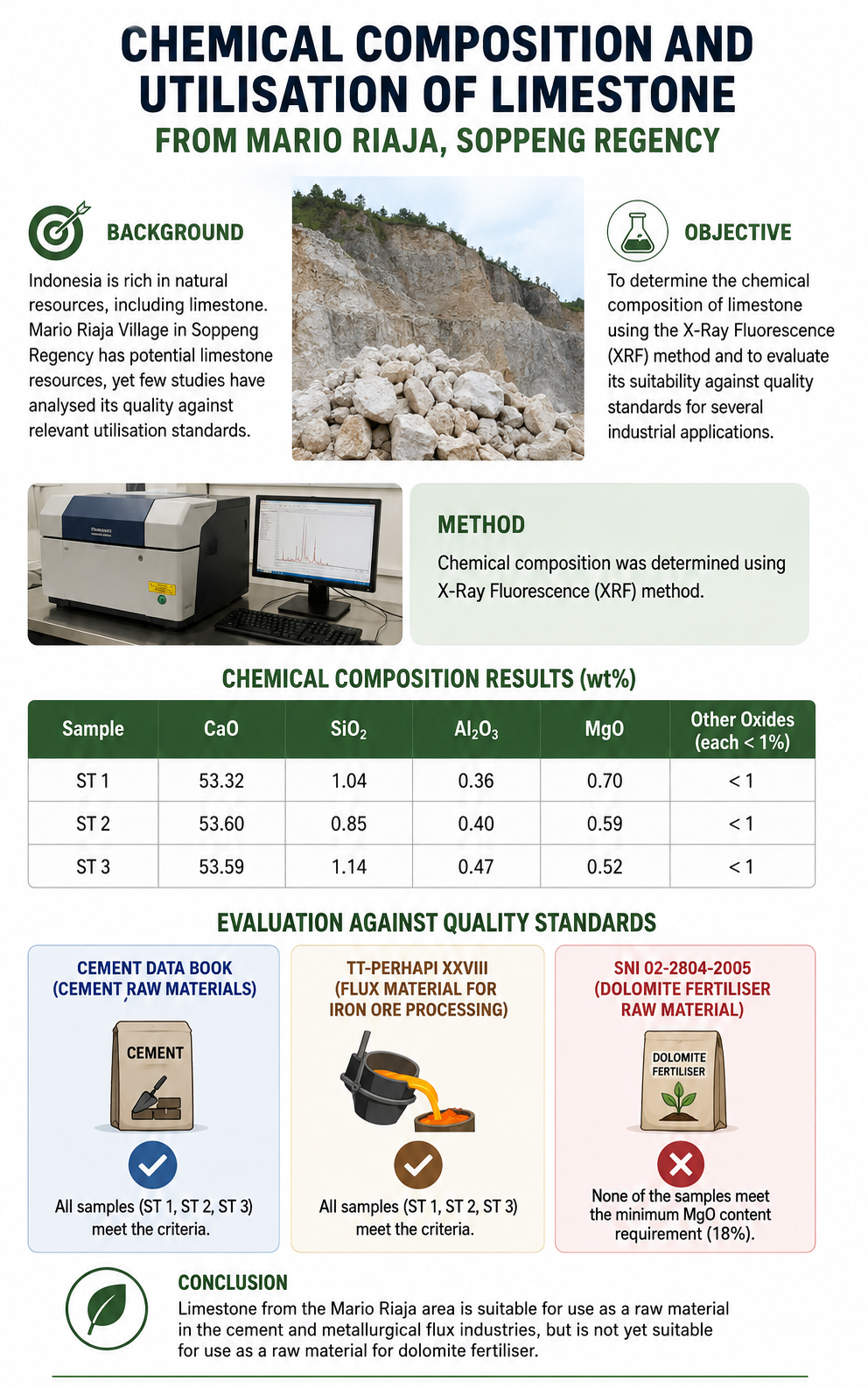
Indonesia is a country rich in natural resources, one of which is limestone. The village of Mario Riaja in Soppeng Regency is one of the areas with potential limestone resources; however, to date, there have been few studies analysing its quality against relevant utilisation standards. This study aims to determine the chemical composition of limestone using the X-Ray Fluorescence method, as well as to evaluate its suitability against quality standards for several industrial applications. The results of the chemical analysis show that sample ST 1 contains 53.32% calcium oxide (CaO), 1.04% silica (SiO₂), 0.36% aluminium oxide (Al₂O₃), 0.70% magnesium oxide (MgO), and other oxides below 1 %. Sample ST 2 contains 53.60% CaO, 0.85% SiO₂, 0.40% Al₂O₃, 0.59% MgO, and other oxides below 1%. Meanwhile, ST 3 contains CaO 53.59%, SiO₂ 1.14%, Al₂O₃ 0.47%, MgO 0.52%, and other oxides in relatively low concentrations. Based on classification against the Cement Data Book standard as cement raw materials, all samples meet the criteria. Based on the Domestic Literature Standard by TT-PERHAPI XXVIII as a flux material for iron ore processing, all samples were also found to meet the criteria. However, based on SNI 02-2804-2005 as a raw material for dolomite fertiliser, none of the three samples met the minimum MgO content requirement (18%). This study shows that limestone from the Mario Riaja area is suitable for use as a raw material in the cement and metallurgical flux industries, but is not yet suitable for use as a raw material for dolomite fertiliser.
Downloads
Article Details
Section
Copyright © 2026 Muhamad Hardin Wakila, Andi Fahdli Heriansyah, Abdul Salam Munir, Muhammad Afrian Firmansyah

This work is licensed under a Creative Commons Attribution-ShareAlike 4.0 International License.
How to Cite