

Comparative Study of Morphological Characteristics and Chemical Component Screening of Callyspongia sp. from Samalona Island and Gondong Bali Island, Spermonde Archipelago
Article Sidebar
Section
Issue
Published
Main Article Content


Abstract
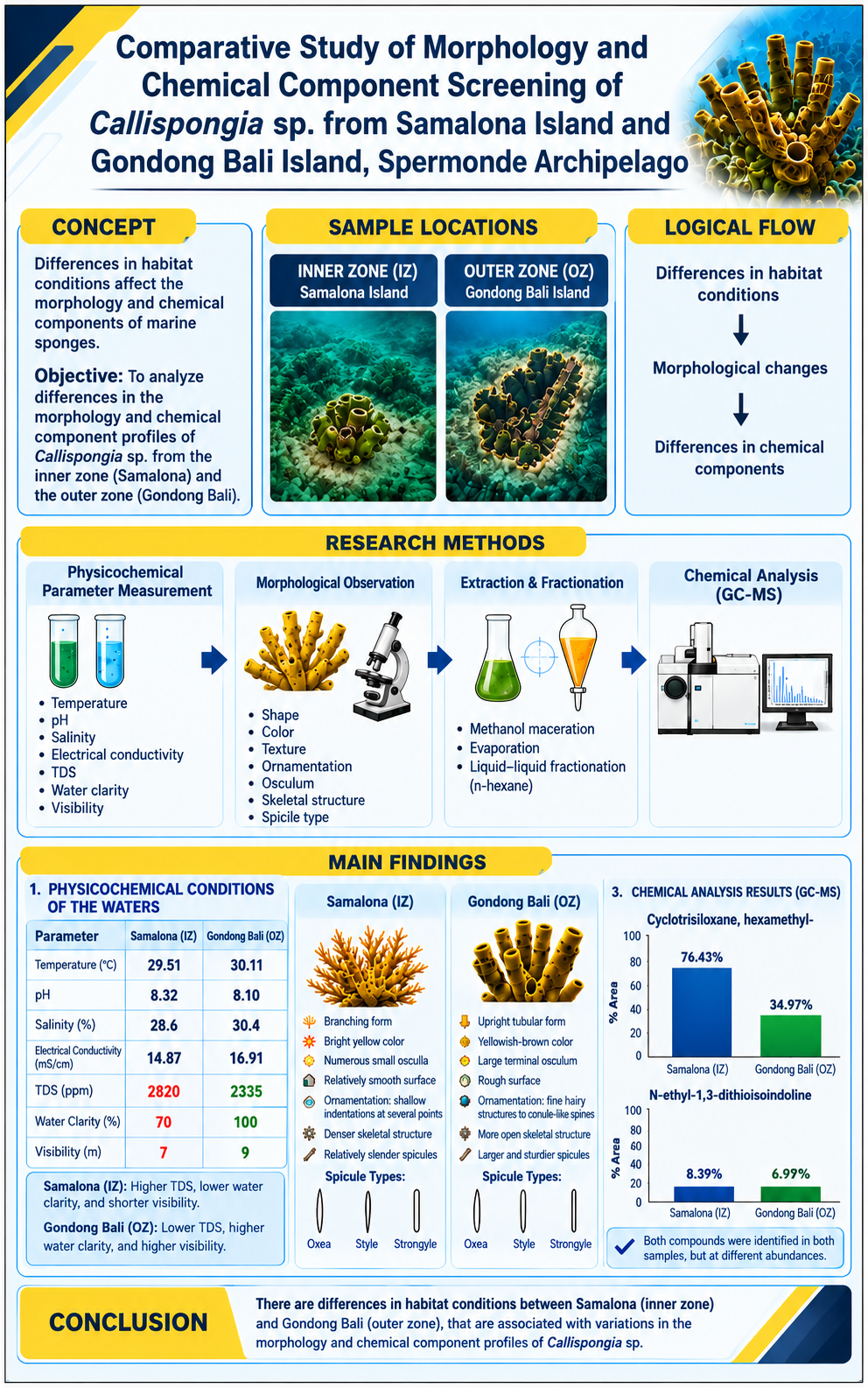
Differences in habitat conditions may be associated with variations in the morphology and chemical component profiles of marine sponges. This study aimed to compare the morphology and chemical component profiles of Callyspongia sp. from Samalona Island (inner zone) and Gondong Bali Island (outer zone) in the Spermonde Islands and to examine their relationships with habitat conditions. A descriptive-comparative approach was employed, involving measurements of physicochemical water parameters, macroscopic and microscopic morphological analyses, and identification of chemical components using GC-MS. Samalona Island exhibited a total dissolved solids concentration of 3820 ppm, water transparency of 70%, underwater visibility of 7 m, and salinity of 28.6‰, whereas the corresponding values for Gondong Bali Island were 2335 ppm, 100%, 9 m, and 30.4‰, respectively. Callyspongia sp. from Samalona Island exhibited a branched growth form, bright yellow coloration, numerous small oscula, a relatively smooth surface, a denser reticulate skeletal framework, and relatively slender spicules. In contrast, Callyspongia sp. from Gondong Bali Island exhibited an erect tubular growth form, yellowish-brown coloration, a large terminal osculum, a rough surface, a more open skeletal framework, and relatively larger spicules. Both specimens possessed monaxon megascleres of the oxea, style, and strongyle types. Cyclotrisiloxane, hexamethyl- was detected at 76.43% and 34.97%, whereas N-ethyl-1,3-dithioisoindoline was detected at 8.39% and 6.98% in samples from Samalona Island and Gondong Bali Island, respectively. Descriptively, variations in habitat conditions coincided with differences in the morphology and chemical component profiles of Callyspongia sp.
How to Cite




Downloads
|
|


|
|


Copyright © 2026 Alfirayanti Alfirayanti, Ismail Marzuki

This work is licensed under a Creative Commons Attribution-ShareAlike 4.0 International License.
You are free to:
Share — copy and redistribute the material in any medium or format
Adapt — remix, transform, and build upon the material for any purpose, even commercially
Under the following terms:
Attribution — You must give appropriate credit, provide a link to the license, and indicate if changes were made. You may do so in any reasonable manner, but not in any way that suggests the licensor endorses you or your use.
ShareAlike — If you remix, transform, or build upon the material, you must distribute your contributions under the same license as the original
No additional restrictions — You may not apply legal terms or technological measures that legally restrict others from doing anything the license permits
References
[1] G. Adami et al., “Association between long-term exposure to air pollution and immune-mediated diseases: a population-based cohort study,” RMD Open, vol. 8, no. 1, p. e002055, Mar. 2022, https://doi.org/10.1136/rmdopen-2021-002055
[2] S. Salm, J. Rutz, M. van den Akker, R. A. Blaheta, and B. E. Bachmeier, “Current state of research on the clinical benefits of herbal medicines for non-life-threatening ailments,” Front. Pharmacol., vol. Volume 14-2023, 2023, https://doi.org/10.3389/fphar.2023.1234701
[3] J. e. n Veron et al., “Delineating the Coral Triangle,” Galaxea, Journal of Coral Reef Studies, vol. 11, pp. 91–100, Aug. 2009, https://doi.org/10.3755/galaxea.11.91
[4] A. Faizal, D. Ilmu Kelautan, F. Ilmu Kelautan dan Perikanan, U. Hasanuddin, and J. Perintis Kemerdekaan Km, “Zonasi Perairan Kepulauan Spermonde Berdasarkan Konsentrasi Nutrient dan Dampaknya Terhadap Ekosistem Terumbu Karang Zonation of the Waters of Spermonde Archipelago Base on Nutrient Concentration and its Impact to Coral Reef Ecosystem,” Torani: JFMarSci, vol. 6, no. 2, pp. 126–137, 2023. https://doi.org/10.35911/torani.v6i2.27205
[5] H. F. Kegler et al., “Bacterial Community Composition and Potential Driving Factors in Different Reef Habitats of the Spermonde Archipelago, Indonesia,” Front. Microbiol., vol. Volume 8-2017, 2017, https://doi.org/10.3389/fmicb.2017.00662
[6] - Estradivari et al., “Coastal urbanization-related stressors affect fish herbivory in the Spermonde Archipelago, Indonesia,” Front. Mar. Sci., vol. Volume 12-2025, 2025, https://doi.org/10.3389/fmars.2025.1359139
[7] Y. E. Hadisaputri, A. A. Nurhaniefah, S. Sukmara, A. Zuhrotun, R. Hendriani, and I. Sopyan, “Callyspongia spp.: Secondary Metabolites, Pharmacological Activities, and Mechanisms,” Metabolites, vol. 13, no. 2, 2023, https://doi.org/10.3390/metabo13020217]
[8] S. De Caralt, D. Bry, N. Bontemps, X. Turon, M.-J. Uriz, and B. Banaigs, “Sources of Secondary Metabolite Variation in Dysidea avara (Porifera: Demospongiae): The Importance of Having Good Neighbors,” Mar. Drugs, vol. 11, no. 2, pp. 489–503, 2013, https://doi.org/10.3390/md11020489
[9] C. M. Brinkmann, A. Marker, and D. İ. Kurtböke, “An Overview on Marine Sponge-Symbiotic Bacteria as Unexhausted Sources for Natural Product Discovery,” Diversity (Basel)., vol. 9, no. 4, 2017, https://doi.org/10.3390/d9040040
[10] D. Jiang, R. Hua, and J. Shao, “Ecological Evaluation of Sponge City Landscape Design Based on Aquatic Plants Application,” Land (Basel)., vol. 11, no. 11, 2022, https://doi.org/10.3390/land11112081
Show All References (34 more)
[11] C. Schoenberg, “No taxonomy needed: Sponge functional morphologies inform about environmental conditions,” Ecol. Indic., vol. 129, p. 107806, Aug. 2021, https://doi.org/10.1016/j.ecolind.2021.107806
[12] M. C. Pineda, A. Duckworth, and N. Webster, “Appearance matters: sedimentation effects on different sponge morphologies,” Journal of the Marine Biological Association of the United Kingdom, vol. 96, no. 2, pp. 481–492, 2016, https://doi.org/10.1017/S0025315414001787
[13] M. C. Pineda et al., “Effects of sediment smothering on the sponge holobiont with implications for dredging management,” Sci. Rep., vol. 7, Dec. 2017, https://doi.org/10.1038/s41598-017-05243-x
[14] C. H. L. Schönberg and D. Barthel, “Inorganic skeleton of the demosponge Halichondria panicea. Seasonality in spicule production in the Baltic Sea,” Mar. Biol., vol. 130, no. 2, pp. 133–140, 1997, https://doi.org/10.1007/s002270050232
[15] I. B. Subagio, E. Setiawan, S. Hariyanto, and B. Irawan, “Spicule size variation in Xestospongia testudinaria Lamarck, 1815 at Probolinggo-Situbondo coastal,” Jun. 26, 2017, American Institute of Physics Inc. https://doi.org/10.1063/1.4985425
[16] E. Ternon, E. Perino, R. Manconi, R. Pronzato, and O. P. Thomas, “How Environmental Factors Affect the Production of Guanidine Alkaloids by the Mediterranean Sponge Crambe crambe,” Mar. Drugs, vol. 15, no. 6, 2017, https://doi.org/10.3390/md15060181
[17] L. M. Bayona et al., “Influence of Geographical Location on the Metabolic Production of Giant Barrel Sponges (Xestospongia spp.) Revealed by Metabolomics Tools,” ACS Omega, vol. 5, no. 21, pp. 12398–12408, May 2020, https://doi.org/10.3390/md15060181
[18] E. Hanani, A. im, R. Sekarini, and M. Kefarmasian, “Identifikasi Senyawa Antioksidan dalam spons Callyspongia sp dari Kepulauan Seribu,” pp. 127–133, Jan. 2005, https://doi.org/10.7454/psr.v2i3.3389
[19] A. Haris and D. N. Nabaing, “Bioaktivitas Antibakteri Ekstrak Spons (Porifera: Demospongiae) Dari Pulau Barrang Lompo Dan Lae-Lae. Antibacteria Bioactivity of Sponge Extract (Porifera: Demospongiae) from Barrang Lompo and Lae-lae Islands,” SPERMONDE, vol. 2, no. 2, pp. 1–5, 2016. [Online]. Available: https://doi.org/10.20956/jiks.v2i2.1301
[20] W. Mangurana, Y. Yusnaini, and S. Sahidin, “Analisi LC-MS/MS (Liquid Crhomatogaph Mass Spectrometry) dan Metabolit Sekunder Serta Potensi Antibakteri Ekstrak n-Heksana Spons Callyspongia aerizusa yang Diambil Pada Kondisi Tutupan Terumbu Karang yang Berbeda di Perairan Teluk Staring,” Jurnal Biologi Tropis, vol. 19, pp. 131–141, Aug. 2019, https://doi.org/10.29303/jbt.v19i2.1126
[21] D. Bindu, T. Vinothkumar, and D. Geetharamani, “Bioprospecting Of Marine Sponge (Callyspongia Diffusa) For Antibacterial Compound.,” Asian Journal of Pharmaceutical and Clinical Research, vol. 11, pp. 150–153, 2018.
[22] J. Hooper, “Sponguide: Guide to Sponge Collection and Identification,” Jan. 2000.
[23] I. Marzuki, L. Daris, S. Yunus, and A. Riana, “Selection and characterization of potential bacteria for polycyclic aromatic biodegradation of hydrocarbons in sea sponges from Spermonde Islands, Indonesia,” Dec. 2020.
[24] M. Kamaruddin et al., “Potent Secondary Metabolites From Marine Sponge Extracts: Isolation, Characterization and Medicinal Applications,” vol. 15, pp. 1552–1566, Aug. 2025. [Online]. Available: https://jchr.org/index.php/JCHR/article/view/8511
[25] P. S. Arin, “Effect of evaporation duration on the antioxidant activity of leaf and bark extracts of the mangrove Sonneratia caseolaris from Serang Beach, Blitar Regency, East Java ,” undergraduate thesis, Universitas Brawijaya, Malang, Indonesia, Nov. 2018. [Online]. Available: http://repository.ub.ac.id/id/eprint/165155/
[26] G. Silap, D. Wewengkang, and H. Rotinsulu, “Antimicrobial activity of the soft coral Dendronephyta sp. collected from Tumbak Village, Pusomaen District, Southeast Minahasa Regency against Eschericia coli, Staphylococcus aureus, and Candida albicans,” PHARMACON, vol. 9, p. 63, Aug. 2020, https://doi.org/10.35799/pha.9.2020.27411
[27] B. Setyadji and S. Panggabean, “The effect of substrate and water depth on the growth of Callyspongia sp. in Jepara Waters,” BAWAL Widya Riset Perikanan Tangkap, vol. 3, p. 175, Dec. 2010, 10.15578/bawal.3.3.2010.175-181
[28] W. Mangurana, N. Annaastasia, S. Patiung, L. O. Arsal, and A. Wahyudi, “Morphological Identification of Major Sponge in Tanjung Senja Water Moramo District, South Konawe Regency,” Jurnal Biologi Tropis, vol. 25, pp. 984–990, Aug. 2025, https://doi.org/10.29303/jbt.v25i1.8133
[29] Almay Fitrah Ghaly Hasan, “Uncontrolled tourism: Samalona Island and the challenge of sustainable tourism,” Kumparan, Jan. 2026. [Online]. Available: https://kumparan.com/almay-fitrah/pariwisata-tanpa-kendali-pulau-samalona-dan-tantangan-pariwisata-berkelanjutan-26ZIjfgVYMq
[30] N. Sugianto, N. Nursanti, W. Oktaviani, B. Jamal, and M. Zainuddin, “Aksi Pulau Bersih sebagai Upaya Peningkatan Kesadaran Lingkungan Pesisir di Pulau Samalona Kota Makassar,” Journal of Community Service and Engagement, vol. 1, pp. 258–266, Aug. 2026, https://doi.org/10.65310/99atgf72
[31] I. B. Subagio and A. Aunurohim, “arine sponge (Porifera) community structure at Pasir Putih Beach, Situbondo,” Jurnal Sains dan Seni ITS, vol. 2, no. 2, pp. E159–E165, 2013, https://doi.org/10.12962/j23373520.v2i2.3962
[32] W. A. Setyaningsih, D. G. Bengen, H. H. Madduppa, M. S. Ismet, M. W. Taqiyuddin, and A. Salsabila, “Species composition and density of sponges (Porifera: Demospongiae) on Panggang Island, Kepulauan Seribu, DKI Jakarta,” Jurnal Ilmu dan Teknologi Kelautan Tropis, vol. 16, no. 2, pp. 239–252, Aug. 2024, https://doi.org/10.29244/jitkt.v16i2.56300
[33] H. Effendi, Water Quality Assessment: For the Management of Aquatic Resources and Waters. Yogyakarta, Indonesia: PT Kanisius, 2003.
[34] S. Widagdo, D. Viegas Wibisono, and V. Djanat Prasita, “Upwelling Musiman di Perairan Spermonde, Sulawesi Selatan,” vol. 4, no. 1, pp. 124–136, 2022, https://doi.org/10.30649/jrkt.v4i2.54
[35] B. W. Strehlow et al., “Sediment tolerance mechanisms identified in sponges using advanced imaging techniques,” PeerJ, vol. 5, p. e3904, Nov. 2017, https://doi.org/10.7717/peerj.3904
[36] D. F. R. Cleary and N. J. de Voogd, “Environmental associations of sponges in the Spermonde Archipelago, Indonesia,” Journal of the Marine Biological Association of the United Kingdom, vol. 87, no. 6, pp. 1669–1676, 2007, https://doi.org/10.1017/S0025315407052770
[37] C. R. Wilkinson and J. Vacelet, “Transplantation of marine sponges to different conditions of light and current,” J. Exp. Mar. Biol. Ecol., vol. 37, no. 1, pp. 91–104, 1979, https://doi.org/10.1016/0022-0981(79)90028-5
[38] F. Curdt, P. J. Schupp, and S. Rohde, “Light Availability Affects the Symbiosis of Sponge Specific Cyanobacteria and the Common Blue Aquarium Sponge (Lendenfeldia chondrodes),” Animals, vol. 12, no. 10, 2022, https://doi.org/10.3390/ani12101283
[39] I. Abfa, ocky karna Radjasa, A. B. Susanto, H. Nuryadi, and F. Karwur, “Exploration, Isolation, and Identification of Carotenoid from Bacterial Symbiont of Sponge Callyspongia vaginalis,” Ilmu Kelaut., vol. 22, pp. 49–58, Aug. 2017, https://doi.org/10.14710/ik.ijms.22.2.49-58
[40] R. Davies-Colley and D. Smith, “Turbidity, suspended sediment, and water clarity: A review,” JAWRA Journal of the American Water Resources Association, vol. 37, pp. 1085–1101, Aug. 2007, https://doi.org/10.1111/j.1752-1688.2001.tb03624.x
[41] M. Uriz, “Mineral skeletogenesis in sponges,” Canadian Journal of Zoology-revue Canadienne De Zoologie - CAN J ZOOL, vol. 84, pp. 322–356, Aug. 2006, https://doi.org/10.1139/Z06-032
[42] M. B. DeBiasse and M. E. Hellberg, “Discordance between morphological and molecular species boundaries among Caribbean species of the reef sponge Callyspongia,” Ecol. Evol., vol. 5, no. 3, pp. 663–675, Feb. 2015, https://doi.org/10.1002/ece3.1381
[43] F. Karampoula, E. Giaouris, J. Deschamps, A. I. Doulgeraki, G.-J. E. Nychas, and F. Dubois-Brissonnet, “Hydrosol of Thymbra capitata Is a Highly Efficient Biocide against Salmonella enterica Serovar Typhimurium Biofilms,” Appl. Environ. Microbiol., vol. 82, no. 17, pp. 5309–5319, 2016, https://doi.org/10.1128/AEM.01351-16
[44] E. G. A. M. El-Dawy, Y. A. Gherbawy, P. Ioan, and M. A. Hussein, “Identification of Trichoderma spp., Their Biomanagement Against Fusarium proliferatum, and Growth Promotion of Zea mays,” Journal of Fungi, vol. 11, no. 9, 2025, https://doi.org/10.3390/jof11090683