

Nanostructured Sodium Molybdate Anodes for Enhanced Bioelectricity Generation and sustainable Wastewater Treatment in Microbial Fuel Cells
Article Sidebar
Section
Issue
Published
Main Article Content


Abstract
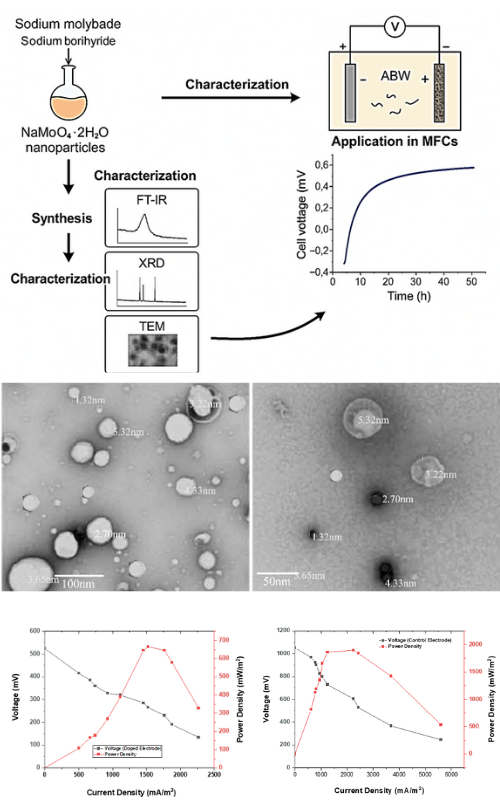
Abattoir wastewater (ABW) is characterized by extremely high organic loads, posing serious environmental and management challenges. Conventional treatment methods are often inadequate, highlighting the urgent need for advanced, sustainable technologies. Microbial fuel cells (MFCs) offer a promising dual solution by integrating wastewater treatment with renewable bioelectricity generation; however, their performance is limited by inefficient anode materials. To address this gap, this study investigates sodium molybdate dihydrate (Na2MoO₄·2H₂O) nanoparticles as a novel catalyst for anode modification in MFCs treating ABW. The nanoparticles were synthesized using sodium borohydride as a reducing agent and characterized by UV-Vis spectra, FT-IR (functional groups), XRD (size and crystal structure) and TEM (morphology), revealing non-uniform particles within 20–100 nm. MFCs performances were evaluated by comparing Na2MoO₄ coated (doped) electrodes with unmodified graphite electrodes. Results demonstrated a significant enhancement, with the nano-coated electrode achieving a maximum voltage of 899 mV, power density of 1896 mW/m², current density of 2246 mA/m² at 3500 Ω, and 69.9% COD removal efficiency. These findings confirm that Na2MoO₄ based nanostructured anodes can substantially improve both energy recovery and pollutant removal in MFCs, offering a sustainable approach for treating high-strength industrial effluents such as ABW
How to Cite




Downloads
Copyright © 2025 Akinwumi Odunayo. D, Agarry Samuel. E, Aremu Mujidat. O, Olowonyo Idayat. A, Sole-Adeoye Opeoluwa. D, Fajobi Omoteniola. T, Oloyede Victoria. I, Abioye Oyindamola, Odunola Olufolake Adebamke, Popoola Adewemimo.O

This work is licensed under a Creative Commons Attribution-ShareAlike 4.0 International License.
You are free to:
Share — copy and redistribute the material in any medium or format
Adapt — remix, transform, and build upon the material for any purpose, even commercially
Under the following terms:
Attribution — You must give appropriate credit, provide a link to the license, and indicate if changes were made. You may do so in any reasonable manner, but not in any way that suggests the licensor endorses you or your use.
ShareAlike — If you remix, transform, or build upon the material, you must distribute your contributions under the same license as the original
No additional restrictions — You may not apply legal terms or technological measures that legally restrict others from doing anything the license permits